
Markets crash, headlines scream, social media explodes, and suddenly, it feels like your entire financial future is in imminent danger. Your phone buzzes with push notifications about plummeting stocks, impending recessions, and economic collapse. In the heat of the moment, the urge to sell everything and move your money to cash can feel overwhelming. But reacting emotionally to the daily news cycle is the fastest way to wreck a solid, long-term financial plan.
As a professional financial advisor, I see this pattern time and time again. Investors who are glued to the financial news ticker often make costly mistakes driven by fear, greed, and a fundamental misunderstanding of how the media operates. The truth is, the financial media ecosystem is not designed to help you build wealth; it is designed to capture your attention. To protect your portfolio and your peace of mind, you must learn how to read financial news without panicking. You need to filter out the noise, spot what really matters, and make smarter, more rational decisions with your money.
From clickbait headlines to real market signals, separating fact from fear is a critical skill for any investor. This comprehensive guide will walk you through the psychology of financial media, teach you how to decode sensationalized headlines, and help you build a robust information filter system. By the end of this article, you will know exactly how to consume financial news objectively, ensuring that your investment strategy is guided by data and logic, rather than fear and speculation.
The Business of Fear: Understanding Financial Media’s Hidden Agenda
To successfully navigate financial news, you must first understand the business model behind it. Financial news outlets, television networks, and digital publishers make their money from clicks, views, and user engagement. They are not fiduciaries; their primary goal is not to help you make better investment decisions, but to keep you consuming their content.
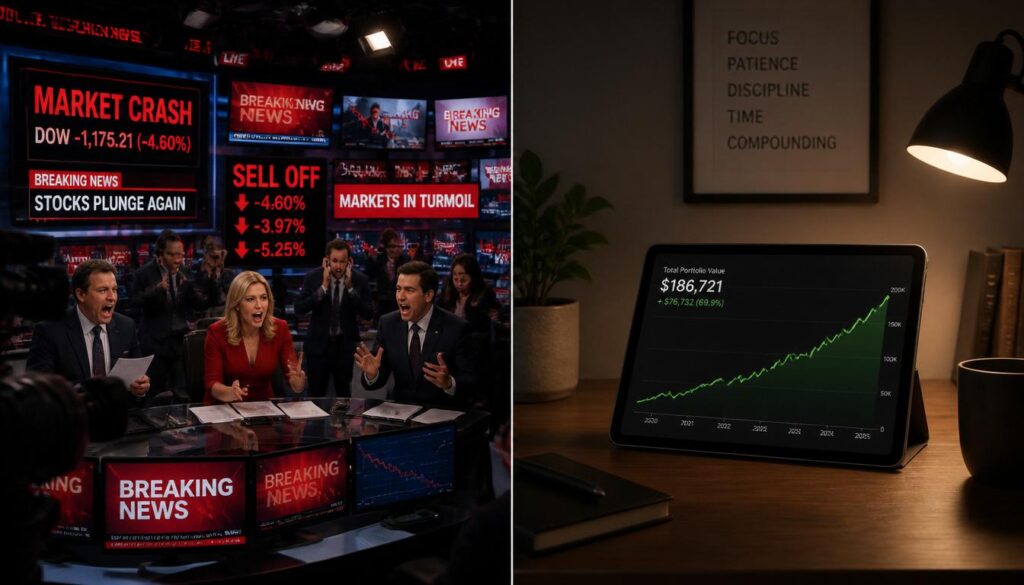
This creates a natural, systemic bias toward sensationalism over substance. The more dramatic the headline, the more likely you are to click on it. News channels need to fill twenty-four hours of daily programming, which means they must turn minor, everyday market movements into major, breaking news stories. A standard two percent market dip, which is historically completely normal market behavior, is frequently framed as a catastrophic event.
The most critical skill you can develop is recognizing when content is designed to trigger an emotional response rather than inform a rational decision. Financial media frequently relies on fear, greed, and the Fear Of Missing Out (FOMO) to drive engagement. You will notice the heavy use of emotionally charged trigger words like “crash,” “collapse,” “soaring,” “plummeting,” and “unprecedented.” These words are carefully chosen to bypass your rational thinking and stimulate an immediate emotional reaction.
Before you react to any financial news, pause and ask yourself: “Is this article or broadcast making me feel anxious, excited, or pressured to act immediately?” If the answer is yes, you are being emotionally manipulated. Step back, take a deep breath, and analyze the actual, unvarnished facts being presented. Financial news should inform you, not control you. When you understand that the media profits from your attention, you can begin to view their content with a healthy dose of skepticism, stripping away the emotional manipulation to find the actual information underneath.
Decoding the Headline: How to Read Beyond the Sensationalism
Headlines are designed to grab your attention, not to provide nuanced, accurate information. In the digital age, the headline is often the only thing a person reads before sharing an article on social media. Consequently, editors are incentivized to write headlines that are as dramatic and provocative as possible, even if the actual story tells a very different, much more mundane tale.
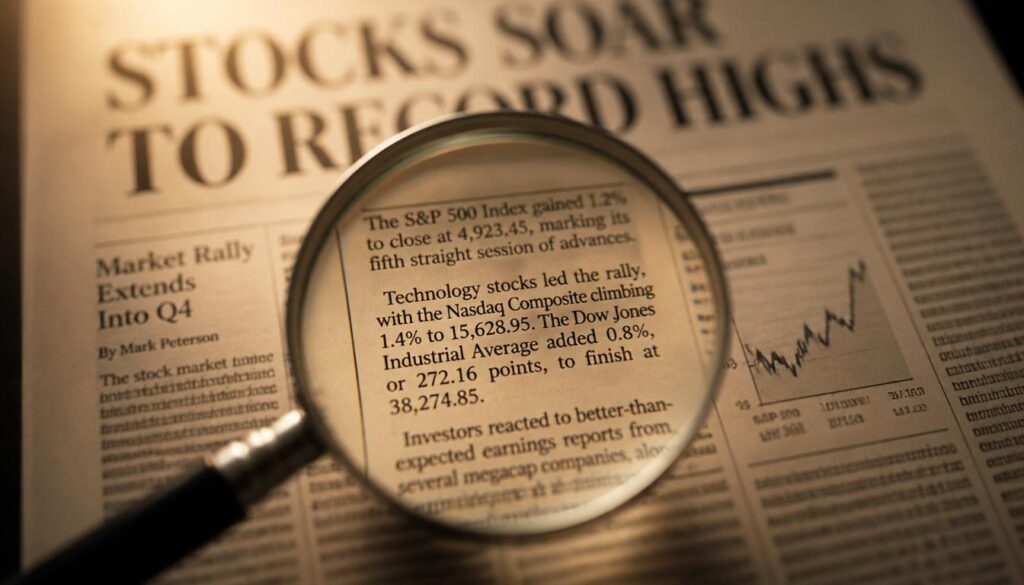
To become financially literate, you must practice reading beyond the headline. Make it a strict rule to never make a financial decision based solely on a headline. Always click through and read the full article. When you do, pay special attention to the buried details that provide crucial context.
For example, a headline might scream, “Stocks Plunmet in Early Trading!” causing a wave of panic. However, if you read the third or fourth paragraph, you might discover that the market is simply returning to its baseline price after an unusual, unsustainable spike the previous day, or that the “plummet” is actually a mere one percent drop on a low-volume holiday trading session.
Look for specific numbers, precise time frames, and historical context. Often, the most important, clarifying information is found in the middle paragraphs of an article, not in the opening hook or the concluding summary. By reading the full text, you equip yourself with the context necessary to realize that the dramatic headline was merely a marketing tool, while the reality of the market movement was entirely unremarkable.
Vetting Your Sources: Identifying Credible Journalism vs. Hidden Agendas
Not all financial news sources are created equal. In an era where anyone can publish content on the internet, establishing a curated list of credible, well-researched publications is vital. You need to prioritize accuracy over sensationalism. Look for established outlets that provide deep context, cite multiple verifiable sources, and openly acknowledge uncertainty when making economic predictions. Publications like The Wall Street Journal, The Financial Times, and Reuters typically maintain much higher journalistic standards than anonymous blog sites or social media influencers.
Conversely, you must be extremely wary of sources that consistently predict doom, promise guaranteed returns, or use excessive emotional language. Quality financial journalism explains complex economic topics clearly without resorting to fear tactics. If a pundit is constantly predicting the end of the world for the stock market, they will eventually be right, but they will be wrong for years in between, costing you dearly if you listen to them.
Furthermore, you must learn to recognize sponsored content and hidden commercial agendas. Many financial articles, videos, and segments are essentially marketing disguised as journalism. Watch for subtle product placements, recommendations that conveniently benefit the publisher’s advertisers, or content designed to drive traffic to specific trading platforms. Financial influencers and media personalities often have affiliate relationships, sponsorships, or personal investments that create massive conflicts of interest.
Always ask yourself: “Who benefits if I act on this information?” If someone is aggressively promoting a specific investment strategy, a new cryptocurrency, or a particular trading product while delivering the “news,” treat it as an advertisement. Look for disclosure statements, but remember that many conflicts of interest are not properly disclosed. Be especially suspicious of content that creates a false sense of urgency around financial products, as this is a classic sales tactic

The Power of Perspective: Historical Context and Long-Term Trends
Every financial event exists within a broader historical context, yet the daily news cycle rarely provides it. When reading about market movements, economic indicators, or policy changes, you must actively ask yourself: “How does this compare to similar situations in the past?”
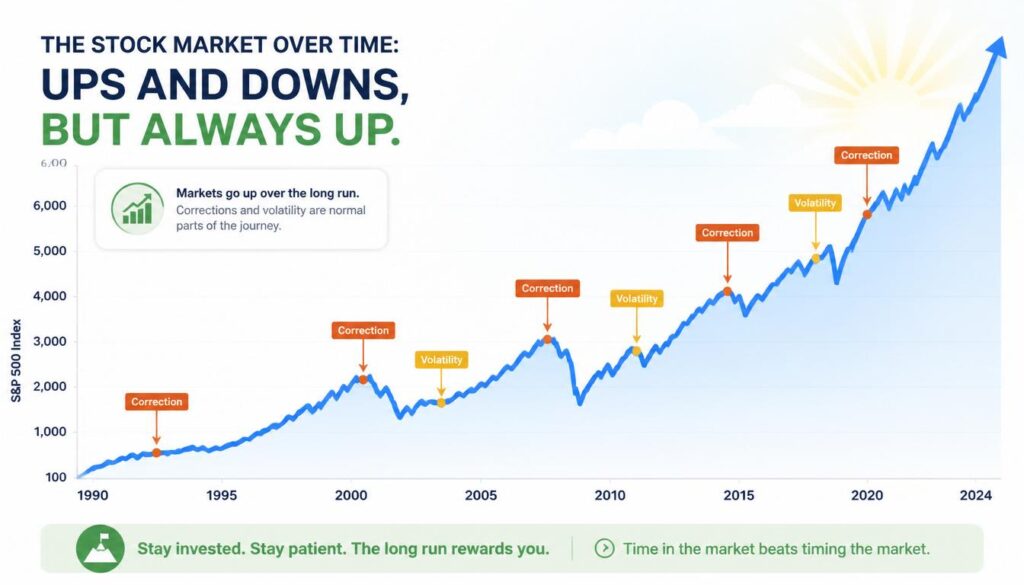
Market corrections—defined as a drop of 10 to 20 percent from a recent peak—happen regularly. They are not signs of impending doom; they are a normal, healthy mechanism for markets to cool off and reassess valuations. Bear markets and recessions occur roughly every seven to ten years, and historically, the stock market has recovered and reached new highs within one to three years. Understanding these historical patterns helps you maintain your perspective when consuming current financial news. Look for articles that provide this historical context rather than treating every minor event as an unprecedented catastrophe.
Additionally, you must learn to distinguish between hard news and subjective opinion. One of the biggest mistakes investors make is treating financial commentary as factual reporting. There is a massive difference between a factual statement like, “The S&P 500 dropped 50 points today,” and an opinion like, “This market drop signals the beginning of a decade-long bear market.” The first is an objective fact; the second is someone’s interpretation and prediction.
Opinion pieces, market predictions, and analyst commentary should be consumed with extreme skepticism. Even the most respected, highly-paid financial experts are wrong about short-term market direction roughly half the time. Always ask yourself: “Is this person stating what actually happened, or are they predicting what they think might happen?” Keep your focus on the facts, and treat predictions as merely one person’s educated guess.
Finally, shift your focus from daily fluctuations to long-term trends. Daily market movements are largely noise. A single day’s performance tells you almost nothing about the underlying health of the economy or the viability of your investment strategy. Instead, focus on longer-term trends spanning months and years. Is unemployment trending up or down over several quarters? Are corporate earnings growing consistently? Are interest rates following a clear directional pattern? Daily volatility is just the background static of healthy markets. If you are making investment decisions based on daily news cycles, you are essentially gambling, not investing.
Building Your Personal Information Filter System
To truly protect yourself from the chaos of financial media, you need to develop your own systematic approach to consuming information. Relying on willpower to ignore sensational news is a losing battle; instead, build a structural filter.
Start by setting specific, limited times for checking financial news. Do not constantly monitor the markets or refresh your news feeds throughout the day. This constant drip of information keeps your nervous system in a state of low-grade fight-or-flight. Instead, check the news once in the morning and once in the evening, or limit yourself to reading comprehensive weekly or monthly summaries rather than reacting to daily updates.
Maintain a strict list of key economic indicators that you actually track. For a long-term investor, this might include the unemployment rate, inflation data, GDP growth, and your portfolio’s quarterly performance. Once you have checked these specific metrics, actively ignore the rest of the daily chatter.
Develop the discipline to ask a single, golden question whenever you encounter a new piece of financial news: “Will this information actually change my long-term financial strategy?” For the vast majority of news stories, the answer will be no. If a piece of news does not alter your fundamental investment thesis or your long-term goals, it is noise that you can safely ignore. Building this filtered system protects you from information overload and prevents the emotional decision-making that destroys wealth.
You must also learn to question the timing and motivation behind stories. Always consider why a particular story is being published right now. Is there a genuine, data-driven news event driving the coverage, or is it a slow news day being filled with speculative filler? Financial content is sometimes published simply to generate trading activity or promote specific investments. By questioning the timing, you can easily separate legitimate, timely journalism from content designed to manipulate your financial decisions for someone else’s profit.

Translating Filtered News into Smarter Investment Decisions
Once you have successfully filtered out the noise, how do you use the remaining, high-quality information to make smarter decisions? The goal of reading financial news should not be to time the market, but to ensure your portfolio remains aligned with your goals.
When you read credible, factual news about a shift in the economic landscape—such as a sustained change in interest rates by the central bank or a structural shift in a specific industry—use that information to review your asset allocation. Are you properly diversified? If the news highlights rising inflation, does your portfolio have adequate exposure to inflation-resistant assets? If the news points to a technological revolution in a specific sector, is your index fund or investment strategy adequately capturing that growth?
Use the news to rebalance, not to panic. If the market has experienced a genuine, news-driven downturn and your stock allocation has dropped below your target percentage, this is not a time to sell. This is a mathematical opportunity to buy more stocks at a discount, bringing your portfolio back into balance. This is the essence of dollar-cost averaging and long-term investing.
By removing the emotional manipulation from the news, you transform financial media from a source of anxiety into a tool for strategic portfolio management. You stop reacting to the daily ticker and start responding to macroeconomic realities. This shift in perspective is what separates amateur traders, who are constantly whipped around by the news, from successful, wealthy investors who let their strategies work over time.

Conclusion
The financial news will always be there, and it will always be loud. The media business model guarantees that sensationalism, fear, and urgency will continue to be the primary tools used to capture your attention. However, your reaction to that news is entirely within your control.
By understanding the hidden agendas of financial media, reading beyond the clickbait headlines, and vetting your sources for credibility, you can strip away the emotional manipulation. When you combine this with a strong grasp of historical context and a commitment to long-term trends, you become immune to the daily market panic. Building a personal information filter system ensures that you only consume the data that actually matters to your financial future.
Financial news should inform your strategy, not dictate your emotions. The next time the headlines scream that the sky is falling, take a step back, apply the filters you have learned, and remember that true wealth is built in the quiet, boring moments of consistent, long-term investing. Stay calm, stay informed, and let logic, not fear, guide your financial journey.
Frequently Asked Questions (FAQ)
1. How often should I check financial news to stay informed without getting overwhelmed?
For the average long-term investor, checking financial news once a day or even just a few times a week is more than sufficient. Constant monitoring of daily market fluctuations leads to information overload and emotional decision-making. Instead of checking daily updates, focus on reading comprehensive weekly summaries or monthly reports from credible sources. This allows you to stay aware of major macroeconomic trends without getting distracted by the daily “noise” of market volatility.
2. What are the most reliable financial news sources for objective reporting?
The most reliable sources are established, legacy financial publications that adhere to strict journalistic standards and employ experienced financial journalists. Top-tier examples include The Wall Street Journal, The Financial Times, Reuters, and Bloomberg. These outlets prioritize factual reporting, provide historical context, and clearly separate hard news from opinion pieces. It is best to avoid relying on social media influencers, anonymous blogs, or YouTube personalities who often rely on sensationalism and lack editorial oversight.
3. How can I tell if a financial article or video is sponsored or has a hidden agenda?
To spot sponsored content or hidden agendas, look for subtle clues such as overly enthusiastic recommendations for a specific product, platform, or stock. Check the bottom of the article or the description of the video for disclaimers like “sponsored,” “in partnership with,” or “affiliate links.” Additionally, ask yourself who benefits from the content. If the creator is pushing you to sign up for a specific trading app, buy a specific course, or invest in a highly speculative asset, they likely have a financial incentive, making the content an advertisement rather than objective journalism.
4. Should I sell my investments when the news says the stock market is crashing?
In almost all cases, no. Selling your investments in a panic during a market downturn locks in your losses and guarantees that you will miss the eventual recovery. Historically, the stock market has always recovered from crashes, corrections, and bear markets, often reaching new all-time highs. Unless your fundamental financial goals have changed or you desperately need the cash for an emergency, a market drop reported in the news should be viewed as a normal part of the investing cycle, not a signal to abandon your long-term strategy.
5. What is the difference between financial news and financial opinion, and why does it matter?
Financial news consists of objective, verifiable facts about what has already happened, such as “The central bank raised interest rates by 0.25 percent” or “Company X reported earnings of $2 billion.” Financial opinion consists of subjective predictions, analysis, and interpretations of what those facts might mean for the future, such as “This rate hike will definitely cause a recession next year.” It is crucial to distinguish between the two because treating an expert’s opinion as a guaranteed fact can lead to poor investment decisions. Always base your core strategy on factual news and historical data, and treat opinions with healthy skepticism.