Your name is the single most undervalued financial asset you own. While most people focus exclusively on traditional savings accounts, stock portfolios, or climbing the corporate ladder, a growing number of financially savvy individuals are discovering something powerful: a well-built personal brand can outperform nearly every conventional income strategy over time.
Think about it from a pure wealth-building perspective. A savings account might earn you three to five percent annually. A diversified index fund historically returns around seven to ten percent. But a personal brand that positions you as a trusted authority? That can generate five, six, or even seven figures in annual revenue with relatively low overhead costs. More importantly, it compounds. Every piece of content you publish, every relationship you nurture, and every problem you solve for your audience adds to an asset that appreciates rather than depreciates.
This is not about becoming an influencer or chasing vanity metrics. This is about treating your reputation as a legitimate business asset, structuring it for sustainable income, and building the kind of financial security that no employer or market downturn can take away from you. Whether you are looking to supplement your salary, replace your nine-to-five income entirely, or create multiple passive revenue streams, the principles below will show you exactly how to transform your expertise into a reliable money-making engine.
Step One: Identify Your Financial Sweet Spot
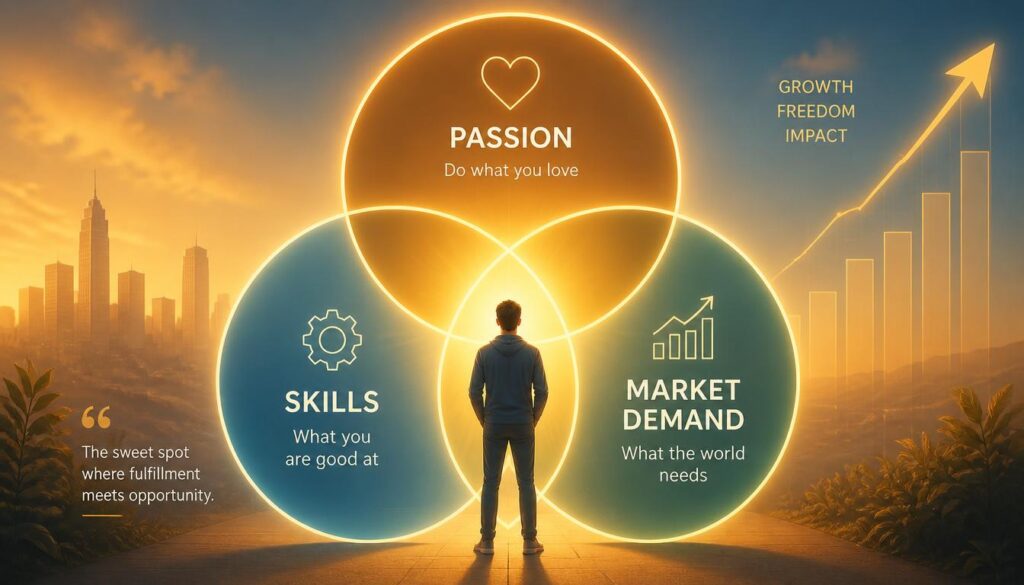
Before you write a single post or record a single piece of content, you need to identify what makes you genuinely valuable in the marketplace. In personal finance terms, this is your competitive moat. It is the intersection where your natural skills, your genuine passion, and actual market demand overlap.
Ask yourself three critical questions. What do people consistently ask me for help with? What knowledge or experience do I possess that others would pay to access? Where is there a gap in the market that my unique background allows me to fill?
The financial lesson here is simple: do not chase trends or copy what appears to be working for others. Authentic positioning always outperforms imitation because it is sustainable. When you build your brand around your genuine zone of genius, you eliminate the exhausting cost of pretending to be someone else, and you create a foundation that can support long-term revenue growth without burning you out.
Step Two: Master LinkedIn as Your Authority Engine
If you are serious about converting your expertise into income, LinkedIn should be treated as your primary professional storefront. Unlike other platforms that reward entertainment, LinkedIn rewards knowledge, experience, and professional credibility. This makes it the ideal environment for attracting high-value clients, consulting opportunities, and partnerships.
The strategy is straightforward but requires discipline. Share detailed insights drawn from your real-world experience. Publish case studies that demonstrate measurable results. Offer actionable advice that your target audience can implement immediately. Post consistently, ideally three to five times per week, and engage authentically with others in your industry by leaving thoughtful comments and responding to messages personally.
From a financial perspective, LinkedIn functions like a compounding investment. Early posts may generate modest engagement, but over time, your accumulated content builds a searchable library of expertise that attracts opportunities around the clock. Connections evolve into conversations, conversations evolve into clients, and clients evolve into recurring revenue. The key metric is not follower count but relationship depth. One genuine connection with the right decision-maker can be worth more than ten thousand passive followers.
Step Three: Build a Newsletter You Actually Own
Here is a truth that every financially minded person should internalize: social media platforms are rented land. Algorithms change, accounts get restricted, and reach can vanish overnight. A newsletter, however, is owned property. It is the digital equivalent of owning real estate versus renting an apartment.
Start small and focus entirely on delivering value. Share insights, frameworks, and practical advice that your readers cannot easily find elsewhere. Build trust before you ever think about monetization. Once your audience is engaged and growing, you can introduce revenue streams such as paid subscription tiers, carefully selected affiliate partnerships, or promotions for your own products and services.
The financial beauty of a newsletter lies in its predictability and scalability. Unlike one-off client work, a newsletter with five thousand engaged subscribers can generate consistent monthly income through sponsorships, premium content, or product launches. It becomes a reliable cash flow asset that supports every other revenue stream in your personal brand portfolio.

Step Four: Use Social Media with Strategic Precision
One of the most common financial mistakes in personal branding is spreading your energy across too many platforms. This is the equivalent of diversifying your investment portfolio into assets you do not understand. The result is diluted effort, inconsistent quality, and ultimately, poor returns.
Instead, select two to three platforms where your ideal audience genuinely spends time. If your target clients are professionals and business owners, LinkedIn combined with a newsletter may be all you need. If you are targeting a younger demographic interested in personal finance, a combination of short-form video content and a community platform might serve you better.
Adopt smart content repurposing to maximize efficiency. A single long-form article can become a LinkedIn post, three short social media tips, a newsletter segment, and a podcast talking point. This approach multiplies your reach without multiplying your workload, protecting both your time and your creative energy. In financial terms, you are maximizing return on invested effort while minimizing opportunity cost.
Step Five: Diversify Your Income Streams
Any sound financial advisor will tell you that relying on a single income source is a recipe for vulnerability. The same principle applies to personal brand revenue. If your entire income depends on one client, one platform, or one product, you are exposed to catastrophic risk.
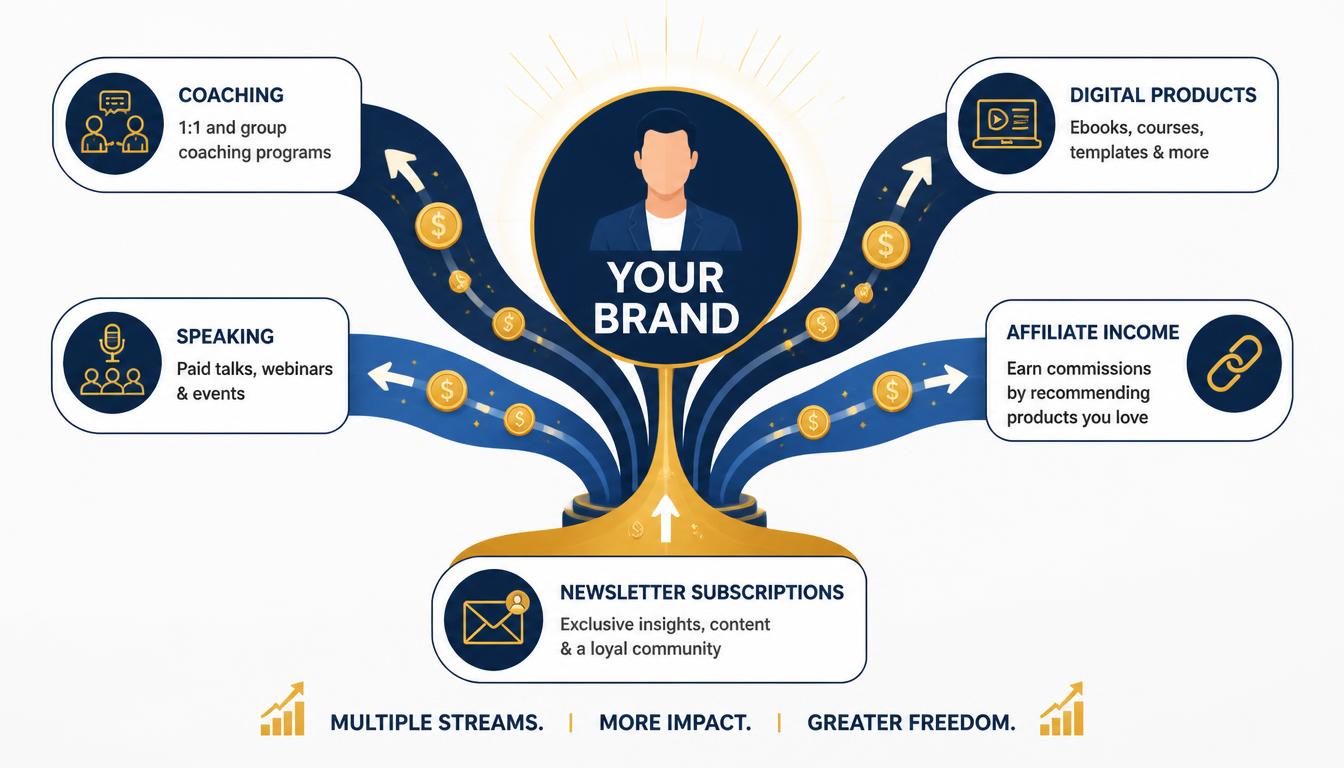
Build multiple revenue streams that complement and reinforce each other. These might include one-on-one coaching or consulting services, digital products such as online courses or downloadable guides, paid speaking engagements, affiliate marketing partnerships, membership communities, or licensing your content to other platforms.
Each additional revenue stream reduces your financial risk while increasing your total earning ceiling. A coaching client might discover you through a LinkedIn post, purchase your online course, subscribe to your paid newsletter, and eventually refer you for a speaking engagement. The brand you built becomes a unified ecosystem where every component feeds revenue into every other component.
Step Six: Systematize and Automate Like a Business
A personal brand that generates real income must eventually operate like a business, not a side project. This means implementing systems that reduce manual effort and eliminate bottlenecks.
Content batching is one of the most powerful time-saving strategies. Dedicate one or two focused sessions per week to creating multiple pieces of content at once, then schedule them for distribution throughout the week using automation tools. Email marketing platforms allow you to set up welcome sequences, nurture campaigns, and promotional funnels that run on autopilot. Social media scheduling tools ensure consistent posting even during busy periods.
As your revenue grows, reinvest a portion of your earnings into delegation. Hiring a virtual assistant, a content editor, or a marketing specialist frees you to focus on the highest-value activities: strategy, relationship building, and creating the signature content that only you can produce. This is not an expense. It is an investment in your most productive hours, and the return compounds over time.
Step Seven: Track Your Numbers Ruthlessly
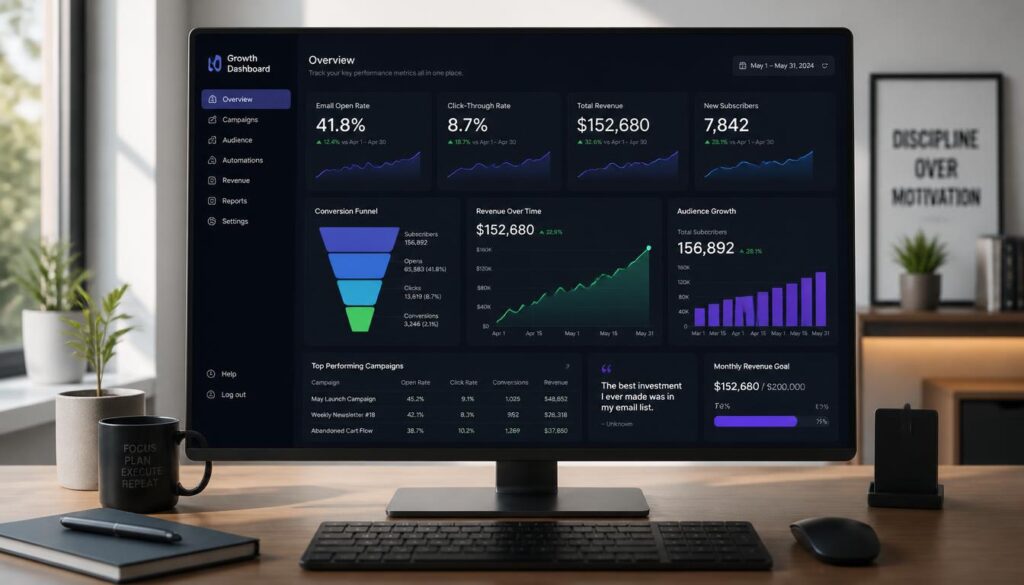
You would not manage an investment portfolio without reviewing performance data, and you should not manage a personal brand without tracking key metrics. Pay close attention to email open rates, click-through rates, lead sources, content engagement, and most importantly, conversion rates.
These numbers reveal which strategies are generating real financial returns and which are simply consuming your time. If a particular content format consistently underperforms, eliminate it without sentimentality. If a specific platform drives the majority of your qualified leads, allocate more resources there.
Adopting a data-driven mindset transforms your personal brand from a creative hobby into a measurable business asset. Every decision becomes an informed allocation of your limited time and energy, ensuring that your efforts produce the highest possible financial return.
Step Eight: Listen to Your Audience Constantly
The most profitable personal brands are not built on assumptions. They are built on deep, ongoing conversations with the people they serve. Regularly ask your audience what challenges they face, what questions keep them up at night, and what solutions they are actively searching for.
This feedback loop serves a dual financial purpose. First, it ensures that every product, service, or piece of content you create addresses a verified need, dramatically increasing your conversion rates and reducing the risk of failed launches. Second, it builds emotional loyalty. When your audience feels genuinely heard and understood, they become advocates, referring others to you organically and reducing your customer acquisition costs to near zero.
In investing terms, listening to your audience is equivalent to conducting thorough due diligence before deploying capital. It removes guesswork and positions you to deliver exactly what the market will pay for.
Step Nine: Build Trust Before You Ever Sell
People do not buy from brands. They buy from people they trust. This principle is the foundation of every successful personal brand monetization strategy.
Share your failures alongside your successes. Show the behind-the-scenes reality of your work. Be transparent about your process, your mistakes, and your lessons learned. This vulnerability is not a weakness. It is the most powerful trust-building tool available to you.
When your audience sees the real, unfiltered person behind the brand, they develop a parasocial connection that no amount of polished marketing can replicate. They trust your recommendations, they invest in your products, and they remain loyal through market fluctuations and competitive noise. In financial terms, trust is the currency that converts attention into revenue, and it cannot be manufactured or shortcut.
Step Ten: Play the Long Game
The most financially successful personal brands are not built on viral moments or fleeting trends. They are built on consistent, compounding value delivered over months and years. Think of your personal brand the way you would think of a long-term index fund investment. The early returns may feel slow, but the exponential growth that comes from sustained effort is extraordinary.
Focus on creating lasting value rather than chasing algorithm spikes. Nurture relationships patiently. Publish content that will remain relevant and useful long after the posting date. Build a reputation for reliability, expertise, and integrity. Over time, this approach creates a brand moat that competitors cannot easily cross and that generates income with decreasing effort as your authority compounds.
A strong personal brand does not just open doors. It makes people actively seek you out, refer others to you, and choose you over every alternative. That is the ultimate financial leverage.

Conclusion
Building a personal brand that generates real, sustainable income is not a get-rich-quick scheme. It is a disciplined, strategic approach to turning your knowledge, experience, and authenticity into a diversified financial asset. The principles are simple: identify your unique value, build authority on the right platforms, own your audience through a newsletter, diversify your revenue streams, systematize your operations, track your performance, listen deeply, earn trust, and commit to the long game.
From a personal finance perspective, this strategy offers something that traditional employment and even conventional investing cannot: complete ownership, unlimited upside, and resilience against economic downturns. Your personal brand travels with you regardless of job markets, industry shifts, or corporate restructuring. It is an asset that you build once and that pays dividends for years, even decades, to come.
Start where you are. Use what you know. Share what you have learned. The financial returns will follow, not overnight, but steadily, reliably, and with compounding force. Your name is your most valuable asset. It is time to invest in it deliberately, protect it fiercely, and let it work for your financial future every single day.
Frequently Asked Questions
1. How much money can I realistically expect to earn from a personal brand?
Income varies widely depending on your niche, audience size, and monetization strategy. In the early stages, you might earn a few hundred dollars per month through freelance work, affiliate commissions, or small digital product sales. As your authority grows and your audience expands into the thousands, income can scale to several thousand dollars monthly through coaching, courses, sponsorships, and paid content. The key is to focus on building genuine value first. Revenue follows trust, and trust takes consistent effort over several months. Treat it like a long-term investment rather than a quick income source, and the financial returns become substantial and sustainable.
2. Do I need a large social media following to monetize my personal brand?
No. A large following is not a prerequisite for income. What matters far more is the depth of trust and relevance you build with a smaller, engaged audience. A newsletter with five hundred dedicated subscribers who genuinely value your expertise can outperform a social media account with fifty thousand passive followers. Focus on attracting the right people rather than the most people. Quality relationships convert into paying clients, premium subscribers, and product buyers far more effectively than sheer volume. Niche authority beats broad popularity when it comes to actual revenue generation.
3. What is the most cost-effective way to start building a personal brand?
The most cost-effective approach requires almost zero financial investment. Start by creating free content on LinkedIn or another relevant platform using nothing but your expertise and a smartphone or basic laptop. Launch a free newsletter using affordable email platforms that offer generous free tiers. Repurpose your content across platforms to maximize reach without additional cost. As revenue begins to flow, reinvest strategically in better tools, design, or delegation. The initial investment is your time and knowledge, both of which you already possess. Avoid expensive courses, fancy equipment, or paid advertising until your organic strategy has proven itself.
4. How long does it typically take before a personal brand starts generating income?
Most people begin seeing their first meaningful income within three to six months of consistent effort, though this timeline varies by niche and strategy. The first few months are primarily about building trust, establishing credibility, and growing your audience. Early revenue often comes from freelance work, consulting inquiries, or small affiliate commissions. More scalable income streams like digital products, paid newsletters, and speaking engagements typically develop after six to twelve months of sustained content creation and audience engagement. Patience and consistency during the early phase are critical. The compounding effect accelerates significantly once your foundation is solid.
5. How do I protect my personal brand income from platform changes or algorithm shifts?
The most effective protection is diversification and ownership. Never rely on a single platform for your audience or income. Build an email list through your newsletter so you maintain direct access to your audience regardless of algorithm changes. Distribute your content across multiple channels to reduce dependency on any single platform. Develop income streams that are not tied to social media reach, such as one-on-one consulting, digital product sales through your own website, or membership communities. Think of platforms as distribution channels, not as your business foundation. The brand, the audience relationship, and the revenue infrastructure should all belong to you, not to a third-party platform.