
Turning Corporate Profits Into Your Personal Paycheck
Imagine waking up to find that money landed in your account overnight—not from a side hustle, not from overtime hours, but simply because you own a small piece of well-run businesses. That is the core promise of dividend investing. Companies around the world distribute billions of dollars in profits to shareholders every single quarter, and anyone with a brokerage account can claim a slice of that pie.
Dividend stocks sit at the intersection of income generation and long-term wealth building. They reward patience, they punish impulsivity, and they offer something rare in the investing world: predictable cash flow that tends to grow over time. Whether you are twenty-five and just starting to save, or fifty-five and planning the transition into retirement, understanding how dividend-paying companies work is one of the most practical financial skills you can develop.
This guide walks you through every layer of dividend investing, from the basic mechanics to advanced portfolio construction, tax strategies, and the compounding power of reinvestment. By the end, you will have a clear, actionable roadmap to start collecting your first dividend checks.
What Exactly Are Dividend Stocks?
A dividend stock is a share in a company that regularly distributes a portion of its net earnings to shareholders in the form of cash payments. These payouts typically happen quarterly, though some companies opt for monthly or semi-annual schedules. The board of directors decides the dividend amount, and once declared, shareholders of record receive their proportionate share on a predetermined payment date.
Companies that pay dividends tend to be mature, profitable enterprises operating in stable industries—think consumer goods manufacturers, utility providers, pharmaceutical giants, and established financial institutions. They have moved past the hyper-growth phase where every dollar of profit gets funneled back into research, expansion, or acquisitions. Instead, they generate more cash than they need for operations and return the surplus to the people who funded them: the shareholders.
For the investor, this creates a dual benefit. You receive regular income while simultaneously holding an asset that can appreciate in market value. A single stock can therefore serve as both a savings account alternative and a growth vehicle.
Why Dividend Stocks Deserve a Spot in Your Portfolio
A Predictable Income Stream
Unlike rental income that requires tenant management or freelance earnings that fluctuate month to month, dividend payments arrive on a fixed schedule with minimal effort on your part. For retirees, this predictability can replace a portion of a pension. For younger investors, it creates a growing second income that requires no additional hours of work.
The Compounding Engine
Here is where dividend investing becomes genuinely powerful. When you reinvest your dividends instead of spending them, you purchase additional shares. Those new shares then generate their own dividends at the next payout cycle. The cycle repeats, and each rotation adds more fuel to the fire. Over a period of two or three decades, this compounding effect can multiply your initial investment several times over, often outperforming a strategy where dividends are simply withdrawn as cash.
Lower Volatility and Emotional Stability
Dividend-paying companies are generally well-established businesses with decades of operational history. Their stock prices tend to swing less dramatically than speculative growth stocks. During market corrections, the steady stream of dividend income acts as a psychological anchor, reminding investors that the underlying business continues to generate real profits regardless of short-term price movements.
Inflation Protection
Companies with a long track record of raising their dividends year after year effectively provide an income stream that keeps pace with—or exceeds—inflation. A dividend that grows at five to seven percent annually protects your purchasing power far better than a fixed-rate bond.
Three Key Metrics Every Dividend Investor Must Master
Chasing the highest dividend yield is the most common beginner mistake. A yield of twelve or fifteen percent often signals distress rather than generosity. Instead, evaluate every candidate through three lenses.
1. Dividend Yield
Calculated by dividing the annual dividend per share by the current stock price, the yield tells you the income return you receive relative to what you pay. A yield between two and five percent is typical for healthy, sustainable companies. Anything dramatically above the sector average warrants deeper investigation into why the market is pricing the stock so low.
2. Payout Ratio
This metric reveals what percentage of earnings (or free cash flow) the company distributes as dividends. A payout ratio below fifty percent indicates a comfortable cushion—the company retains enough profit to fund operations, reduce debt, and still grow the dividend in future years. A ratio consistently above eighty percent raises a warning flag. The company may be stretching to maintain its payment, leaving little room for error during an economic slowdown.
3. Dividend History
Look for companies that have paid uninterrupted dividends for at least ten to twenty-five years, ideally through multiple recessions. A track record of annual increases demonstrates management discipline and financial resilience. Groups commonly referred to as “Dividend Aristocrats” represent companies that have raised their payouts for twenty-five or more consecutive years.

High-Yield Stocks vs. Dividend Growth Stocks: Two Different Philosophies
Not every dividend strategy looks the same, and your personal goals should dictate which path you emphasize.
High-yield stocks offer a large current income relative to their share price. They suit investors who need maximum cash flow right now—perhaps to cover living expenses in retirement. The trade-off is elevated risk. Some high-yield names operate in cyclical or capital-intensive industries where profits can compress quickly. Always verify that the underlying earnings support the payout before committing capital.
Dividend growth stocks, by contrast, may start with a modest yield of two or three percent, but they increase that payment every single year. After a decade or two of consistent raises, the effective yield on your original investment can climb into the seven, eight, or even ten percent range. These companies tend to be financially robust, with pricing power and expanding markets. For long-term wealth accumulation, dividend growth stocks often deliver superior total returns because the rising income compounds alongside share price appreciation.
A balanced portfolio can blend both types: a core of dependable dividend growers supplemented by a smaller allocation of higher-yield names for immediate income.
Building a Diversified Dividend Portfolio
Concentration is the silent enemy of passive income. If three stocks make up ninety percent of your portfolio and one of them cuts its dividend, your income collapses overnight. Diversification protects you from that single-point-of-failure scenario.
Stock Count: Aim to hold between twenty and sixty individual dividend stocks. This range reduces company-specific risk without making the portfolio unmanageable for a self-directed investor.
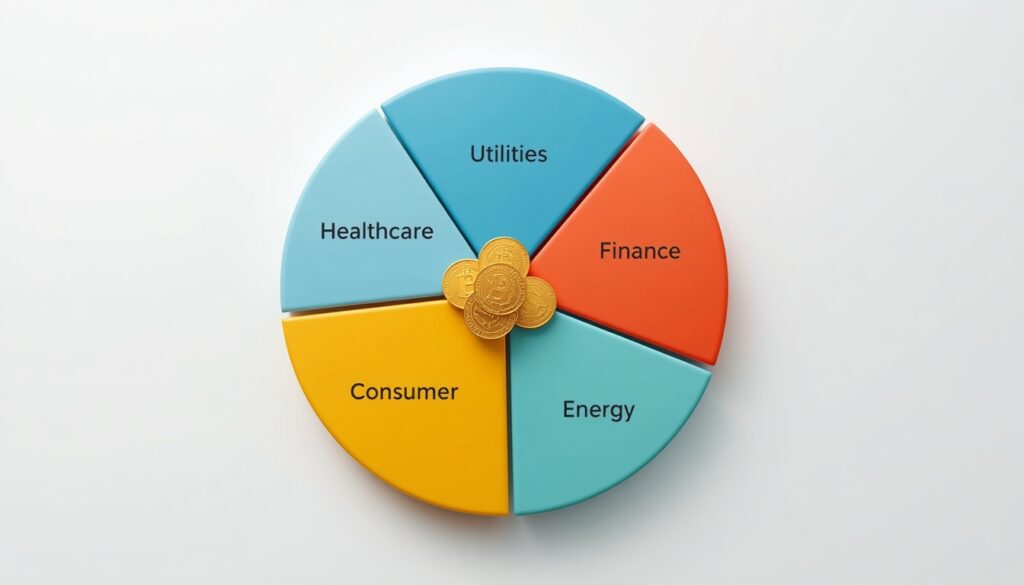
Sector Spread: Distribute holdings across defensive sectors like utilities, consumer staples, and healthcare, alongside cyclical sectors such as industrials, financials, and energy. When one sector faces headwinds, another often continues paying reliably.
ETFs and Mutual Funds: If selecting individual stocks feels overwhelming, dividend-focused exchange-traded funds offer instant diversification in a single transaction. These funds hold hundreds of qualifying dividend stocks, automatically rebalance, and charge minimal expense ratios. They are an excellent starting point while you build the knowledge and confidence to add individual positions.
Dividend Reinvestment Plans: The Wealth Accelerator
A Dividend Reinvestment Plan, commonly called a DRIP, automates the compounding process. Instead of receiving cash in your account, your brokerage or the issuing company automatically uses each dividend payment to purchase additional shares—often fractional shares—of the same stock, typically without any trading commission.
The mathematical impact over long periods is staggering. A five percent yield reinvested continuously can roughly double your share count in about fourteen years, even if the stock price remains flat. Add modest price appreciation on top, and the growth curve steepens considerably.
Most major brokerage platforms allow you to toggle DRIP on or off for each holding with a single click. Some companies also run direct stock purchase plans that let you buy shares straight from their transfer agent, sometimes with small discounts to market price. If your goal is maximum long-term wealth accumulation rather than immediate income, activating DRIP should be one of your very first steps.

Understanding the Tax Side of Dividend Income
Dividends are taxable events, and knowing how they are classified helps you plan more efficiently.
Qualified dividends are taxed at the favorable long-term capital gains rates, which are lower than ordinary income tax brackets. To qualify, you generally must hold the stock for more than sixty days during the 121-day window surrounding the ex-dividend date.
Non-qualified (ordinary) dividends are taxed at your standard income tax rate. Certain payouts from real estate investment trusts, master limited partnerships, and some foreign companies fall into this category.
At the end of each tax year, your brokerage issues a Form 1099-DIV summarizing all dividend income and its classification. Holding dividend stocks inside tax-advantaged accounts such as IRAs or employer-sponsored retirement plans can defer or eliminate the annual tax drag, allowing the full power of compounding to work uninterrupted.
Consult a tax professional to determine the most efficient account structure for your specific situation, especially if you hold a mix of domestic and international dividend payers.
Your Step-by-Step Action Plan
- Open a Brokerage Account. Choose a reputable platform with low or zero commissions, robust research tools, and the ability to enable automatic dividend reinvestment.
- Define Your Objective. Decide whether your priority is immediate income, long-term dividend growth, or a blend of both. Your answer shapes every subsequent decision.
- Set a Monthly or Quarterly Investment Amount. Consistency beats timing. Even modest, regular contributions build a meaningful position over time.
- Research and Screen Candidates. Apply the three metrics—yield, payout ratio, dividend history—to narrow a broad market list down to a manageable shortlist.
- Diversify Across Sectors and Geographies. Build your portfolio gradually, adding positions over several months to smooth out entry prices.
- Activate DRIP and Automate Contributions. Remove emotion from the equation. Let the system compound on your behalf.
- Review Annually. Once a year, reassess each holding. Check whether payout ratios remain healthy, whether the company still generates growing free cash flow, and whether any position has become an outsized portion of your portfolio.

Conclusion
Dividend investing is not a get-rich-quick scheme. It is a get-wealthy-slowly framework that rewards discipline, patience, and a willingness to let compounding do the heavy lifting. The companies that pay you today will likely pay you more tomorrow, and the shares you reinvest today will generate their own income streams in the years ahead.
Start small if you need to. Buy one quality dividend stock, turn on reinvestment, and commit to adding a little more each month. Over time, those quarterly deposits into your account transform from pocket change into a meaningful income stream—one that requires no boss, no clients, and no additional hours of labor. That is the quiet, compounding power of dividend stocks, and it is available to anyone willing to begin.
Frequently Asked Questions
1. How much money do I need to start investing in dividend stocks?
There is no universal minimum. Many brokerages allow you to purchase fractional shares, meaning you can start with as little as five or ten dollars. However, to build a meaningfully diversified portfolio of twenty to sixty stocks, most investors aim to accumulate several thousand dollars over their first year or two through regular monthly contributions. The key is starting early and staying consistent rather than waiting for a large lump sum.
2. Are dividend payments guaranteed, or can a company stop paying them?
Dividends are not contractually guaranteed. A company’s board of directors can reduce or suspend a dividend at any time, particularly during severe financial distress. This is why evaluating the payout ratio, free cash flow, and overall balance sheet health is critical. Companies with long histories of uninterrupted and rising dividends are statistically far less likely to cut, but no dividend is absolutely risk-free.
3. Should I choose high-yield stocks or dividend growth stocks for retirement income?
If you are within five years of retirement and need maximum current income, a higher allocation toward high-yield stocks makes sense. If you have a longer runway, dividend growth stocks typically provide a better combination of rising income and capital appreciation. Many retirees use a blended approach: a growth-oriented core supplemented by higher-yield positions for immediate cash needs.
4. Do I owe taxes on dividends that I reinvest through a DRIP?
Yes. In a standard taxable brokerage account, reinvested dividends are still treated as income in the year they are paid, even though you never receive the cash directly. You will owe either qualified or ordinary income tax depending on the classification. Holding dividend stocks inside a tax-advantaged retirement account can defer or eliminate this annual tax obligation.
5. How often should I review and rebalance my dividend portfolio?
An annual review is sufficient for most long-term dividend investors. During that review, confirm that each company still meets your safety criteria—payout ratio below your threshold, stable or growing free cash flow, and no fundamental deterioration in the business. Rebalance only if a single position has grown to represent an outsized percentage of your total portfolio, typically above ten to fifteen percent. Avoid over-trading, as frequent buying and selling can generate unnecessary taxes and transaction costs.