Why Index Funds Deserve a Spot in Every Investor’s Portfolio
If you have ever felt overwhelmed by the stock market, you are not alone. Thousands of tickers flash across screens every trading day, analysts shout conflicting predictions, and the sheer volume of information can paralyze even the most motivated saver. Yet there is a strategy that strips away nearly all of that noise, requires almost no daily attention, and has quietly helped millions of everyday people build serious wealth over the decades. That strategy is index fund investing.
Index funds sit at the intersection of simplicity, low cost, and long-term growth. They do not ask you to predict which company will soar next quarter. They do not demand a finance degree or forty hours of weekly research. Instead, they let you own a broad slice of the entire market in a single transaction and then get on with your life while compounding does the heavy lifting.
Whether you are opening your very first brokerage account or you have been investing for years and want to streamline your approach, understanding how index funds work, what types exist, and how to use them effectively can transform your financial future. This guide walks you through every essential concept, from the basic mechanics to practical steps for getting started, so you can make confident, informed decisions with your hard-earned money.
What Exactly Is an Index Fund?
At its core, an index fund is a pooled investment designed to replicate the performance of a specific market benchmark, often called an index. Think of an index as a carefully curated list of companies that represents a particular segment of the economy. The S&P 500, for example, tracks the five hundred largest publicly traded companies in the United States. The NASDAQ-100 focuses on the biggest technology and growth-oriented firms. The Dow Jones Industrial Average follows thirty blue-chip giants.
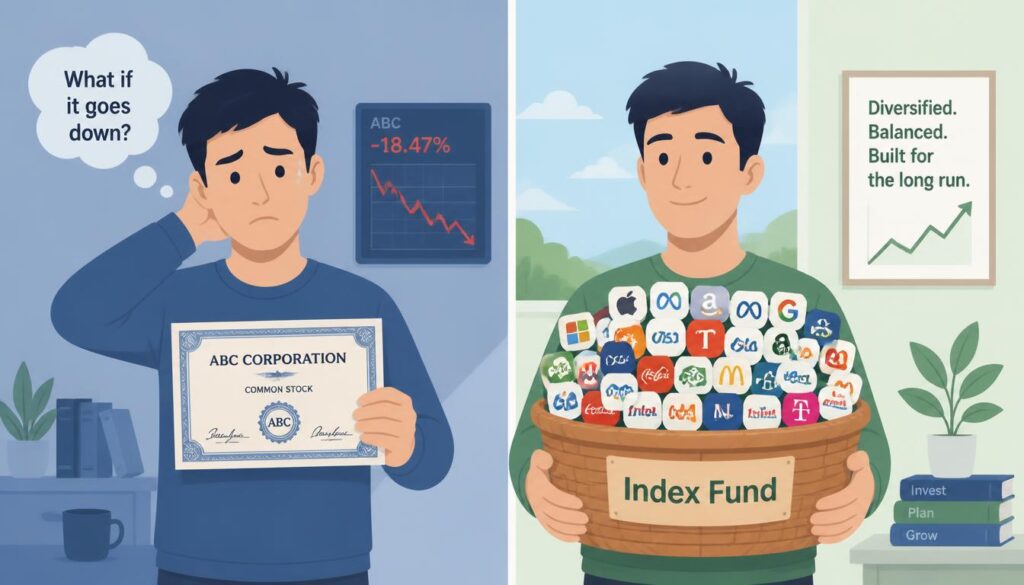
When you buy shares of an index fund tied to one of these benchmarks, you are not betting on a single company. You are purchasing a tiny ownership stake in every company within that index simultaneously. One purchase gives you exposure to hundreds or even thousands of businesses across multiple industries, geographies, and market capitalizations.
Index funds come in two primary wrappers: mutual funds and exchange-traded funds, commonly known as ETFs. Both follow the same passive management philosophy. There is no portfolio manager waking up at dawn to decide which stocks to buy or sell. The fund simply mirrors the index composition, adjusting only when the index itself adds or removes constituents. This passive structure is what keeps costs remarkably low and removes the emotional guesswork that often derails active trading strategies.
How Index Funds Actually Work
The mechanics behind an index fund are refreshingly straightforward. The fund provider identifies the target index and then purchases the underlying securities in the exact same weightings. If a particular technology company represents seven percent of the S&P 500, the index fund allocates roughly seven percent of its assets to that same company. If a healthcare firm accounts for two percent, the fund mirrors that allocation as well.
Because the fund only needs to rebalance when the index changes its composition, which typically happens a few times per year, trading activity stays extremely low. Low trading activity translates directly into lower transaction costs, fewer taxable events, and less drag on your returns. This is a critical advantage over actively managed funds, where managers may buy and sell positions dozens of times per month, generating fees and capital gains taxes that quietly erode your profits.
Index funds are not limited to equities. You can find index funds that track government bond portfolios, corporate debt, commodity baskets, real estate investment trusts, and international markets. The underlying principle remains identical regardless of the asset class: replicate the benchmark, keep costs minimal, and let the market’s long-term upward trajectory work in your favor.
One concept worth understanding is tracking error. No fund can replicate an index with absolute perfection. Tiny discrepancies arise from management fees, rounding of share quantities, and the timing of dividend reinvestments. Reputable fund providers keep this tracking error exceedingly small, often below a few basis points per year, but it is a factor worth reviewing when comparing similar products.
The Main Types of Index Funds You Should Know
Not all index funds are created equal, and the variety available today means you can tailor your portfolio with surgical precision. Here are the primary categories:
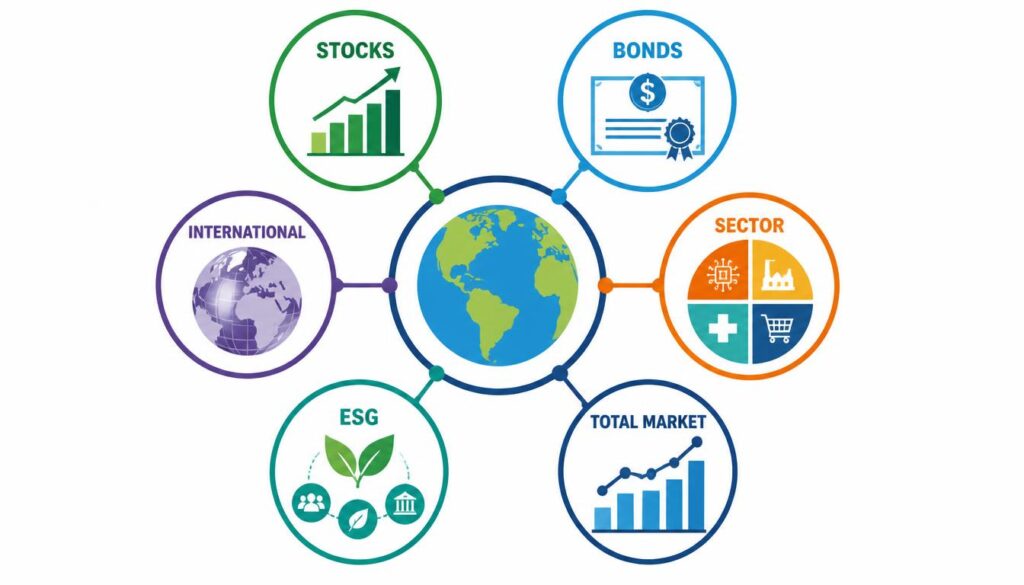
Broad Stock Market Index Funds track major equity benchmarks such as the S&P 500, the Russell 3000, or the total U.S. stock market. These are the most popular starting point for new investors because they provide exposure to the entire domestic equity landscape in one holding.
Bond Index Funds follow fixed-income benchmarks like the Bloomberg U.S. Aggregate Bond Index, which includes Treasuries, mortgage-backed securities, and investment-grade corporate bonds. They tend to be less volatile than stock funds and serve as a stabilizing anchor in a diversified portfolio.
International and Emerging Market Index Funds extend your reach beyond domestic borders. Developed-market funds cover economies in Europe, Japan, and Australia, while emerging-market funds target faster-growing regions in Asia, Latin America, and Africa. Adding international exposure reduces your dependence on any single country’s economic performance.
Sector and Thematic Index Funds concentrate on specific industries such as technology, healthcare, energy, or financial services. They carry higher volatility than broad-market funds but allow you to tilt your portfolio toward areas you believe will outperform.
ESG Index Funds screen for environmental, social, and governance criteria, excluding companies that fail to meet certain sustainability or ethical standards. They have grown rapidly in popularity among investors who want their money aligned with personal values.
Total Market Index Funds combine large-cap, mid-cap, and small-cap stocks into a single product, offering the broadest possible equity exposure with one purchase.
Mixing several of these categories lets you construct a globally diversified portfolio that matches your risk tolerance and time horizon without ever needing to analyze individual company balance sheets.
The Benefits That Make Index Funds a Wealth-Building Powerhouse
Index funds have earned their reputation for good reason. The advantages stack up in ways that compound dramatically over time.
Instant Diversification. A single index fund can hold five hundred, three thousand, or even nine thousand individual securities. If one company stumbles, the impact on your overall portfolio is negligible. You are protected from the catastrophic loss that can come from concentrating your money in one or two stocks.
Rock-Bottom Fees. Because there is no team of analysts to pay, no expensive trading algorithms to maintain, and minimal buying and selling, expense ratios on index funds can dip below 0.03 percent. Compare that to the one percent or more charged by many actively managed funds, and the savings over a thirty-year investing horizon can amount to tens of thousands of dollars staying in your pocket instead of a fund company’s.
Tax Efficiency. Low portfolio turnover means fewer realized capital gains distributions. In taxable brokerage accounts, this translates into a lower annual tax bill, allowing more of your money to remain invested and compounding.
Consistent, Market-Matching Returns. Index funds do not promise to beat the market; they promise to be the market. Historically, broad equity markets have trended upward over long periods, rewarding patient investors who stay the course through inevitable dips and corrections.
Transparency and Simplicity. You always know exactly what you own because the holdings mirror a publicly available index. There are no hidden positions, no surprise strategy shifts, and no opaque trading decisions made behind closed doors.
Ideal for Retirement Accounts. The combination of low fees and tax efficiency makes index funds a natural fit for 401(k) plans, IRAs, Roth IRAs, and other tax-advantaged retirement vehicles where every dollar saved on expenses compounds over decades.
Understanding the Risks: What Index Funds Cannot Protect You From
No investment is without risk, and intellectual honesty demands that we examine the downsides.
Market Risk Is the Big One. Because an index fund mirrors the market, it will fall when the market falls. During a broad sell-off, there is no manager rotating into defensive stocks or raising cash. Your portfolio value will decline alongside the benchmark. Historically, markets have recovered and reached new highs, but the psychological toll of watching your balance drop twenty, thirty, or even fifty percent during a severe recession can test even the most disciplined investor.
No Downside Protection. Index funds hold every company in the index, including the weak performers. You cannot exclude a struggling firm the way an active manager might. You ride the entire market, warts and all.
Limited Flexibility. You surrender the ability to overweight a company you love or underweight one you dislike. The index composition dictates your holdings.
Sector and Niche Volatility. Sector-specific or emerging-market index funds can swing far more dramatically than broad-market products. A technology index fund, for instance, will feel the full force of a tech-sector correction.
Inflation Risk. If market returns lag behind the rate of inflation for an extended period, your purchasing power erodes even if your account balance is technically growing.
Tracking Error. Small deviations between the fund’s return and the index’s return can accumulate, though reputable providers keep this gap minimal.
Understanding these risks does not mean you should avoid index funds. It means you should pair them with a realistic time horizon, an emergency fund, and a diversified asset allocation that includes bonds or other stabilizing investments.

Step-by-Step: How to Start Investing in Index Funds
Getting started is easier than most beginners expect. Here is a practical roadmap.
Step One: Define Your Goal and Risk Tolerance. Are you saving for retirement thirty years away, a down payment in eight years, or your child’s education in fifteen? Your time horizon and comfort with volatility will shape which index funds you choose and how you allocate between stocks and bonds.
Step Two: Choose the Index Fund Type. A young investor with a long runway might lean heavily into total stock market and international equity index funds. Someone closer to retirement might shift a larger share into bond index funds for stability.
Step Three: Decide Between a Mutual Fund and an ETF. Both track indexes passively. ETFs trade throughout the day like stocks and often have slightly lower minimum investments. Mutual funds price once daily after market close and may offer automatic investment features. Functionally, the long-term results are nearly identical.
Step Four: Open a Brokerage Account. Major platforms such as Vanguard, Fidelity, Charles Schwab, and numerous robo-advisors offer access to thousands of index funds and ETFs, many with zero commission trades. Compare expense ratios, minimum investment requirements, and the fund’s historical tracking accuracy before committing.
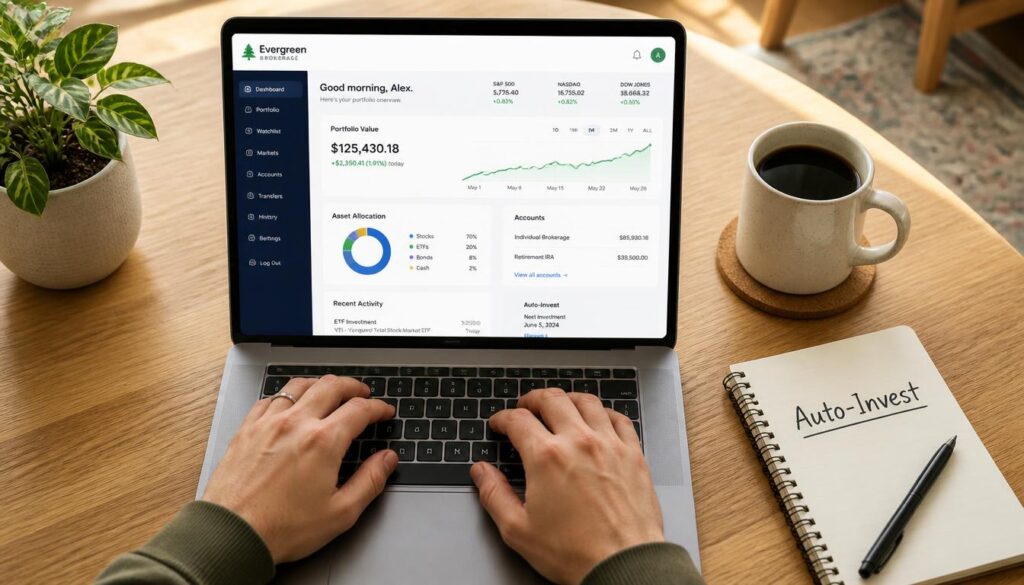
Step Five: Automate Your Contributions. Set up a recurring transfer from your checking account to your brokerage account on every payday. This strategy, known as dollar-cost averaging, means you buy more shares when prices are low and fewer when they are high, smoothing out volatility and removing the temptation to time the market.
Step Six: Stay the Course. The single most powerful thing you can do after investing is leave the money alone. Resist the urge to sell during headlines-driven panic. History shows that investors who remain invested through downturns capture the eventual recovery and the compounding growth that follows.
Index Funds Versus Actively Managed Funds: An Honest Comparison
This is one of the most debated topics in personal finance, and the data paints a clear picture.
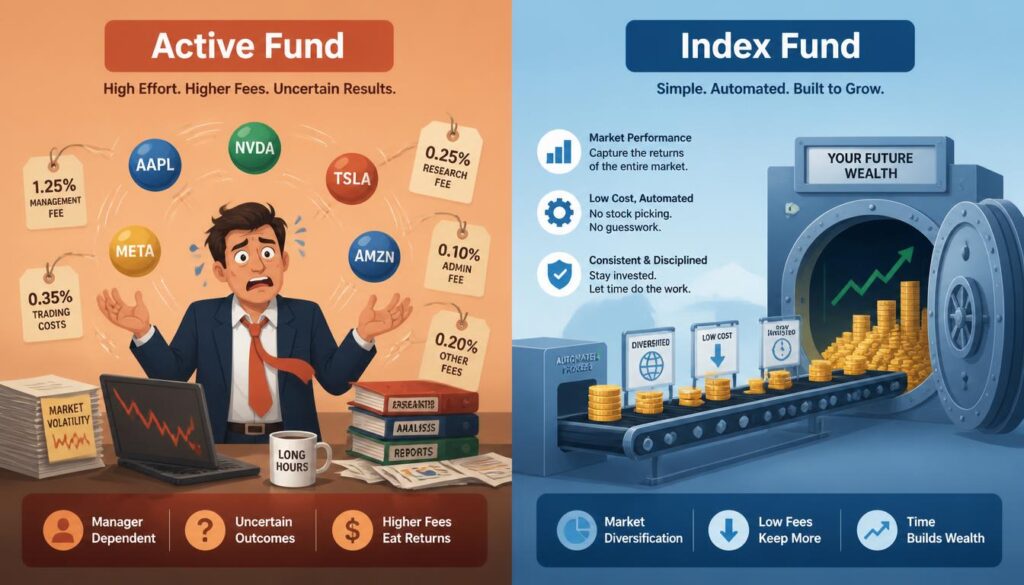
Actively managed funds employ professional portfolio managers who research companies, forecast earnings, and attempt to buy undervalued stocks while selling overvalued ones. The goal is to beat the benchmark. In any given year, some active managers do outperform. The problem is consistency. Study after study has shown that over ten, fifteen, and twenty-year periods, the vast majority of actively managed funds underperform their benchmark index after fees are deducted.
The fee gap is the silent killer. An active fund charging one percent annually versus an index fund charging 0.05 percent creates a 0.95 percent annual drag. Over thirty years on a portfolio that would otherwise grow to one million dollars, that difference can cost an investor well over one hundred thousand dollars in lost growth. Add in higher trading costs and less favorable tax treatment from frequent capital gains distributions, and the gap widens further.
That said, active management is not universally wrong. In less efficient markets, such as certain emerging economies or niche asset classes, skilled managers may find genuine edges. For most individual investors focused on domestic and developed-market equities, however, index funds deliver superior risk-adjusted returns at a fraction of the cost.
Are Index Funds the Right Fit for Your Financial Life?
Index funds shine brightest for investors who value simplicity, low cost, and long-term compounding over the thrill of stock picking. If your primary objective is to build a retirement nest egg, fund a child’s education, or grow a general wealth portfolio without spending evenings analyzing earnings reports, index funds are an outstanding foundation.
They also work beautifully as the core of a “core-and-satellite” strategy. You might allocate eighty or ninety percent of your portfolio to broad-market index funds for stability and then use the remaining ten to twenty percent for individual stocks, sector funds, or alternative investments that satisfy your curiosity and appetite for higher risk.
On the other hand, if you genuinely enjoy researching companies, have the time to monitor positions, and accept the possibility of underperforming the market in exchange for the chance to beat it, a small allocation to active strategies can coexist alongside your index fund holdings. The key is to be honest about your motivations, your available time, and your emotional resilience during drawdowns.

Conclusion: The Quiet Power of Owning the Market
Index funds will never make for exciting dinner-party conversation. There is no dramatic stock tip, no overnight windfall story, no adrenaline rush of watching a single ticker spike. And that is precisely their genius. They channel the collective growth of the entire economy into your portfolio with minimal fees, minimal effort, and minimal stress.
The math of compounding is unforgiving in both directions. Every dollar you save on fees is a dollar that stays invested, earning returns, generating its own returns, and snowballing over decades. Every automated contribution you make during a market dip buys more shares at a discount, positioning you for outsized gains when the cycle turns. Every year you resist the urge to sell in panic is another year your money stays in the market, capturing the recoveries that have historically followed every major downturn.
You do not need a six-figure salary to begin. You do not need to predict the next recession or the next breakout stock. You need a clear goal, a low-cost index fund, a recurring contribution schedule, and the patience to let time do what it has always done for disciplined investors: reward consistency over cleverness.
Start small if you must. Automate what you can. Increase your contributions as your income grows. Review your allocation once or twice a year, rebalance if necessary, and then step away. The market will have its loud days, its scary headlines, and its breathless pundits. Your index fund will quietly keep collecting dividends, reinvesting, and compounding in the background.
That is not the flashiest path to wealth. It is, however, the one with the highest probability of actually getting you there.
Frequently Asked Questions About Index Funds
1. How much money do I need to start investing in an index fund?
Many index fund ETFs can be purchased for the price of a single share, which can be as low as fifty to one hundred dollars depending on the fund. Several major brokerages now offer fractional shares, allowing you to invest with as little as one dollar or five dollars. Index mutual funds may have minimum initial investments ranging from zero to a few thousand dollars, but the barrier to entry has never been lower. The most important step is simply to begin, regardless of the amount.
2. Can I lose all my money in an index fund?
It is extremely unlikely that a broad-market index fund would lose all of its value, because that would require every single company in the index to go bankrupt simultaneously. However, the value of your investment can and will decline during market downturns. A broad equity index fund might drop thirty to fifty percent during a severe recession. The critical point is that historically, diversified markets have always recovered over time. Investors who hold through downturns rather than selling in panic have consistently recouped losses and gone on to achieve positive long-term returns.
3. How are index funds taxed, and how can I minimize my tax burden?
Index funds generate taxable events primarily through dividend distributions and capital gains when you sell shares. Because index funds have low turnover, they tend to distribute fewer capital gains than actively managed funds, making them inherently more tax-efficient. To further reduce taxes, hold your index funds inside tax-advantaged accounts such as a 401(k), Traditional IRA, or Roth IRA. In a taxable brokerage account, choosing ETFs over mutual funds can offer a slight additional tax advantage due to the way ETF shares are created and redeemed.
4. Should I invest in an S&P 500 index fund or a total stock market index fund?
Both are excellent choices, and their long-term performance has been very similar because the S&P 500 represents roughly eighty percent of total U.S. market capitalization. A total stock market fund adds exposure to mid-cap and small-cap companies, providing slightly broader diversification. If you want the simplest possible single-fund U.S. equity holding, either option works. Many investors choose a total market fund for the extra diversification and then add an international index fund for global coverage.
5. How often should I check or rebalance my index fund portfolio?
For most long-term investors, checking your portfolio once or twice a year is more than sufficient. Rebalancing, which involves adjusting your allocation back to your target mix of stocks and bonds, typically only needs to happen annually or when your allocation drifts more than five percentage points from the target. Frequent checking can lead to emotional decision-making, especially during volatile periods. Set your allocation, automate your contributions, and give your investments time to compound without constant interference.