Stepping into the world of investing can feel incredibly intimidating. Between the endless financial jargon, complicated stock charts, and the constant pressure to “beat the market,” many beginners feel paralyzed. You know you need to grow your wealth to secure your financial future, but the complexity of doing it yourself often leads to inaction.
Fortunately, technology has stepped in to bridge the gap between wanting to invest and actually knowing how to do it. Enter the robo-advisor. Over the last decade, these digital platforms have revolutionized personal finance, emerging as one of the most accessible ways for newcomers to build wealth without getting lost in the weeds. But while automated investing is a powerful tool, it is not a one-size-fits-all solution. To make the best decision for your money, you need to understand exactly what robo-advisors are, how their fee structures work, and the distinct advantages and drawbacks they present.
Demystifying Robo-Advisors: What Are They and How Do They Work?
At their core, robo-advisors are digital wealth management platforms that use complex algorithms to provide automated financial planning and investment management. Instead of sitting across a desk from a human financial advisor who charges premium fees for personalized recommendations, you interact entirely through a website or a mobile application.
The onboarding process is designed to be frictionless. When you sign up, the platform will ask you a series of foundational questions. These typically cover your financial goals (e.g., retirement, buying a house, building an emergency fund), your time horizon (when you need the money), and your risk tolerance (how you would react to a market downturn).
Based on your unique profile, the algorithm automatically constructs a diversified investment portfolio for you. This portfolio is almost exclusively built using Exchange-Traded Funds (ETFs). ETFs are baskets of securities that trade on an exchange, allowing you to buy a single fund that holds hundreds or thousands of individual stocks or bonds. By utilizing low-cost, broad-market ETFs, the robo-advisor ensures your money is spread across various asset classes, such as U.S. equities, international stocks, and fixed-income bonds.
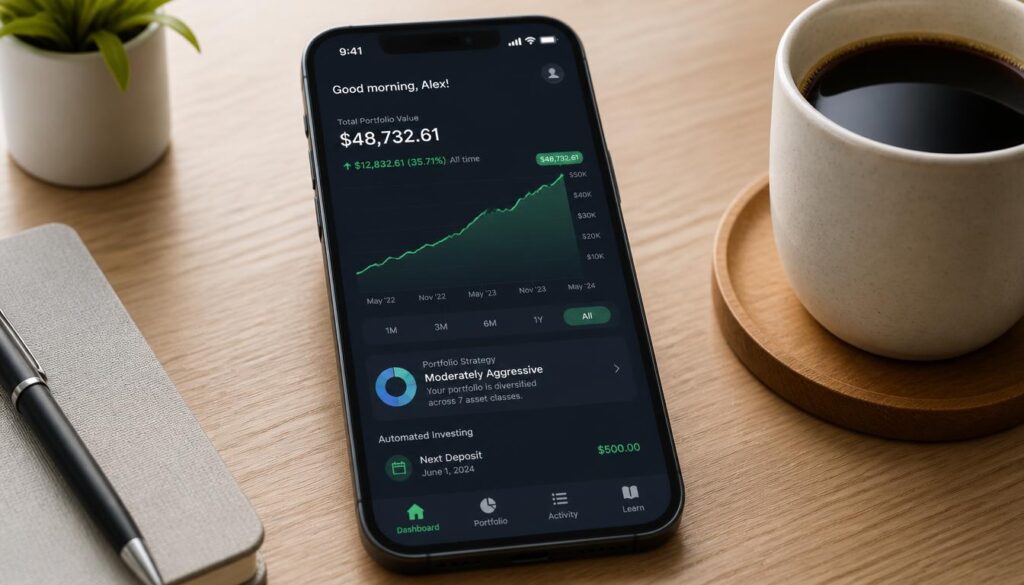
Think of a robo-advisor as putting your financial future on autopilot. The underlying technology is designed to execute smart, evidence-based investment strategies—like Modern Portfolio Theory—without requiring you to understand the granular details of asset allocation or market timing. You simply link your bank account, set up automatic recurring deposits, and let the algorithm do the heavy lifting.
The Compounding Advantages of Automated Investing
For someone new to the markets, the appeal of automated investing is undeniable. It removes the emotional stress and time commitment required to manage a portfolio manually. Here is a deep dive into the primary benefits that make robo-advisors a game-changer for beginners.
1. Unmatched Accessibility and Low Barriers to Entry
Traditional human financial advisors often require high minimum investments, sometimes demanding $100,000 or more in assets before they will even take you on as a client. This effectively locks young professionals and first-time investors out of professional wealth management. Robo-advisors completely flip this model. Most platforms allow you to open an account and start investing with as little as $10, $100, or sometimes even no minimum at all. This democratization of investing allows you to start building wealth with whatever you have right now, rather than waiting until you are “rich enough” to begin.
2. Highly Competitive Fee Structures
One of the most significant advantages of robo-advisors is cost efficiency. Human advisors typically charge around 1% of your Assets Under Management (AUM) annually. While 1% sounds small, it compounds negatively over decades, eating away at your returns. Robo-advisors typically charge a management fee between 0.25% and 0.50%. Furthermore, because they invest primarily in low-cost index ETFs, the underlying expense ratios of the funds themselves are minimal. Over a 30-year career, this fee differential can result in tens of thousands of dollars in additional compounded wealth staying in your pocket.
3. Automated Rebalancing and Tax-Loss Harvesting
Robo-advisors automate critical maintenance tasks that beginner investors frequently overlook.
- Rebalancing: If the stock market surges, your portfolio might become too heavily weighted in equities, increasing your risk. The robo-advisor automatically sells high-performing assets and buys underperforming ones to return your portfolio to your target allocation. This forces you to “buy low and sell high” systematically.
- Tax-Loss Harvesting: This is an advanced strategy where the algorithm identifies investments that have lost value and sells them to realize a loss. This loss can be used to offset capital gains in your taxable accounts, reducing your overall tax burden. The algorithm then immediately reinvests the proceeds into a similar (but not identical) ETF to keep your market exposure intact. Doing this manually is incredibly tedious; the robo-advisor does it daily.
4. Behavioral Guardrails
Perhaps the most underrated benefit of automated investing is how it protects you from yourself. Human beings are notoriously bad at investing. We panic-sell during market crashes and greed-buy during bubbles. Because a robo-advisor operates purely on logic and your pre-set risk parameters, it removes emotion from the equation. It keeps you invested and disciplined, which is historically the biggest driver of long-term investment success.
Navigating the Limitations and Drawbacks
Despite their immense utility, robo-advisors are not perfect. Relying entirely on an algorithm comes with specific limitations that you must weigh against the benefits before committing your capital.
1. The Lack of Personalized Human Touch
The most glaring drawback is the absence of a human element. Algorithms are fantastic at executing general, mathematically sound investment strategies, but they cannot provide nuanced, holistic financial planning. If your financial life is complex—involving things like estate planning, navigating concentrated stock positions from employer RSUs, optimizing a small business’s cash flow, or coordinating a spouse’s disparate retirement accounts—a robo-advisor will fall short. They manage the investment portfolio, but they do not manage your entire financial life.
2. The Illusion of Control and Lack of Customization
Some investors simply enjoy the process of picking stocks. They want to invest in specific companies they believe in, or they want to avoid certain industries for ethical reasons. With a standard robo-advisor, you surrender this control. Your money is funneled into a pre-built, generalized mix of ETFs. While some platforms now offer slight customizations (like tilting toward ESG—Environmental, Social, and Governance—funds), you generally cannot exclude specific companies or sectors. For hands-on investors, this lack of control can feel incredibly restrictive.
3. The “Fee Floor” Reality
While robo-advisor fees are much lower than human advisors, they are not zero. If you are highly motivated and willing to spend a few hours learning the basics of personal finance, you can open a standard brokerage account and buy the exact same low-cost index ETFs yourself for free. In a pure DIY approach, you only pay the tiny underlying expense ratios of the ETFs (often 0.03%), completely bypassing the 0.25% robo-advisor management fee. For highly frugal investors, paying an algorithm to do something you could easily learn to do yourself might feel like an unnecessary expense.

The Investing Spectrum: Robo vs. Human vs. DIY
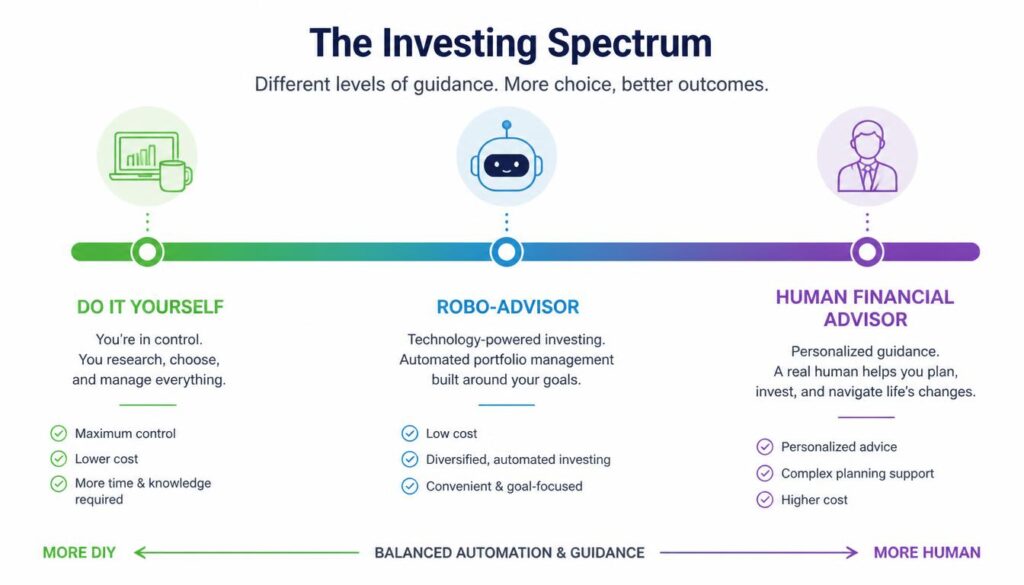
To truly understand where a robo-advisor fits, it helps to view wealth management as a spectrum. On one end, you have the “Do It Yourself” (DIY) investor. On the other end, you have the traditional Human Financial Advisor. The robo-advisor sits perfectly in the middle.
The DIY Investor:
- Cost: Lowest (only underlying ETF fees).
- Control: Total. You pick every single asset.
- Time/Effort: High. You must research, execute trades, and rebalance manually.
- Best for: Frugal individuals, finance enthusiasts, and those with simple financial lives who want maximum control.
The Robo-Advisor:
- Cost: Low (0.25% – 0.50% + underlying ETF fees).
- Control: Low to Medium. You choose the risk level; the algorithm chooses the assets.
- Time/Effort: Very Low. Entirely automated.
- Best for: Busy professionals, beginners, and those who want professional-grade portfolio management without the high fees or time commitment.
The Human Financial Advisor:
- Cost: High (1% or more + underlying fees).
- Control: Medium. You collaborate on the strategy, but the advisor executes it.
- Time/Effort: Low for you, but requires periodic meetings.
- Best for: High-net-worth individuals, those with highly complex financial situations, and those who value the emotional reassurance of a human relationship.
The Hybrid Approach: You do not have to choose just one. Many successful investors use a “Core and Satellite” strategy. They use a robo-advisor for their “core” portfolio—putting 80% to 90% of their money into the automated, diversified ETF baskets to ensure steady, long-term growth. They then use the remaining 10% to 20% as a “satellite” in a standard DIY brokerage account to scratch the itch of picking individual stocks, experimenting with crypto, or trying to beat the market. This satisfies the psychological need for control while keeping the bulk of your wealth safely on autopilot.
Who Should Use a Robo-Advisor? (And Who Shouldn’t)
Making the final decision comes down to self-awareness regarding your time, knowledge, and financial complexity.
A Robo-Advisor is Ideal For You If:
- You are a complete beginner: You want to start investing but are terrified of making a costly mistake by picking the wrong stocks.
- You are incredibly busy: You work long hours, have a busy family life, and have zero desire to spend your weekends reading financial reports or tracking market fluctuations.
- You are prone to emotional decisions: You know that if the market drops 20%, you will panic and sell. You need a system that removes your emotions from the equation.
- You are starting with a smaller balance: You want to build the habit of investing with $50 or $100 a month and don’t meet the minimums for a human advisor.
You Should Skip the Robo-Advisor If:
- You want to be an active stock picker: You derive joy from researching companies and believe you can identify undervalued stocks.
- You have a highly complex financial picture: You need help with tax planning, estate trusts, or navigating complex compensation packages.
- You are fiercely anti-fee: You are willing to read a few books on index fund investing to save that 0.25% management fee over the next 40 years.
If you decide to take the plunge, getting started is simple. Define your goal, pick a reputable platform, answer the questionnaire honestly (do not overestimate your risk tolerance), set up an automatic monthly transfer from your checking account, and then ignore it. The secret to automated investing is literally in the name: automate it, and let time do the rest.

Conclusion
Building wealth does not have to be a second job. Robo-advisors have successfully democratized access to sophisticated, diversified, and tax-efficient investment strategies that were once reserved for the ultra-wealthy. By leveraging algorithms and low-cost ETFs, they provide a seamless, low-stress pathway to financial independence for beginners and busy professionals alike.
However, they are not a magic bullet. They lack the personalized touch of a human advisor and the granular control of a DIY portfolio. The key to success is aligning your investment vehicle with your personal goals, your available time, and your comfort level with financial complexity. Whether you choose to go fully automated, take a hybrid approach, or dive into DIY investing, the most important step is simply to start. Time in the market will always beat timing the market, and the best investment strategy is the one you actually stick with.
Frequently Asked Questions (FAQ)
1. Are robo-advisors safe if the stock market crashes?
Yes, robo-advisors are safe in terms of platform security, but your investments are still subject to market risk. If the stock market crashes, the value of your portfolio will temporarily drop, just as it would in a DIY account. However, the robo-advisor’s algorithm is designed to handle this by maintaining your diversified asset allocation. Furthermore, the accounts are typically protected by SIPC (Securities Investor Protection Corporation) insurance up to $500,000, which protects your assets if the brokerage firm itself goes bankrupt, though it does not protect against market losses.
2. Can I choose specific stocks or customize my portfolio with a robo-advisor?
Generally, no. The core philosophy of a robo-advisor is broad diversification through ETFs, so you cannot pick individual companies (like buying just Apple or Tesla). However, many modern platforms offer varying levels of customization. You can often choose to tilt your portfolio toward specific themes, such as ESG (Environmental, Social, and Governance) investing, socially responsible funds, or specific factor investing (like value or momentum). But for single-stock selection, you will need a traditional brokerage account.
3. How do robo-advisor fees compare to traditional mutual funds?
Robo-advisors are almost always cheaper than actively managed traditional mutual funds. An actively managed mutual fund might charge an expense ratio of 0.50% to 1.00% (or more), plus a human advisor might charge 1% on top. A robo-advisor typically charges a flat management fee of 0.25% to 0.50%, and the underlying ETFs they use usually have expense ratios between 0.03% and 0.15%. This makes the total cost of a robo-advisor significantly lower than traditional mutual fund investing.
4. What happens to my money if the robo-advisor company goes out of business?
Your money is safe. Robo-advisors do not actually hold your money; they act as the investment manager, while the actual assets are held by a custodial brokerage (like Charles Schwab, Fidelity, or Apex Clearing). If the robo-advisor company goes out of business, your assets remain safely held at the custodian. Additionally, because the accounts are SIPC insured, your investments are protected up to $500,000 (including a $250,000 limit for cash) against the failure of the custodial brokerage.
5. Can I transfer my robo-advisor account to a traditional broker later?
Yes, absolutely. If you outgrow your robo-advisor or decide you want to take a more hands-on approach, you can easily initiate an ACATS (Automated Customer Account Transfer Service) transfer. This allows you to move your entire portfolio, in-kind (without having to sell your investments and trigger tax events), from the robo-advisor to a traditional brokerage account like Fidelity, Vanguard, or Schwab. The process is largely handled by the receiving broker and usually takes a few business days.