
Getting ahead with money does not require a six-figure salary, a trust fund, or winning the lottery. It simply requires setting the right goals, even if you are starting from absolute zero. When money feels tight, the very idea of setting financial goals can seem like a cruel joke. You might be living paycheck to paycheck, struggling to cover basic bills, or constantly worried about overdraft fees draining what little you have left at the end of the month.
However, the truth about building a stronger financial future is that it does not begin with huge, overwhelming milestones like buying a house or retiring early. It begins with small, realistic, and highly actionable goals that create momentum and give you tangible control over your money. Even if you feel financially stuck right now, you can make immediate progress by focusing on three foundational money goals: creating a small savings cushion, avoiding unnecessary banking fees, and opening your very first investment account.
By shifting your focus from what you cannot do to what you can do today, you lay the groundwork for lifelong financial security. Let us break down exactly how to achieve these goals, step by step, transforming financial anxiety into actionable momentum.
Step 1: Shift Your Money Mindset

The first and most significant barrier to financial progress is rarely the size of your paycheck; it is your mindset. If you constantly tell yourself, “I will never get ahead,” or “I am just naturally bad with money,” those limiting beliefs will actively hold you back. Many people in tough financial situations convince themselves that saving is pointless because they cannot save a large amount.
Here is the fundamental truth: five dollars saved is infinitely more valuable than zero dollars. Think of it like physical fitness. If you have never worked out before, doing a single push-up will not transform your body overnight, but it is still a vital beginning. It breaks the inertia. The exact same principle applies to your finances. Every small, intentional step adds up over time.
Instead of fixating on what you cannot do right now, shift your focus to what you can do. Maybe you cannot save one thousand dollars today, but can you save ten dollars by skipping a takeout meal or brewing coffee at home? That small, deliberate action matters far more than waiting for a “perfect” financial moment that may never arrive. Progress is built on consistency, not perfection.
Step 2: Track and Trim Your Expenses

Have you ever gotten paid, only to wonder two weeks later where all the money disappeared? You are not alone in this experience. Most people have at least some “mystery spending” each month—small, forgotten transactions that quietly drain their accounts. This is why the next critical step is tracking every single dollar that flows in and out of your life.
When you track your spending, you uncover hidden leaks. For instance, many individuals swear they cannot save a dime, only to discover upon reviewing their bank statements that they are spending over a hundred dollars a month on forgotten app subscriptions, premium delivery fees, or unused gym memberships. With a few strategic cancellations and a commitment to cooking at home just one extra time a week, that redirected money can instantly flow into your savings. What once felt financially impossible suddenly becomes highly achievable simply by bringing awareness to where your dollars are actually going.
Once you know where your money is going, the next move is to cut just one expense that does not add genuine value to your life. When money is tight, the idea of cutting expenses can feel like a punishment. To avoid this psychological trap, recommend trimming only one thing that truly does not serve you. This could be a subscription you never use, a daily habit like an expensive coffee that does not taste significantly better than what you could make at home, or impulse purchases that pile up in a closet.
For example, a person might realize they are spending nearly eighty dollars a month on beauty or snack subscription boxes. They may have loved the initial idea of them, but admit that half the products sit unused in a drawer. By canceling that single subscription, they free up almost a thousand dollars a year. That money can go directly into an emergency fund, providing real financial security instead of funding unused products.
Step 3: Goal 1 – Build a Barebones $500 Emergency Fund

Now we arrive at the first official, concrete money goal: saving five hundred dollars. You might initially think that five hundred dollars is not much of a safety net, but here is why it is incredibly powerful. Without any savings whatsoever, even a minor crisis—a flat tire, a surprise medical bill, or a broken household appliance—can immediately push you into high-interest debt. Suddenly, you are paying compounding interest on a credit card, which only makes your financial situation worse.
However, with five hundred dollars in a dedicated savings account, you can cover the vast majority of small, unexpected emergencies. That money acts like a financial shield, protecting you from setbacks and keeping you out of the debt cycle.
Saving this amount does not have to be overwhelming or require a massive lifestyle overhaul. If you put away just ten dollars a week, you will reach your five-hundred-dollar goal in less than a year. If you can manage twenty dollars a week, you will be there in six months. The key is to open a separate, high-yield savings account specifically for this fund, keeping it out of your daily checking account to reduce the temptation to spend it.
Step 4: Goal 2 – Stop Paying Overdraft and Late Fees
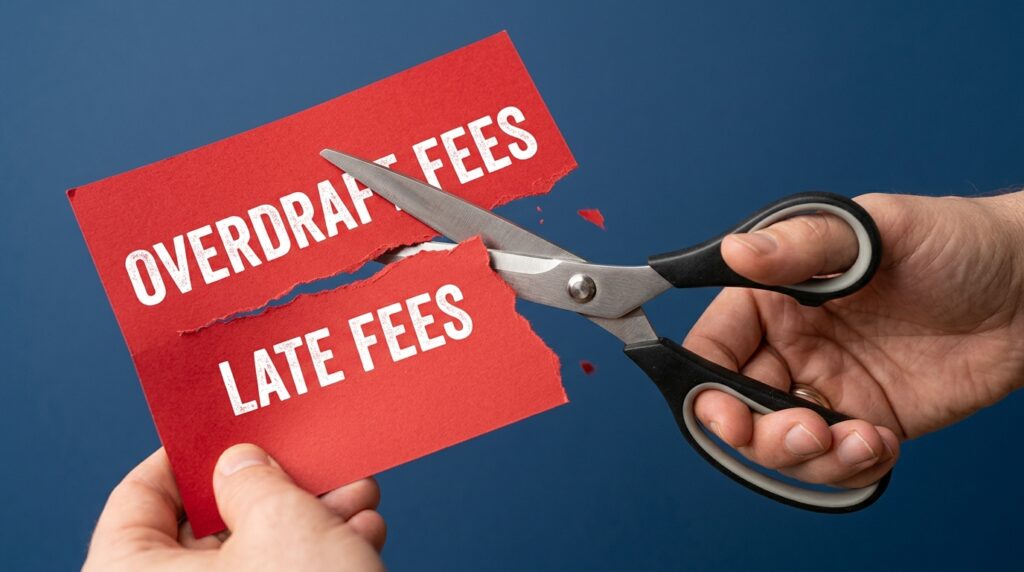
Your second major money goal is just as critical as building your emergency fund: avoiding unnecessary fees. Overdraft charges, late payment fees, and bank penalties are like hidden leaks in a sinking boat. You work hard for your money, so why let banks and credit card companies take it for absolutely nothing?
For example, many traditional banks charge thirty-five dollars or more each time your checking account goes negative. If this happens just a few times a month, you could easily lose hundreds of dollars a year to fees. Late credit card payments incur another thirty to forty dollars each time, plus the damaging effect of compounding interest and a hit to your credit score.
The solution to this problem is part awareness and part system-building. First, contact your bank and turn off overdraft protection if they allow it. While it sounds counterintuitive, declining a transaction when you have no funds is often much better than paying a thirty-five-dollar fee for a five-dollar purchase. Second, set up automatic calendar reminders for all your bills, or even better, enable autopay for at least the minimum payments on all your accounts. Third, use your newly built five-hundred-dollar cushion to avoid going negative in the first place. Eliminating these predatory fees is mathematically equivalent to giving yourself a raise. That is money you can immediately redirect toward goals that actually matter.
Step 5: Goal 3 – Open Your First Investment Account

Here is where your financial journey gets truly exciting. Your third foundational money goal is to open your very first investment account, even if you do not have much money to invest. Thanks to the modern financial innovation of fractional shares, you can now own a piece of major, stable companies or broad market index funds for as little as five or fifteen dollars.
Why does this matter so much? Because investing, not just saving, is the primary vehicle for building long-term wealth. Traditional savings accounts barely keep pace with inflation, meaning your money slowly loses purchasing power over time. Investing in a diversified portfolio of stocks or index funds allows your money to compound. Compounding is the magical financial process where your money earns money, and then those earnings earn money, too. Over years and decades, this effect snowballs into substantial, life-changing wealth.
Imagine starting with just twenty dollars a month. At a conservative seven percent annual return, that tiny, manageable habit grows into over three thousand four hundred dollars in ten years, and nearly seven thousand dollars in fifteen years. That is not bad for what most people casually spend on snacks or streaming services. The key is not the starting amount; the key is starting the habit. Opening the account and making that first fractional purchase breaks the psychological barrier to investing forever.
Step 6: Automate, Celebrate, and Keep Learnin

Once you have established your three main goals, you must implement the secret sauce of personal finance: automation. Relying on willpower alone to save or invest is highly risky, because life always gets in the way. Unexpected expenses arise, and motivation fades. However, if you set up automatic transfers—such as ten dollars a week into your emergency fund or twenty-five dollars a month into your investment account—you remove the decision-making process altogether.
Think of automation as paying your future self first. You will naturally adjust to living on the money that is left over, just as you have already adjusted to taxes being automatically deducted from your paycheck. Over time, automation builds unstoppable financial momentum without causing you any daily stress.
As you automate, it is equally important to celebrate small wins along the way. Money management can feel like a long, lonely journey if you do not acknowledge your progress. Did you save your first hundred dollars? That is a massive win. Did you avoid overdraft fees for an entire month? Another huge win. Did you finally buy your first fractional share? That is a monumental milestone. Celebrating does not mean spending money. It can be as simple as writing your achievement down in a journal, sharing your progress with a supportive friend, or treating yourself to a free reward, like a long walk in a favorite park. Recognizing these milestones keeps you motivated and reminds you that progress is happening, even when it feels slow.
Furthermore, your financial journey does not stop with these three goals; it expands as you grow. The more you learn, the more powerful you become. Start small by reading articles on budgeting, listening to podcasts about investing, or researching simple side hustles. Think of financial knowledge like learning a new language. At first, terms like “compound interest,” “expense ratios,” or “index funds” feel foreign and intimidating. But with consistent exposure, you start to understand them. Soon, they will not feel like jargon; they will feel like practical tools you can confidently use to your advantage.
Conclusion: Focus on Momentum, Not Perfection

Finally, remember this crucial principle: financial success is not about perfection. You will make mistakes along the way. You may occasionally dip into your emergency fund for a non-emergency. You may forget to pay a bill on time once. That is completely okay. What truly matters is your overall momentum.
Saving five hundred dollars, avoiding predatory fees, and starting to invest may sound like small steps, but these specific goals create the unshakable foundation for everything that comes next in your financial life. Do not wait for the “right” time. Do not wait until you make more money. Start today, even with five dollars, even with baby steps. Momentum is the real secret to wealth creation. By building a small savings cushion, staying out of unnecessary fees, and starting your first investment account, you are already firmly on the path to lasting financial security.
Frequently Asked Questions (FAQ)
1. What if I genuinely cannot save $500 right now?
If saving $500 feels impossible, lower the initial target. Start with a “micro-emergency fund” of $100 or even $50. The psychological victory of saving your first $50 is far more valuable than the paralysis of aiming for $500 and saving nothing. Once you hit $50, increase the goal to $100, then $250, and so on. The habit of saving is more important than the initial amount.
2. Is a $500 emergency fund really enough to protect me?
For beginners, yes. A $500 fund is not designed to cover a six-month job loss or a major medical catastrophe. It is specifically designed to cover the minor, unexpected hiccups of life—a blown car tire, a broken phone screen, or a sudden co-pay. By covering these small emergencies, you prevent them from turning into high-interest credit card debt, which is the primary wealth-killer for beginners.
3. How do I start investing if I have bad credit or very little money?
Your credit score does not affect your ability to open a standard brokerage account or invest in the stock market. Brokerage accounts are not credit products; you are using your own cash. Thanks to fractional shares, many modern investment platforms allow you to start investing with as little as $1 to $5. Focus on low-cost, broad-market index funds to minimize risk while you learn.
4. What is the absolute best way to avoid overdraft fees?
The most effective method is a two-pronged approach: First, call your bank and explicitly opt out of “overdraft coverage” for debit card transactions. This means if you try to buy something you cannot afford, the card will simply be declined, saving you a $35 fee. Second, set up low-balance alerts on your banking app to notify you when your account drops below a certain threshold, such as $50.
5. How long does it take to see real results from investing $20 a month?
Investing is a long-term game. At a historical average annual return of 7%, investing $20 a month will grow to roughly $3,400 in 10 years and nearly $7,000 in 15 years. While the early years may seem slow, the power of compounding accelerates over time. The true “result” is not just the final dollar amount, but the establishment of a lifelong wealth-building habit that can be scaled up as your income grows.