
Managing money does not have to be a complicated, stressful, or time-consuming chore. Imagine a financial system where your bills pay themselves, your savings grow automatically, and your investments keep working for you in the background, all without you having to lift a finger. This is the transformative power of financial automation. By setting up auto-deposits, auto-payments, and scheduled investing, you can completely eliminate decision fatigue and stay perfectly consistent with your long-term financial goals.
If you are ready to take absolute control of your money and make your finances work on autopilot, you are in the right place. Financial automation is not just a convenience; it is a foundational strategy for building lasting wealth. In this comprehensive guide, we will break down exactly how to design, implement, and maintain an automated financial system that aligns with your goals and secures your financial future.
The Psychology and Power of Financial Automation
Automation is fundamentally about creating unbreakable consistency in your financial habits. Human willpower is a finite resource. When you rely on manual transfers and manual bill payments, you are relying on your daily motivation to make the right financial choices. Over time, decision fatigue sets in, leading to procrastination, forgotten due dates, or impulsive spending decisions driven by short-term emotions.
When you automate your finances, you ensure that your savings grow steadily, your bills are paid on time, and your investments happen without hesitation. It removes the emotional friction from money management. You no longer have to juggle multiple deadlines and complex money movements in your head. This creates profound peace of mind. In short, automation turns financial discipline into a default behavior rather than something that requires constant, exhausting effort. It shifts your financial trajectory from reactive to proactive.

Step 1: Automating Your Income with Direct Deposits
The first and most crucial step in building an automated financial system is setting up your income properly at the source. Most employers now offer direct deposit, which sends your paycheck directly into your bank account. This alone saves time and ensures you receive your money on schedule, but you can take this a step further to supercharge your automation.
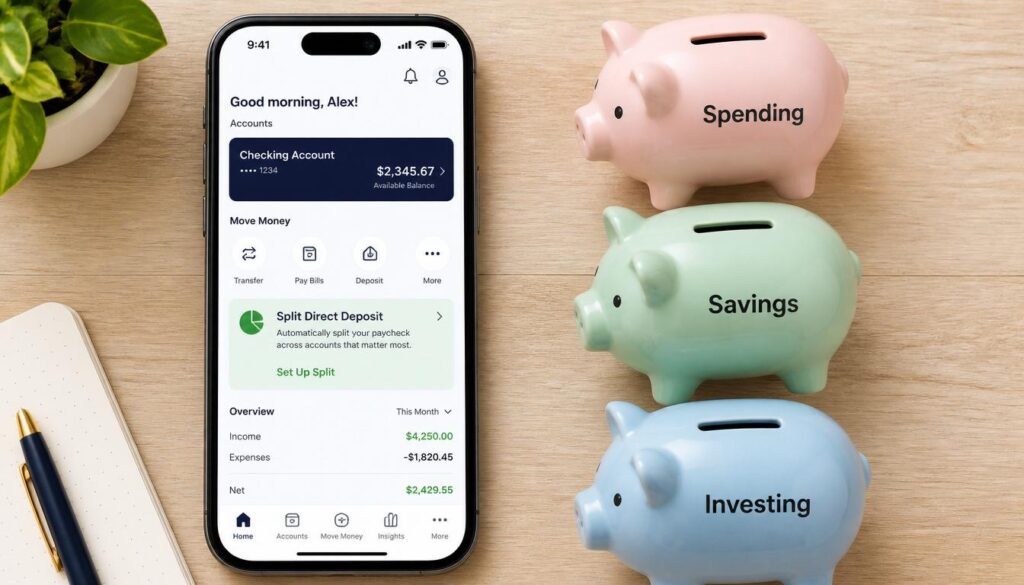
Instead of having your entire paycheck dump into a single checking account, utilize your employer’s payroll split feature to divide your income into multiple accounts automatically. For instance, you can designate a specific percentage to go directly into your primary checking account for everyday spending. Simultaneously, route another percentage directly into a high-yield savings account for your emergency fund, and send a final portion directly into your brokerage or retirement investment account.
By dividing your income at the source, you never have to manually transfer money later in the month. More importantly, you completely remove the temptation to spend money that was meant for saving or investing. This simple adjustment ensures you are always “paying yourself first” before lifestyle expenses and discretionary spending can take over.
Action Step: Contact your HR department or log into your payroll portal to set up a multi-account direct deposit split. Aim to automate at least 10% to 20% of your net income directly into savings and investments.
Step 2: Automating Bill Payments to Protect Your Credit
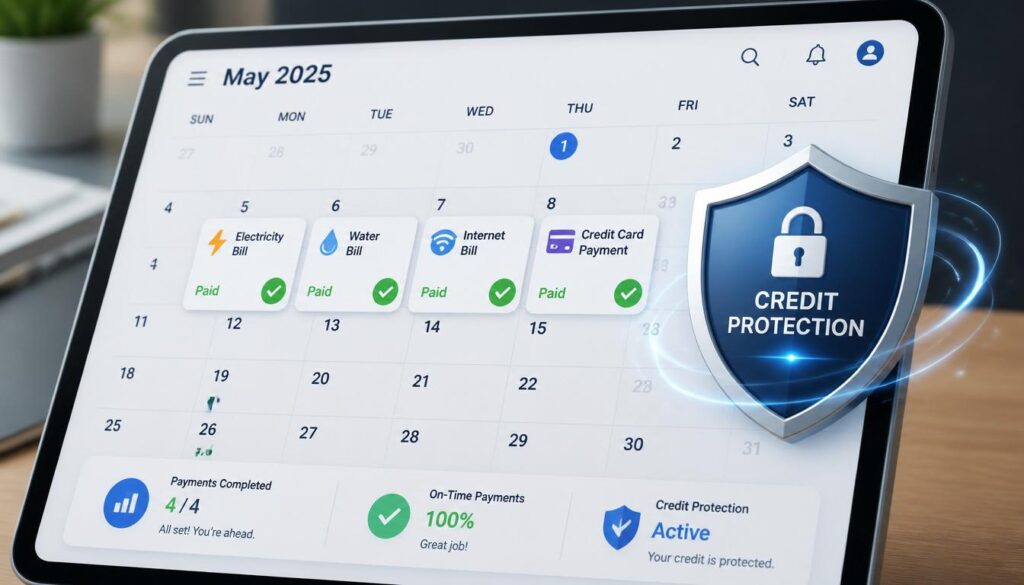
Nothing is more stressful than realizing you have missed a bill payment. Late payments not only lead to unnecessary late fees and penalty interest rates, but they can also severely damage your credit score, which takes years to rebuild. Automation solves this problem entirely and acts as a shield for your credit health.
Set up recurring, automated payments for all your fixed monthly bills, such as rent or mortgage, utilities, internet, phone, and insurance. The key strategy here is to schedule these payments for two to three days immediately after your payday. This ensures the funds are fully available in your account and the payments process without issue, avoiding any overdraft risks.
For credit cards, the strategy requires a bit more nuance. It is highly wise to automate payments for the “statement balance” or “full balance” each month, rather than just the minimum payment. Paying the full balance automatically keeps you entirely debt-free, prevents interest charges from accruing, and helps build a strong credit history over time. Once your bill payments are automated, you no longer have to worry about deadlines sneaking up on you. You free up mental energy to focus on more important wealth-building goals.
Action Step: Log into every utility, subscription, and credit card account. Set them to auto-pay the full statement balance a few days after your typical payday.
Step 3: Automating Savings for Short-Term Security
Saving money is often one of the hardest habits to build because it traditionally relies on sheer willpower. Many people wait until the end of the month to save whatever is “left over,” only to find there is absolutely nothing left at all. Automation flips this psychological process by treating your savings like a non-negotiable bill that must be paid.
If you did not set up automatic savings directly through your payroll (as discussed in Step 1), you must schedule automatic transfers from your checking account to your savings account on payday. This ensures that saving always comes first. Over time, these small but consistent transfers grow into a substantial financial safety net without you ever feeling the pinch in your daily checking account balance.
Beyond building a standard emergency fund (which should cover three to six months of living expenses), you can use automation to create multiple sub-savings accounts for specific goals. Many banks allow you to create “sinking funds” or goal-based buckets for travel, home improvements, a new car, or holiday spending. With automation, progress toward these goals happens effortlessly in the background, and you are never left scrambling to come up with cash at the last minute.
Action Step: Open a High-Yield Savings Account (HYSA) if you haven’t already. Set up an automatic weekly or bi-weekly transfer that aligns with your pay schedule, starting with an amount that feels comfortable but still pushes you toward your goals.

Step 4: Automating Investments for Long-Term Wealth
If saving ensures you are secure in the short term, investing ensures you build substantial wealth in the long term. Yet, many people hesitate to invest regularly because they are uncertain about market timing, fear losing money, or simply forget to make their monthly contributions. Automation removes that hesitation entirely through scheduled investing.
With employer-sponsored retirement plans like a 401(k) or 403(b), money is deducted directly from your paycheck before it even reaches your bank account. This is one of the simplest and most effective forms of automation. Ensure you are contributing at least enough to get your full employer match, as this is essentially free money.
For individual accounts such as an IRA (Individual Retirement Account) or a standard taxable brokerage account, you can set up recurring monthly contributions that move money automatically from your bank to your investment account. This strategy is known as Dollar-Cost Averaging (DCA). DCA allows you to invest a fixed amount at regular intervals regardless of market fluctuations. Over time, this builds ironclad discipline and protects you from making emotional, panic-driven decisions based on short-term market movements. You buy more shares when prices are low and fewer when prices are high, averaging out your cost basis.
Today, many robo-advisors and modern investment apps make this process even easier. They automatically allocate your money into diversified, low-cost index fund portfolios based on your risk tolerance and automatically reinvest your dividends for you, compounding your growth effortlessly.
Action Step: Set up an automatic monthly transfer to your IRA or brokerage account. If you are a beginner, consider using a robo-advisor or setting up automatic investments into a broad-market S&P 500 index fund or a target-date retirement fund.

Step 5: Automating Debt Repayment
For those carrying debt, automation can be a incredibly powerful tool to accelerate repayment and avoid falling further behind. The simplest first step is to automate your minimum payments so you never risk late fees, penalty APRs, or damage to your credit score.
Once your minimums are automated, you can add extra recurring payments to reduce the principal balance much more quickly. You can choose between two popular strategies: the Debt Snowball method, where you automate extra payments toward the smallest balances first for psychological wins, or the Debt Avalanche method, where you target the highest interest rates first to save the most money mathematically.
Whichever method you choose, automation ensures your plan stays on track month after month. You can set up a separate, recurring automatic transfer specifically designated for “extra debt payment” a few days after payday. By sticking to an automated repayment schedule, you gradually and relentlessly chip away at your balances without having to think about it constantly or rely on monthly motivation.
Action Step: Automate the minimum payment for all your debts. Then, set up one additional automatic monthly transfer directed specifically to the principal of your highest-interest debt or smallest balance, depending on your chosen payoff strategy.

Maintenance: Reviewing and Adjusting Your System
It is crucial to understand that automation does not mean you can completely forget about your finances forever. Life changes, income fluctuates, and your financial system needs to adapt with you. That is why it is essential to review your automated setup periodically.
A quarterly review (every three months) is usually sufficient to confirm that your payments, transfers, and investments are all happening as planned. Check your bank statements to ensure no subscriptions have crept up, verify that your automated transfers didn’t cause any overdrafts, and confirm your investment allocations are on track.
An annual review allows you to make larger, strategic adjustments. If you receive a raise, use this time to increase your automated savings and investment contributions. If you have paid off a specific debt, redirect that automated payment toward your next financial goal. You should also rebalance your investment portfolio annually to maintain your desired asset allocation. Think of financial automation like a well-designed irrigation system for a garden: it waters the plants reliably, but you still need to check the hoses occasionally to make sure there are no leaks and everything is working properly.
Action Step: Put a recurring calendar reminder in your phone for the first weekend of every quarter to do a 30-minute “Financial Autopilot Check-in,” and a more comprehensive 2-hour review at the end of every year.

Common Pitfalls to Avoid in Financial Automation
While automation is incredibly powerful, it can lead to significant problems if it is not managed correctly. Awareness of these pitfalls is key to maintaining a healthy financial system.
One common mistake is over-automating without any oversight. If you literally never check your accounts, you may miss unexpected changes, unauthorized charges, or banking errors. Automation should free up your time, not make you blind to your financial reality.
Another major mistake is failing to leave a buffer in your checking account to cover automated payments. If your account balance dips too low when an auto-payment triggers, you will be hit with costly overdraft fees, completely defeating the purpose of your system. Always maintain a “buffer” of $500 to $1,000 in your checking account that you do not count as spendable cash.
Furthermore, automating only the minimum payments on credit cards can be financially dangerous. While it protects your credit score from late marks, it prolongs your debt for years and costs you a fortune in interest. Always automate the full statement balance if possible.
Finally, beware of “subscription creep.” When you automate payments, it is easy to forget about unused gym memberships, streaming services, or app subscriptions. This is why your quarterly reviews are so important. Automation is not about giving up control of your money; it is about designing a system that aligns with your goals and runs reliably in the background. Once you experience the peace of mind it brings, you will wonder why you ever tried to manage your money manually.
Conclusion
By automating your finances like a professional, you set yourself up for long-term, compounding success while freeing your mental energy to focus on the things that truly matter in life—your family, your career, and your passions. With auto-deposits, bill payments, automated savings, scheduled investing, and structured debt repayment in place, you are not just saving time. You are building wealth with significantly less stress and vastly more consistency.
Financial automation transforms your relationship with money. It removes the emotion, eliminates the friction, and builds a reliable bridge between your current financial reality and your ultimate financial freedom. Take the time this week to set up just one automated transfer. Then build upon it. Your future self will thank you for the systems you put in place today.
Frequently Asked Questions (FAQ)
1. How much of my income should I automate into savings and investments?
A widely recommended baseline is the 50/30/20 rule, where 20% of your net income goes toward savings and investments. However, the exact percentage depends on your specific goals and cost of living. Start with a comfortable amount, such as 5% or 10%, and gradually increase your automated contributions by 1% every few months or whenever you receive a raise, until you reach your target savings rate.
2. Is it safe to automate all my bill payments?
Yes, it is generally very safe and highly recommended to automate fixed, predictable bills like rent, utilities, and insurance. For variable bills that fluctuate monthly (like electricity), you can still use auto-pay, but ensure you leave a sufficient buffer in your checking account to cover the highest possible monthly amount to avoid overdrafts. Always monitor your statements to ensure the charged amounts are accurate.
3. What is the difference between automating savings and automating investments?
Automating savings involves moving money into liquid, low-risk accounts (like a High-Yield Savings Account) for short-term goals and emergency funds; the principal is protected and easily accessible. Automating investments involves moving money into the stock market, bonds, or retirement accounts (like IRAs or 401ks) for long-term wealth building. Investments carry market risk and should not be touched for 5 to 10+ years, but they offer the potential for compound growth that outpaces inflation.
4. How often should I review my automated financial system?
You should perform a quick “health check” of your accounts quarterly (every three months) to ensure all automated transfers are processing correctly, no unauthorized subscriptions are charging you, and your checking account buffer is intact. A more comprehensive, deep-dive review should be done annually to adjust your contribution percentages, rebalance your investment portfolio, and align your automation with any new life goals.
5. Can automation help me get out of debt faster?
Absolutely. Automation removes the temptation to skip a payment or spend the money elsewhere. By automating your minimum payments, you protect your credit score. By setting up an additional, automated recurring transfer specifically for “extra principal payments,” you systematically reduce your debt balance much faster than making manual, sporadic payments, ultimately saving you thousands of dollars in interest over the life of the loan.