Why a Roth IRA Deserves a Spot in Your Financial Toolkit
Most people think of retirement accounts as complicated, restrictive, and boring. The Roth IRA shatters every one of those assumptions. It is one of the few financial vehicles that lets your money compound for decades and then hands every single dollar back to you without the IRS taking a cut. No tax on dividends. No tax on capital gains. No tax on withdrawals in retirement. Just pure, uninterrupted growth that belongs entirely to you.
Whether you are just landing your first paycheck, climbing the career ladder, or rethinking your retirement strategy, understanding how a Roth IRA works can fundamentally change the trajectory of your financial life. This guide walks you through every essential aspect—from the basic mechanics to advanced strategies—so you can decide whether this account is the right fit for your goals.
What Exactly Is a Roth IRA?
A Roth IRA, short for Roth Individual Retirement Account, is a tax-advantaged investment account designed specifically for long-term retirement savings. Created through the Taxpayer Relief Act of 1997 and named after the late Senator William Roth of Delaware, this account flipped the traditional retirement savings model on its head.
Here is the core principle: you fund a Roth IRA with money you have already paid taxes on. In exchange, the government promises that every dollar of growth—dividends, interest, capital appreciation—can be withdrawn completely tax-free once you meet the qualifying conditions. You pay the tax bill today, while your balance is relatively small, and you sidestep taxes forever on what could become a substantially larger sum.
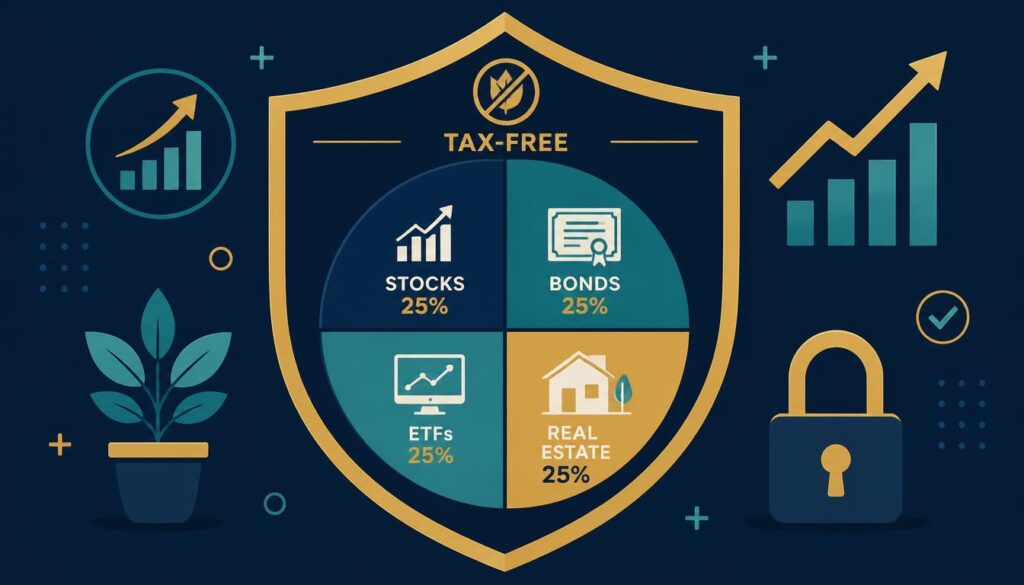
The account itself is not an investment. Think of it as a tax-sheltered container. Inside that container, you can hold stocks, bonds, exchange-traded funds, mutual funds, real estate investment trusts, and in some cases even alternative assets through a self-directed Roth IRA. The flexibility is remarkable, and it puts you firmly in the driver’s seat of your own retirement strategy.
One often-overlooked perk is liquidity. Unlike many retirement accounts that lock your money away, a Roth IRA allows you to withdraw your original contributions—though not the earnings—at any time, for any reason, without taxes or penalties. That safety net makes it far less intimidating for first-time investors who worry about locking their cash away for forty years.
Roth IRA vs. Traditional IRA: Understanding the Critical Difference
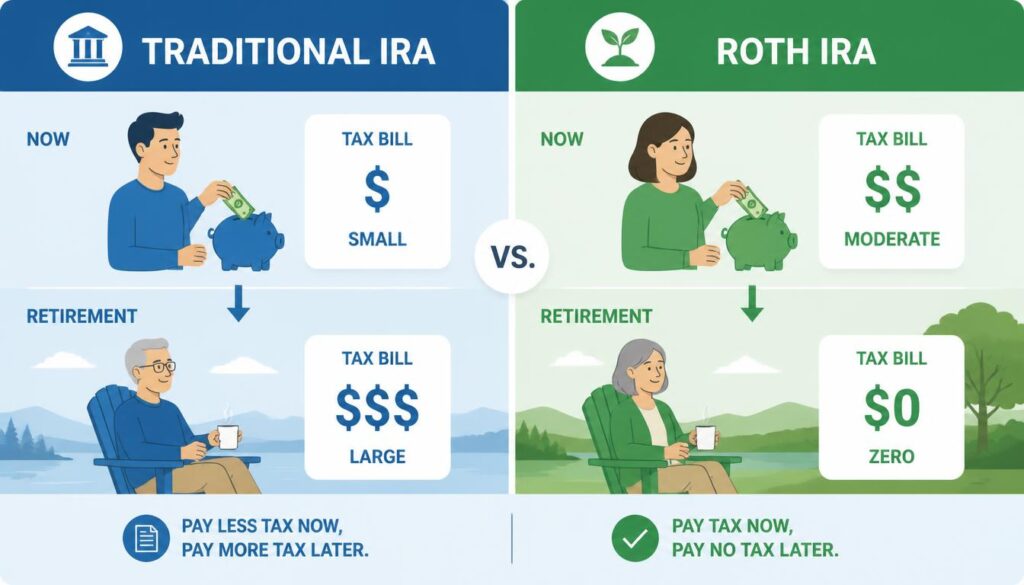
The debate between a Roth IRA and a Traditional IRA comes down to one question: when do you want to pay taxes?
With a Traditional IRA, you typically contribute pre-tax dollars, lowering your taxable income today. The trade-off is that every withdrawal in retirement is taxed as ordinary income. With a Roth IRA, the sequence reverses. You contribute after-tax dollars now, and withdrawals in retirement are entirely tax-free.
This timing difference has enormous implications. If you expect your income—and therefore your tax bracket—to rise over your career, the Roth IRA lets you lock in today’s lower rate. You pay tax on a smaller balance now rather than on a much larger, fully grown portfolio later.
Another major distinction involves Required Minimum Distributions. Traditional IRAs force you to start withdrawing funds at age 73, whether you need the money or not. Those mandatory withdrawals are taxed and can push you into a higher bracket. Roth IRAs have no such requirement. Your money can keep compounding for as long as you live, and you can pass it to heirs who will also enjoy tax-free distributions under current rules.
For younger savers, early-career professionals, or anyone anticipating higher future earnings, the Roth IRA typically delivers superior long-term value. You are essentially pre-paying your tax liability at the lowest possible rate and then letting decades of compound growth work entirely in your favor.
Contribution Rules and Income Limits You Need to Know
The IRS sets annual caps on how much you can contribute to a Roth IRA. If you are under 50, the standard contribution limit applies. Once you turn 50, a catch-up provision kicks in, allowing an additional contribution to help accelerate your savings in the final stretch before retirement.
However, not everyone qualifies for the full contribution. Eligibility phases out based on your Modified Adjusted Gross Income. Single filers and married couples filing jointly face different thresholds, and once your income exceeds the upper limit, you cannot make direct Roth IRA contributions at all. If your income falls within the phase-out range, your allowable contribution is reduced proportionally.
A few important rules to keep in mind:
- Earned income requirement. Contributions must come from wages, salaries, tips, or self-employment earnings. Passive income such as rental revenue, dividends, or interest does not qualify.
- Tax-year deadline flexibility. You can contribute for a given tax year up until the tax filing deadline of the following year, usually mid-April. This gives you extra breathing room if you had a strong financial quarter late in the year.
- No double-dipping. The combined contribution limit across all your IRAs—Roth and Traditional together—cannot exceed the annual cap.
If your income exceeds the direct contribution limit, a strategy known as the “Backdoor Roth IRA” may still allow you to benefit. This involves making a non-deductible Traditional IRA contribution and then converting it to a Roth. Consult a tax professional before executing this maneuver, as the pro-rata rule can complicate things if you hold other pre-tax IRA assets.
The Tax Advantages That Make a Roth IRA a Wealth Multiplier
The headline benefit is obvious: tax-free withdrawals. But the true power of a Roth IRA reveals itself over time through the magic of compound growth.
Consider a simplified scenario. You invest a total of $50,000 over several years. Thanks to consistent market returns and reinvested dividends, that balance grows to $300,000 by the time you retire. In a taxable brokerage account, you would owe capital gains tax on the $250,000 of growth. In a Traditional IRA, you would owe ordinary income tax on the full $300,000 withdrawal. In a Roth IRA, you withdraw the entire $300,000 and owe exactly zero.
Beyond the headline number, Roth IRAs offer several secondary tax benefits:
- No Required Minimum Distributions. You control when and how much you withdraw, which helps you manage your taxable income in retirement and potentially stay in a lower tax bracket.
- Social Security tax shield. Roth withdrawals do not count as taxable income for the purpose of determining whether your Social Security benefits are taxed. This alone can save retirees thousands annually.
- Tax-free rebalancing. You can buy, sell, and reallocate investments inside the account without triggering capital gains events. In a taxable account, every rebalance can create a tax bill. Inside a Roth IRA, you trade freely.
- Dividend reinvestment without tax drag. Every dividend that would normally be taxed in a brokerage account instead compounds silently inside your Roth, accelerating growth year after year.
Over a thirty- or forty-year investing horizon, these advantages can translate into tens of thousands—sometimes hundreds of thousands—of additional dollars compared to taxable or tax-deferred alternatives.

Withdrawal Rules: Flexibility With a Few Guardrails
One of the reasons people hesitate to open a Roth IRA is the fear of locking money away. The reality is more nuanced and far more flexible than most realize.
Contributions come out free, anytime. The money you put in can be withdrawn at any age, for any reason, without taxes or penalties. This makes the Roth IRA a reasonable secondary emergency fund, though tapping it should still be a last resort.
Earnings have strings attached. To withdraw investment gains tax-free and penalty-free, you generally need to be at least 59 and a half years old and the account must have been open for at least five years. Pull earnings before meeting both conditions, and you face ordinary income tax plus a 10 percent early withdrawal penalty.
There are, however, exceptions to the penalty rule. Qualified first-time home purchases (up to a lifetime cap of $10,000), certain higher education expenses, and permanent disability can all allow early access to earnings without the 10 percent penalty, though income tax may still apply in some cases.
The five-year rule deserves special attention. Each contribution and each Roth conversion starts its own five-year clock. If you execute a Backdoor Roth conversion, for instance, that converted amount has a separate five-year holding period before it can be withdrawn penalty-free. Tracking these timelines is essential to avoid surprise tax bills.
The practical takeaway: treat your Roth IRA primarily as a long-term growth engine. The flexibility is a bonus, not the main event.
What Can You Actually Invest In?
Because a Roth IRA is an account wrapper rather than a single investment, your options inside it are broad. Most major brokerages let you build a portfolio that includes:
- Individual stocks for targeted growth
- Broad-market and sector ETFs for diversified, low-cost exposure
- Mutual funds for professionally managed portfolios
- Bonds and bond funds for income and stability
- REITs for real estate exposure without buying property
- Target-date funds for a hands-off, auto-rebalancing approach
- Alternative assets through self-directed Roth IRAs, including certain real estate, precious metals, or private placements
Your allocation should reflect your age, risk tolerance, and timeline. A 25-year-old with four decades until retirement can afford a heavily equity-weighted portfolio focused on growth. Someone five years from retirement might shift toward bonds and dividend-paying stocks to preserve capital.
The key advantage over a taxable account is that every rebalance, every dividend reinvestment, and every capital gain inside the Roth IRA happens without a tax event. You can adjust your strategy freely as your life changes without worrying about an April tax surprise.
Who Benefits Most From a Roth IRA?
Almost anyone with earned income can benefit, but certain profiles gain disproportionate advantages:
Young professionals in lower tax brackets. Locking in a low tax rate today and letting 30 to 40 years of compounding work tax-free is arguably the most powerful financial decision a young earner can make.
Anyone expecting significant income growth. If your salary is likely to climb, paying tax at today’s lower rate beats paying tax on withdrawals when you are in a peak earning bracket.
Retirees who want income flexibility. No RMDs mean you can leave the money growing and withdraw only what you need, keeping your taxable income lean and potentially reducing Medicare premiums and Social Security taxation.
Estate planners. Heirs who inherit a Roth IRA can take tax-free distributions over their life expectancy, making it one of the most tax-efficient assets you can pass down.
Investors with taxable brokerage accounts. Converting a portion of taxable investments into a Roth during low-income years can reduce future capital gains exposure and simplify tax filing in retirement.
How to Open and Manage Your Roth IRA
Getting started is simpler than most people expect. Major brokerages such as Vanguard, Fidelity, Charles Schwab, and robo-advisor platforms like Betterment and Wealthfront all offer Roth IRAs with low or zero account minimums.
Step-by-step process:
- Choose a provider. Compare expense ratios, available investment options, account fees, and user interface. For beginners, a platform with low-cost index funds and educational resources is ideal.
- Gather documentation. You will need your Social Security number, proof of earned income, and basic personal information.
- Fund the account. Link your bank and set up either a lump-sum deposit or recurring automatic contributions. Even $50 or $100 per month builds momentum.
- Select your investments. Do not leave the money in a cash settlement fund. Choose a target-date fund, a simple three-fund portfolio, or a selection of ETFs aligned with your risk tolerance.
- Automate and forget. Set contributions to coincide with your payday so saving happens before you can spend.
- Review annually. Rebalance if your allocation drifts, update beneficiaries, and confirm you remain within income eligibility limits.
Consistency beats perfection. A modest monthly contribution invested in a low-cost index fund, left untouched for decades, can grow into a six-figure nest egg entirely free of taxes.

Conclusion: Start Small, Think Long, Keep Every Penny
The Roth IRA is not a get-rich-quick scheme. It is something far more reliable: a disciplined, tax-efficient framework that rewards patience and consistency. By contributing after-tax dollars today, you eliminate the single biggest drag on long-term wealth—taxes on growth—and give compound interest the runway it needs to work its full magic.
The account’s flexibility, from penalty-free contribution withdrawals to the absence of required minimum distributions, makes it suitable for nearly every stage of financial life. Whether you are 22 and just opened your first brokerage account or 55 and re-evaluating your retirement income strategy, the Roth IRA earns its place at the table.
The most important step is the first one. Open the account. Set up the automatic transfer. Buy the first fund. Then let time do the heavy lifting. Your future self, withdrawing tax-free income on a Tuesday afternoon with zero obligation to the IRS, will thank you profoundly for starting today.
Frequently Asked Questions
1. Can I withdraw money from my Roth IRA before retirement without penalties?
Yes, you can withdraw your original contributions at any time, tax-free and penalty-free, regardless of your age. However, withdrawing investment earnings before age 59 and a half and before the account has been open for five years typically triggers income tax and a 10 percent penalty, unless you qualify for an exception such as a first-time home purchase, qualified education expenses, or permanent disability.
2. What happens if my income is too high to contribute directly to a Roth IRA?
If your Modified Adjusted Gross Income exceeds the IRS threshold, you cannot make a direct Roth IRA contribution. However, you may still benefit through a strategy commonly called the Backdoor Roth IRA. This involves making a non-deductible contribution to a Traditional IRA and then converting it to a Roth IRA. Because the conversion rules include a pro-rata calculation, it is wise to consult a tax advisor before proceeding, especially if you hold other pre-tax IRA balances.
3. Is a Roth IRA better than a Traditional IRA for young investors?
In most cases, yes. Young investors are typically in lower tax brackets, so paying taxes on contributions now costs less than paying taxes on a much larger balance in retirement. Additionally, a younger investor has more decades of tax-free compound growth ahead, magnifying the Roth advantage. The absence of Required Minimum Distributions also gives young savers greater long-term flexibility.
4. Do I have to invest my Roth IRA contributions, or can the money sit in cash?
You are not required to invest the funds immediately, but leaving contributions in a cash or money-market settlement fund means you are missing out on the account’s primary benefit: tax-free growth. To maximize the Roth IRA’s potential, allocate contributions to stocks, ETFs, mutual funds, or other investments aligned with your risk tolerance and timeline. Even a simple target-date fund keeps your money working while requiring minimal management.
5. Can I have both a Roth IRA and a Traditional IRA at the same time?
Absolutely. There is no rule preventing you from holding both types of accounts simultaneously. The only restriction is that the combined annual contributions across all your IRAs cannot exceed the IRS contribution limit. Many investors use a blended strategy, contributing to a Traditional IRA for the immediate tax deduction and to a Roth IRA for long-term tax-free growth, effectively diversifying their tax exposure in retirement.