
Stepping into the world of investing can feel like trying to navigate a complex maze without a map. The financial markets are filled with jargon, fluctuating trends, and an overwhelming amount of information that can easily paralyze a novice. However, the most successful investors share a common trait: they are relentless learners. Before risking a single dollar in the stock market, the smartest move you can make is to invest in your own financial education.
The right book can fundamentally shift your perspective on money, transforming you from a hesitant saver into a confident wealth-builder. Whether you are interested in the deep analytical world of value investing, the hands-off approach of index funds, or the psychological mindset required to build lasting wealth, there is a foundational text designed to guide you.
This comprehensive guide explores the best investing books for beginners. Each of these timeless resources offers practical advice, expert insights, and proven strategies to help you grow your wealth over time. By the end of this guide, you will have a curated reading list tailored to help you achieve financial success, regardless of your starting income or current knowledge level.
1. The Intelligent Investor by Benjamin Graham
Often referred to as the “bible of value investing,” The Intelligent Investor by Benjamin Graham is arguably the most celebrated investing book of all time. Warren Buffett himself has called it “by far the best book on investing ever written.” Graham, who is widely recognized as the father of value investing, provides a profound deep dive into the philosophy of investing with a strict focus on long-term value rather than short-term speculation.
Core Concepts
The book introduces two of the most critical concepts in finance: “Mr. Market” and the “Margin of Safety.” Graham personifies the stock market as a manic-depressive business partner named Mr. Market, who offers to buy or sell shares at wildly fluctuating prices every day. The intelligent investor learns to ignore Mr. Market’s daily emotional swings and only takes advantage of his irrational pricing. Furthermore, the concept of the “Margin of Safety” teaches beginners to only buy stocks when their market price is significantly lower than their intrinsic, calculated value. This buffer protects the investor against errors in judgment and unexpected market volatility.
Key Takeaways
- Investing vs. Speculating: Graham draws a hard line between true investing (thorough analysis promising safety of principal and adequate return) and speculating (betting on price movements).
- Emotional Discipline: The biggest enemy of the investor is likely to be themselves. Learning to avoid emotional decision-making is an essential principle for long-term success.
- Defensive vs. Enterprising: The book provides distinct strategies for the “defensive” investor (who wants safety and freedom from effort) and the “enterprising” investor (who is willing to put in serious work to beat the market).
Who Should Read It?
This book is essential for beginners who want to understand the fundamental philosophy of the stock market. It is highly recommended for those who want to learn how to analyze stocks, read financial statements, and develop a rational, unemotional investment strategy.
2. A Random Walk Down Wall Street by Burton G. Malkiel
If Graham teaches you how to pick individual stocks, Burton G. Malkiel’s A Random Walk Down Wall Street will challenge the very premise that stock picking works at all. In this seminal work, Malkiel presents the “random walk” theory, which posits that short-term stock price movements are entirely unpredictable and follow a random path.
Core Concepts
Malkiel introduces beginners to the Efficient Market Hypothesis (EMH), which suggests that asset prices already reflect all available information, making it impossible to consistently “beat the market” through stock selection or market timing. The book provides a comprehensive overview of various investment vehicles, including stocks, bonds, real estate, and commodities, but ultimately steers the reader toward a specific, highly effective conclusion.
Key Takeaways
- The Futility of Market Timing: Malkiel uses historical data to demonstrate that trying to time the market is a fool’s errand that usually results in underperformance.
- The Case for Index Funds: He argues passionately that beginners and seasoned investors alike are better off focusing on low-cost, broadly diversified index funds rather than paying high fees for actively managed funds.
- Diversification is Crucial: Spreading your money across different asset classes is the only “free lunch” in investing, significantly reducing risk without necessarily sacrificing long-term returns.
Who Should Read It?
This is the perfect book for the analytical beginner who wants to understand market theories and behavioral finance. It is especially valuable for those who are tempted to day-trade or follow hot stock tips, as it provides the empirical evidence needed to steer them toward a more reliable, passive strategy.

3. The Little Book of Common Sense Investing by John C. Bogle
John C. Bogle, the founder of the Vanguard Group and the creator of the first retail index fund, revolutionized the investing world. The Little Book of Common Sense Investing is a concise, straightforward guide that distills decades of financial wisdom into a single, undeniable truth: don’t look for the needle in the haystack; just buy the haystack.
Core Concepts
Bogle’s central thesis revolves around the “cost matters hypothesis.” He explains the mathematical certainty that, as a group, investors must underperform the market by the exact amount of money they pay in fees, transaction costs, and taxes. Actively managed funds charge high expense ratios and incur high turnover costs, which silently devour compound interest over time.
Key Takeaways
- The Power of Low Costs: Bogle demonstrates through extensive data that low-cost index funds consistently outperform the vast majority of actively managed funds over long time horizons.
- Reversion to the Mean: High-performing mutual funds eventually revert to the average, meaning past performance is not indicative of future results.
- Keep It Simple: The most effective way to build wealth is to buy a broadly diversified, low-cost total stock market index fund and hold it forever.
Who Should Read It?
This book is an absolute must-read for beginners who want to adopt a hands-off, highly effective approach to investing. If you want to spend less time worrying about the market and more time enjoying your life while your wealth steadily grows, Bogle’s common-sense approach is the ultimate guide.
4. Rich Dad Poor Dad by Robert T. Kiyosaki
While the previous books focus heavily on the mechanics of the stock market, Robert Kiyosaki’s Rich Dad Poor Dad is a powerful introduction to the overarching mindset of successful wealth builders. It is not strictly a technical investing manual, but rather a foundational text on financial literacy and entrepreneurship.
Core Concepts
Kiyosaki contrasts the financial philosophies of his two “dads”: his biological father (the “Poor Dad,” who was highly educated but struggled financially) and his best friend’s father (the “Rich Dad,” who was an entrepreneur and investor). The core lesson is the critical difference between an asset and a liability. Kiyosaki defines an asset simply as something that puts money in your pocket, and a liability as something that takes money out of your pocket.
Key Takeaways
- Mindset Shift: The wealthy do not work for money; they make money work for them. Shifting from an employee mindset to an investor mindset is the first step to wealth.
- Financial Education: Schools teach us how to be good employees, but not how to manage money. Taking responsibility for your own financial education is paramount.
- Passive Income and Cash Flow: True wealth is measured not by your salary, but by your passive income from assets like real estate, businesses, and dividend-paying stocks.
Who Should Read It?
This book is ideal for beginners who need a massive psychological shift regarding money. If you are stuck in the “rat race” of living paycheck to paycheck, or if you view your primary residence as your greatest investment, this book will completely rewire your financial worldview.
5. The Millionaire Next Door by Thomas J. Stanley and William D. Danko
We are often conditioned by media and society to believe that millionaires drive exotic sports cars, wear designer watches, and live in massive mansions. The Millionaire Next Door shatters this illusion by presenting the empirical reality of how wealth is actually accumulated in America.
Core Concepts
Through years of extensive research and surveys, Stanley and Danko discovered that the vast majority of millionaires do not live in Beverly Hills; they live in middle-class neighborhoods. They drive used cars, clip coupons, and wear inexpensive suits. The authors categorize people into “Prodigious Accumulators of Wealth” (PAWs) and “Under Accumulators of Wealth” (UAWs), showing that high income does not automatically equal high wealth.
Key Takeaways
- Live Below Your Means: The foundation of wealth is spending significantly less than you earn and investing the difference.
- Avoid Lifestyle Creep: As your income rises, your expenses should not rise at the same rate. Time, energy, and money should be allocated toward wealth-building, not conspicuous consumption.
- Targeted Investing: Successful millionaires invest their money efficiently, often in their own businesses or in standard, diversified market investments, prioritizing long-term financial independence over looking rich.
Who Should Read It?
This book is a crucial reality check for beginners. It is highly recommended for young professionals experiencing a sudden increase in income who are tempted to upgrade their lifestyle. It teaches the invaluable discipline of frugality and the importance of prioritizing net worth over social status.

6. The Simple Path to Wealth by JL Collins
For many beginners, the world of investing is intentionally complicated by financial advisors and Wall Street firms looking to sell complex products. JL Collins’ The Simple Path to Wealth strips away all the noise and offers a beautifully simple, highly effective roadmap to financial independence.
Core Concepts
Originally written as a series of letters to the author’s teenage daughter, the book focuses on the concept of “F-You Money”—having enough wealth invested that you are never forced to do anything you don’t want to do. Collins advocates for a radically simple investment strategy: save a high percentage of your income and invest it entirely in a low-cost total stock market index fund (specifically highlighting VTSAX).
Key Takeaways
- Simplicity Wins: You do not need to understand complex derivatives, options, or macroeconomic trends to become wealthy. A single, broadly diversified index fund is all you need.
- Overcoming Fear: Collins addresses the psychological barriers to investing, particularly the fear of market crashes. He teaches that when the market drops, you should not panic; you should simply keep buying.
- The 4% Rule: The book provides a clear framework for the withdrawal phase of investing, explaining how to safely draw down your portfolio in retirement without running out of money.
Who Should Read It?
This is arguably the most accessible and actionable book on this list. It is perfect for beginners who feel completely overwhelmed by financial jargon and want a straightforward, step-by-step formula to achieve early retirement and financial freedom.
7. One Up On Wall Street by Peter Lynch
While passive index investing is the best strategy for the majority of people, some beginners are naturally drawn to the thrill of picking individual stocks. If you fall into this category, Peter Lynch’s One Up On Wall Street is the ultimate guide. Lynch managed the legendary Magellan Fund at Fidelity, achieving an astonishing average annual return of 29.2% over 13 years.
Core Concepts
Lynch’s central premise is that everyday investors have a distinct advantage over Wall Street professionals. Institutional investors are bogged down by bureaucracy, herd mentality, and strict research parameters. The amateur investor, however, can spot trends in their daily life long before Wall Street analysts do. If you notice a new product flying off the shelves at your local mall, or a restaurant that is always packed, you have found a potential “tenbagger” (a stock that goes up tenfold).
Key Takeaways
- Invest in What You Know: Use your personal experiences and observations to identify promising companies before the professionals do.
- Do Your Homework: “Investing in what you know” doesn’t mean buying blindly. You must still research the company’s financials, debt levels, competitive advantage, and growth potential.
- Categorize Your Stocks: Lynch teaches investors to categorize companies (e.g., slow growers, stalwarts, fast growers, cyclicals, turnarounds, asset plays) so you know what to expect from each investment.
Who Should Read It?
This book is essential for beginners who want to actively manage a portion of their portfolio by picking individual stocks. It is highly encouraging, demystifying the stock-picking process and empowering the everyday consumer to become a successful investor.
8. The Bogleheads’ Guide to Retirement Planning by Taylor Larimore, Mel Lindauer, and Michael LeBoeuf
While many books focus on the accumulation phase of wealth, The Bogleheads’ Guide to Retirement Planning specifically targets the endgame: retiring comfortably. Based on the principles of John Bogle, this book is a comprehensive, step-by-step manual for navigating the complexities of retirement.
Core Concepts
The “Bogleheads” are a community of investors who follow the principles of John Bogle. This book takes those principles and applies them specifically to retirement accounts, tax optimization, and asset allocation. It covers the intricate details of 401(k)s, IRAs, Roth conversions, and Social Security optimization, ensuring that you keep as much of your money as legally possible.
Key Takeaways
- Tax Efficiency: It is not just about what you earn; it is about what you keep. The book explains how to place the right investments in the right accounts (asset location) to minimize your lifetime tax burden.
- The Three-Fund Portfolio: The authors advocate for a simple, three-fund portfolio (Total US Stock Market, Total International Stock Market, and Total Bond Market) that can be adjusted as you age.
- Behavioral Coaching: A major focus of the book is preparing investors psychologically for the transition from accumulating wealth to spending it, helping them avoid the fear of outliving their money.
Who Should Read It?
This book is ideal for beginners who are specifically focused on long-term retirement planning. It is also highly valuable for those who are a bit older and need to accelerate their retirement planning, consolidate accounts, or optimize their current portfolio for tax efficiency.

How to Choose the Right Book for Your Journey
With eight incredible books at your disposal, you might be wondering where to begin. The best approach is to align your reading with your current financial goals and personality type.
- For the Absolute Beginner Needing a Mindset Shift: Start with Rich Dad Poor Dad to understand the philosophy of wealth, followed by The Simple Path to Wealth to get a clear, actionable roadmap for investing.
- For the Analytical Thinker: If you want to understand the deep mechanics of the market, read The Intelligent Investor for value principles and A Random Walk Down Wall Street for market theory.
- For the Frugal Saver: If you are great at saving but terrified of investing, The Millionaire Next Door will validate your habits, while The Little Book of Common Sense Investing will give you the confidence to put your savings into the market.
- For the Aspiring Stock Picker: If you want to be actively involved in selecting companies, One Up On Wall Street will teach you how to do it intelligently.
- For the Long-Term Planner: If your primary goal is ensuring a comfortable retirement, The Bogleheads’ Guide to Retirement Planning will provide the specific tax and account strategies you need.
Implementing What You Learn
Reading these books is only the first step; true financial success comes from implementation. As you read, take actionable steps to apply the knowledge. Open a brokerage account, set up an automatic transfer from your checking account, and make your first index fund purchase. The transition from a saver to an investor requires crossing a psychological threshold, and the knowledge gained from these books will give you the confidence to take that leap. Remember, time in the market always beats timing the market. Start early, stay consistent, and let the power of compound interest do the heavy lifting.
Conclusion
Building wealth is not about finding a secret formula, getting lucky on a single stock, or timing the market perfectly. It is about adopting the right mindset, understanding fundamental financial principles, and executing a simple, disciplined strategy over a long period. The best investing books for beginners provide the exact blueprint you need to avoid common pitfalls, minimize fees, and maximize your returns.
By immersing yourself in the wisdom of Benjamin Graham, John Bogle, Peter Lynch, and other financial giants, you are equipping yourself with the most powerful tool in investing: knowledge. Whether you choose the passive route of index funds or the active route of stock picking, the principles of patience, diversification, and emotional discipline remain universal. Pick up one of these books today, take detailed notes, and take the first definitive step toward your financial independence. Your future self will thank you.
Frequently Asked Questions (FAQ)
1. Do I need to read all of these books to become a successful investor?
No, you do not need to read every single book on this list to be successful. In fact, trying to read them all at once might lead to information overload. It is highly recommended to pick two or three books that align with your specific goals and personality. For example, reading The Simple Path to Wealth and The Little Book of Common Sense Investing will give you 95% of the practical knowledge you need to build immense wealth through passive index investing.
2. What is the absolute best first book for someone who knows nothing about investing?
If you are starting from absolute zero, The Simple Path to Wealth by JL Collins is widely considered the best starting point. It is written in a highly accessible, conversational tone that requires no prior financial knowledge. It breaks down complex concepts into simple, actionable steps, making it the perfect primer before diving into denser, more academic texts like The Intelligent Investor.
3. Can I learn everything I need to know about investing just from books?
Books are phenomenal for learning philosophy, strategy, and historical context, which are the most important aspects of investing. However, books cannot teach you the practical mechanics of your specific brokerage platform, the exact current tax laws in your jurisdiction, or how to handle the emotional panic of a real-time market crash. Books provide the map, but you must execute the journey by opening accounts, making trades, and managing your emotions in real-time.
4. What is the main difference between active and passive investing?
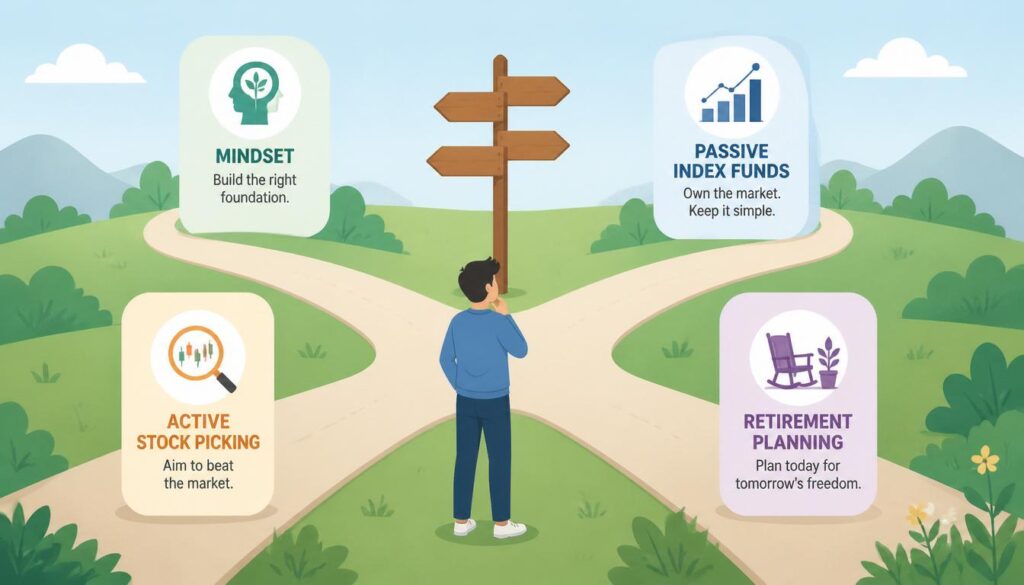
Passive investing involves buying and holding a diversified portfolio, typically through low-cost index funds, with the goal of matching the overall market’s return. It requires very little time and effort. Active investing involves researching, selecting, and trading individual stocks or actively managed funds in an attempt to beat the market’s average return. While active investing can be highly rewarding, statistical data shows that over the long term, the vast majority of active investors underperform passive index funds due to higher fees, taxes, and human error.
5. How do I start investing if I only have a small amount of money?
You do not need to be rich to start investing. Many modern brokerage platforms allow you to open an account with zero minimum deposits and offer fractional shares, meaning you can invest in expensive stocks or index funds with as little as $5 or $10. The most critical factor is not the amount of your initial investment, but the consistency of your contributions. Set up an automatic transfer of a small, manageable amount from your paycheck directly into your investment account every month.