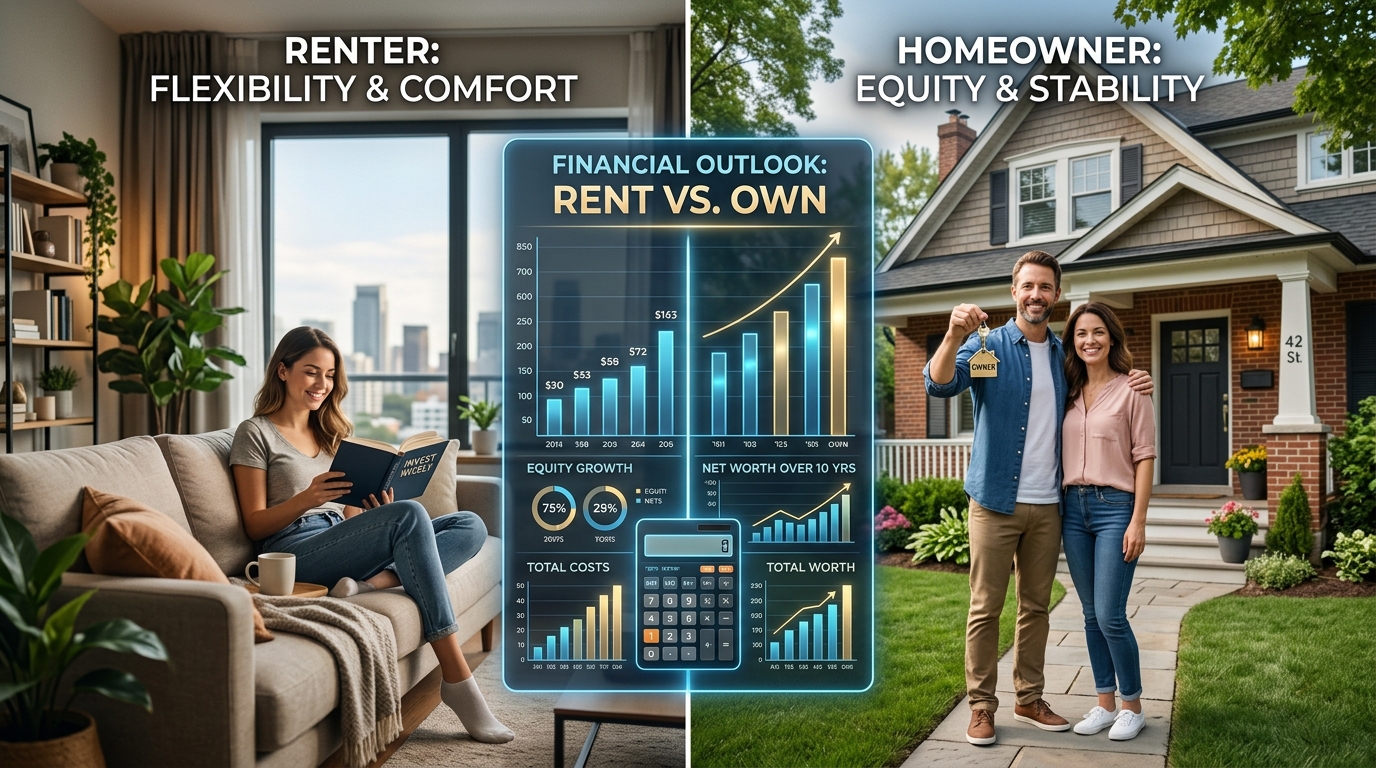
Deciding whether to rent or buy a home is arguably one of the most significant financial crossroads you will ever face. It is a decision that extends far beyond simple monthly payments; it shapes your long-term wealth, your lifestyle flexibility, and your daily peace of mind. With the housing market constantly shifting, interest rates fluctuating, and economic factors evolving, making the right choice can feel overwhelmingly complex.
As a financial advisor, I often see individuals lean toward buying simply because of the societal pressure that “renting is throwing money away,” or conversely, they rent because they fear the responsibilities of homeownership. The truth is, neither option is universally superior. Renting provides unparalleled flexibility and shields you from unexpected maintenance costs, while buying offers the potential to build substantial equity and lock in your housing costs.
In this comprehensive guide, we will break down the full financial comparison between renting and buying. By evaluating upfront costs, monthly expenses, wealth-building potential, tax implications, and lifestyle factors, you will gain a crystal-clear picture of which option aligns best with your budget and life goals.
1. The Upfront Costs: Down Payments vs. Security Deposits
The first major financial hurdle in the rent versus buy dilemma is the initial capital required. The disparity in upfront costs between the two paths is staggering and requires a realistic assessment of your current liquidity.
The Costs of Buying
Purchasing a home demands a significant initial investment. The most substantial is the down payment, which typically ranges from 3% to 20% of the home’s purchase price. On a $400,000 home, a 20% down payment equals $80,000. Beyond the down payment, buyers must navigate closing costs, which generally run between 2% and 5% of the loan amount. These cover appraisal fees, title insurance, origination fees, and prepaid property taxes. Additionally, you must budget for home inspections, immediate moving expenses, and potential initial renovations or furniture purchases. When combined, these initial costs can easily total tens of thousands of dollars.
The Costs of Renting
Conversely, the barrier to entry for renting is remarkably low. Renters typically face a security deposit (usually equal to one or two months’ rent) and the first month’s rent upfront. Sometimes, there are minor broker fees or application fees, but the total upfront cost is a fraction of what is required to buy.
Financial Advisor Insight: While renting is more accessible, it is crucial to evaluate your savings and liquidity. Tying up a massive amount of cash in a down payment impacts your financial flexibility. If buying a home depletes your emergency fund, you are leaving yourself vulnerable to financial shocks. Always ensure you have 3 to 6 months of living expenses saved after paying your closing costs and down payment.

2. Monthly Expenses: Mortgage Payments vs. Rent
When comparing monthly outflows, many people make the mistake of only comparing the mortgage principal and interest to the monthly rent check. A true financial comparison requires looking at the total cost of occupancy.
The True Cost of Homeownership
Monthly costs for homeowners are encapsulated in the acronym PITI: Principal, Interest, Taxes, and Insurance.
- Principal and Interest: Your actual loan repayment.
- Property Taxes: Levied by local governments, these can increase annually.
- Homeowners Insurance: Required by lenders and essential for protecting your asset.
- Private Mortgage Insurance (PMI): If you put down less than 20%, you will pay this monthly premium until you reach 20% equity.
- Maintenance and Utilities: Homeowners are solely responsible for all repairs, from a leaky faucet to a broken HVAC system. A good rule of thumb is to budget 1% to 2% of the home’s value annually for maintenance. Furthermore, homeowners often face higher utility bills and potential Homeowners Association (HOA) fees.
The Simplicity of Renting
Renters generally pay a single, predictable monthly rent check, plus utilities and a cheap renters’ insurance policy (which is highly recommended to protect personal belongings). When the water heater breaks or the roof leaks, the renter simply calls the landlord. There are no surprise maintenance bills, no property tax hikes, and no special HOA assessments.
Financial Advisor Insight: In many markets today, the monthly cost of owning (when factoring in taxes, insurance, and maintenance) is higher than renting a comparable property. You must calculate the “unrecoverable costs” of both. For a renter, 100% of the rent is unrecoverable. For a buyer, the interest, property taxes, maintenance, and PMI are unrecoverable costs—money that does not build equity.
3. Building Wealth: Equity and Long-Term Appreciation
The most compelling argument for buying a home is the potential to build wealth through equity and property appreciation. However, this requires a nuanced understanding of how real estate actually builds wealth.
How Homeownership Builds Equity
Equity is the portion of your home’s value that you truly own, calculated as the current market value minus your outstanding mortgage balance. Every time you make a mortgage payment, a portion goes toward paying down the principal, forcing you to save and building your equity. Furthermore, if the property appreciates in value over time, your equity grows without you spending an extra dime. This equity can eventually be tapped via a Home Equity Line of Credit (HELOC) or a cash-out refinance to fund major life events, like education or home improvements.
The “Rent and Invest” Alternative
Renters do not build equity in their living space; their monthly payments contribute to the landlord’s wealth. However, renting allows you to pursue the “rent and invest” strategy. Because renters avoid the massive upfront down payment and the monthly unrecoverable costs of homeownership (like maintenance and property taxes), they can take the difference in monthly costs and invest it in the stock market (e.g., index funds or retirement accounts). Historically, the stock market has yielded higher average annual returns than real estate. Therefore, a renter who diligently invests their savings can easily outpace a homeowner in total net worth.
Financial Advisor Insight: Equity growth is never guaranteed. Real estate markets are local and cyclical. If you buy at the peak of a market bubble and prices correct, you can end up “underwater” (owing more than the home is worth). Homeownership builds wealth primarily through forced savings (paying down debt) and long-term appreciation, not through quick flips.

4. Flexibility, Mobility, and Lifestyle Factors
Financial calculations only tell half the story. Your lifestyle, career trajectory, and personal preferences play a massive role in the rent versus buy decision.
The Agility of Renting
Renting offers unparalleled flexibility. If you receive a job offer in another state, want to explore a new neighborhood, or simply need to downsize, breaking a lease or waiting for it to expire is vastly simpler and cheaper than selling a house. Lease terms are typically 12 months, providing a natural exit point. This mobility is ideal for young professionals, military personnel, or anyone who anticipates major life changes in the near future.
The Anchoring Effect of Homeownership
Selling a home is a lengthy, expensive process. It involves repairs, staging, agent commissions (typically 5% to 6% of the sale price), and closing costs. Because of these high transaction costs, it generally takes about 5 to 7 years of homeownership just to break even on the costs of buying and selling. If you are forced to sell a home before this break-even point due to a job relocation, you could lose a significant amount of money.
Financial Advisor Insight: Apply the “Five-Year Rule.” If you cannot commit to living in the same city, and specifically the same house, for at least five to seven years, buying is likely a financial risk. The transaction costs of selling will eat away any equity you managed to build in a short timeframe.
5. Tax Implications and Hidden Costs
Understanding the tax code and anticipating hidden expenses is what separates amateur real estate decisions from professional financial planning.
Tax Benefits for Homeowners
Homeowners have historically enjoyed significant tax advantages. You can potentially deduct mortgage interest and property taxes from your taxable income. However, it is vital to understand the current tax landscape. Following recent tax reforms, the standard deduction was dramatically increased, and the deduction for state and local taxes (SALT) was capped. Consequently, a large percentage of homeowners no longer benefit from itemizing their deductions. You must run the numbers with a tax professional to see if buying actually provides a meaningful tax break for your specific income bracket. Renters receive no direct federal tax benefits for their housing payments, though some local jurisdictions offer modest renter credits.
The Hidden Costs of Ownership
First-time buyers are frequently blindsided by hidden costs. Beyond the mortgage, you must budget for:
- Major Repairs: Roofs, water heaters, and appliances have finite lifespans. Replacing a roof can cost $10,000 to $20,000.
- Landscaping and Snow Removal: If you don’t do it yourself, you must pay for it.
- Pest Control and Security: Ongoing services that renters often have covered by the landlord.
- HOA Fees: These can range from $200 to over $1,000 a month and can be increased by the HOA board at any time.

6. The Psychological and Remote Work Impact
We cannot ignore the emotional and psychological elements of housing, especially in an era where remote work has fundamentally altered our relationship with our homes.
The Emotional Value of Ownership
Owning a home provides a profound sense of stability, pride, and control. You can paint the walls, knock down partitions, landscape the yard, and adopt pets without asking for permission. This emotional attachment and the ability to customize your environment can significantly improve your quality of life and provide long-term psychological satisfaction. For many, a home is not just a financial asset; it is a sanctuary.
The Freedom of Renting
On the flip side, renting offers freedom from the mental burden of property maintenance. The “3:00 AM burst pipe” panic belongs to the landlord, not the renter. Renters can easily afford to explore different neighborhoods, upgrade to luxury amenities they couldn’t afford to buy, and live a lifestyle unburdened by property upkeep.
The Remote Work Shift
The rise of remote work has shifted housing priorities. Without the need to commute daily, many professionals are moving away from expensive urban centers to suburban or rural areas, where buying a larger home is financially feasible. Conversely, digital nomads are leveraging renting to live in different countries or cities throughout the year. Your work situation should heavily dictate your housing choice.
7. The Financial Decision Framework: How to Choose
To make an objective decision, remove the emotion and use a structured financial framework.
- Calculate the Price-to-Rent Ratio: Divide the median home price in your target area by the median annual rent. A ratio between 1 and 15 generally favors buying. A ratio between 16 and 20 favors renting. Above 21, renting is almost always the better financial deal.
- Assess Your Time Horizon: Are you staying for 7+ years? Lean toward buying. Less than 5 years? Lean toward renting.
- Evaluate Your Debt-to-Income (DTI) and Savings: Do you have a 20% down payment plus a fully funded emergency fund? If not, renting while you build your savings is the smarter play.
- Run the Unrecoverable Costs Comparison: Calculate the total unrecoverable costs of buying (interest, taxes, maintenance, insurance, closing costs) versus the total rent paid over 5 to 10 years. Factor in the opportunity cost of investing the difference.

Conclusion
The decision to rent or buy a home is not a universal math equation with a single correct answer; it is a deeply personal calculation that balances financial prudence with your lifestyle aspirations. Buying a home is a powerful vehicle for building long-term wealth, forcing savings, and providing emotional stability, but it comes with high upfront costs, rigid mobility, and the heavy burden of maintenance. Renting offers flexibility, predictable monthly costs, and the freedom to invest your capital elsewhere, but it lacks the forced savings mechanism of a mortgage and offers no equity buildup.
Ultimately, the “right” choice is the one that aligns with your current financial readiness, your expected time horizon in the area, and your personal tolerance for responsibility. By looking past the societal narratives and focusing on the hard numbers, hidden costs, and your unique life goals, you can make a confident, strategic decision that sets you up for long-term financial success.
Frequently Asked Questions (FAQ)
1. Is it always cheaper to rent than to buy a home?
No, it is not always cheaper. In many suburban and rural markets, the monthly mortgage payment (principal and interest) can actually be lower than the monthly rent for a comparable property. However, when you factor in the total cost of homeownership—including property taxes, homeowners insurance, maintenance, HOA fees, and closing costs—buying often becomes more expensive on a month-to-month basis. The financial advantage of buying usually materializes over the long term through equity buildup and property appreciation, rather than immediate monthly cash flow savings.
2. How long should I plan to stay in a home before buying?
As a general financial rule, you should plan to stay in a home for a minimum of five to seven years before buying. Because buying and selling a house involves significant transaction costs (such as agent commissions, closing costs, and transfer taxes), it typically takes about five years of equity growth and mortgage paydown just to break even on the costs of the transaction. If you move sooner than that, you could lose money on the sale, making renting the more financially sound option for short-term horizons.
3. What are the most common hidden costs of buying a home?
First-time homebuyers are frequently surprised by ongoing maintenance and repair costs. A standard rule of thumb is to budget 1% to 2% of the home’s purchase price annually for maintenance. Other hidden costs include higher utility bills (heating and cooling a larger space), landscaping and snow removal, pest control, and potential special assessments from a Homeowners Association (HOA). Additionally, major systems like the roof, HVAC, and water heaters have finite lifespans and require massive capital outlays when they fail.
4. Can I build wealth if I choose to rent instead of buying?
Absolutely. While renters do not build equity in their physical living space, they can build significant wealth through the “rent and invest” strategy. Because renting requires a much lower upfront capital commitment and often has lower unrecoverable monthly costs than homeownership, renters can take the difference in their housing expenses and invest it in diversified portfolios, such as index funds, stocks, or retirement accounts. Historically, the stock market has provided higher average annual returns than real estate, meaning a disciplined renter who invests consistently can easily outpace a homeowner in total net worth.
5. How do current mortgage interest rates affect the rent vs. buy decision?
Mortgage interest rates directly impact your monthly purchasing power and the total cost of the loan. When interest rates are high, your monthly mortgage payment increases significantly for the same loan amount, which can make buying more expensive than renting in the short term. High rates also reduce the amount of house you can afford. However, many financial advisors suggest that you should “marry the house and date the rate.” This means you buy a home that fits your budget at current rates, with the intention of refinancing to a lower rate in the future if and when interest rates drop, thereby lowering your monthly payment over time.