
For decades, the stock market was perceived as an exclusive club reserved for the wealthy. When a single share of a massive, industry-leading company like Amazon, Tesla, or Google costs hundreds or even thousands of dollars, it is incredibly easy for the average person to believe that investing is simply out of their reach. If you only have fifty or a hundred dollars to spare, the traditional stock market seems entirely inaccessible.
However, the financial landscape has undergone a massive transformation. Today, you no longer need thousands of dollars to own big-name stocks. Thanks to the innovation of fractional shares, the barriers to entry have been completely dismantled. Modern brokerage platforms now allow you to buy just a piece of expensive stocks and exchange-traded funds (ETFs) with whatever amount you can comfortably afford.
As a financial advisor, I often see beginners paralyzed by the high prices of blue-chip stocks. Fractional investing changes the game entirely. It democratizes wealth building, allowing anyone to participate in the growth of the world’s most successful companies. In this comprehensive guide, we will break down exactly how fractional investing works, why it is a crucial tool for your financial toolkit, and how you can use it to build substantial wealth over time, regardless of your starting budget.
Understanding the Core Concept of Fractional Shares
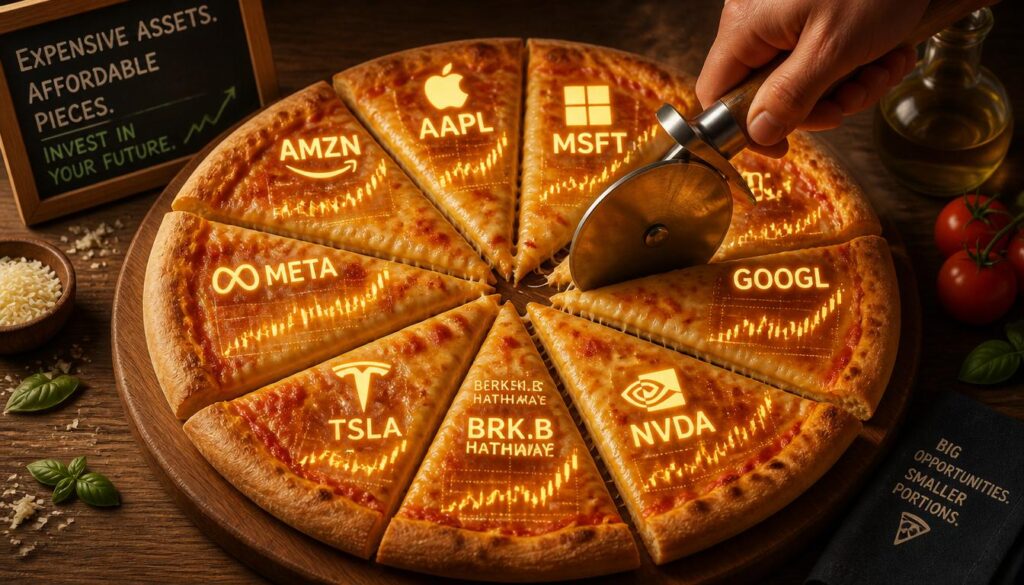
At its absolute core, a fractional share is exactly what it sounds like: a slice of a full share of stock. To understand this, think of a share of stock like a whole pizza. Traditionally, the rules of the stock market dictated that you had to buy the entire pizza, even if you could only afford to pay for a single slice. If you didn’t have the money for the whole pizza, you simply went without.
Fractional shares change that fundamental rule. Now, you can buy just one slice of the pizza and still enjoy all the benefits of ownership.
Let us look at a real-world mathematical example. Suppose a highly sought-after technology stock is priced at $1,000 per single share. For a beginner investor with a modest budget, dropping $1,000 on a single company is not just expensive; it is incredibly risky. However, with fractional shares, you can purchase 0.1 of a share for $100, or even 0.01 of a share for just $10.
You still officially own a piece of that company’s stock. Your ownership is simply proportional to the amount of money you invested. If the stock price goes up by 10%, your fractional investment also goes up by 10%. The mechanics of wealth generation remain exactly the same; only the barrier to entry has been lowered.
How Fractional Ownership Works in Real Life
One of the most common questions new investors have is whether owning a fraction of a share means you get a fraction of the benefits. The answer is a resounding yes. When you own a fractional share, your rights, benefits, and returns scale down perfectly with your percentage of ownership.
Let us explore how this works with dividends. Dividends are a portion of a company’s profits paid out to shareholders. Suppose a stable, blue-chip company issues a generous dividend, paying out $20 per full share annually. If you own a full share, you receive the full $20. But if you own exactly 0.25 (or one-quarter) of a share, you will receive exactly $5 in dividend payouts.
The math is simple, but the financial opportunity is incredibly powerful. Even though you are investing smaller amounts of capital, your experience as an investor is identical to that of a high-net-worth individual owning thousands of full shares. You will watch the price fluctuate daily, you will receive your proportional share of dividends, and most importantly, you will experience the magic of compounding. Your small dividend payouts can be automatically reinvested to buy even more fractional shares, creating a snowball effect of wealth generation.
Top Platforms Making Fractional Shares Possible
Fractional investing would not exist without the advent of modern financial technology. Today, several major, highly regulated brokerage platforms offer this feature, making it accessible to millions of people. Choosing the right platform depends on your specific investing style and goals.
Robinhood Robinhood largely popularized the concept of fractional investing for the masses with its incredibly user-friendly mobile app. It allows investors to purchase tiny slices of expensive companies without paying any commission fees. It is an excellent choice for absolute beginners who value simplicity, intuitive design, and a frictionless onboarding process.
Fidelity Fidelity introduced its own robust version of fractional shares, allowing people to start investing with as little as $1. Fidelity is perfect for investors who want broader options, deep educational resources, and top-tier customer service. It offers a more comprehensive suite of research tools compared to simpler apps.
Charles Schwab Charles Schwab offers a feature called “Stock Slices,” allowing you to invest as little as $5 into major companies in the S&P 100 index. Schwab is ideal for investors who want a traditional, highly trusted brokerage experience with access to extensive market research and a wide variety of investment vehicles.
Vanguard While Vanguard is a titan in the investing world, its approach to fractional shares is slightly different. They primarily provide fractional shares in their own ETFs and mutual funds, rather than individual stocks. This makes Vanguard the ultimate go-to choice for those who prefer a hands-off approach, focusing on index funds to build long-term retirement portfolios.
No matter which platform you choose, the key takeaway is that these technologies have successfully democratized the financial markets.

Diversification Made Easy on a Small Budget
One of the most sacred golden rules of investing is diversification: never put all your eggs in one basket. Without fractional shares, if you only had $100 to invest, you would be forced to put it all into one or two relatively cheap companies. That is a highly risky strategy. If that single company underperforms, your entire portfolio suffers.
Fractional shares completely solve this problem. They allow you to spread that same $100 across multiple high-quality companies and broad market ETFs.
Imagine being able to take your $100 and invest $20 into Apple, $20 into Tesla, $20 into Amazon, $20 into Microsoft, and $20 into a broad S&P 500 index fund. Suddenly, you are no longer tied to the performance of a single entity. Your money is actively working across different sectors—technology, e-commerce, automotive, and the broader market. This drastically reduces your unsystematic risk. If one company has a bad quarter, the others may balance it out. Fractional shares make professional-grade portfolio diversification accessible to the everyday investor.
Building Wealth Through Consistency and Patience
It is vital to understand that fractional shares are not a get-rich-quick scheme. They are not about making quick money or day-trading. They are about building wealth steadily, reliably, and predictably over time. The true power of fractional investing lies in combining it with consistency.
This is where a strategy called Dollar-Cost Averaging (DCA) comes into play. DCA involves investing a fixed amount of money on a regular schedule, regardless of what the stock market is doing on that specific day. For example, you might set up an automatic transfer to invest $50 every single month into fractional shares of an index fund.
When the market is high, your $50 buys fewer fractional shares. When the market dips, your $50 buys more fractional shares. Over time, the costs average out, and you avoid the emotional trap of trying to “time the market.”
When you pair Dollar-Cost Averaging with the magic of compound interest, the results are staggering. Compounding occurs when your investments earn returns, and then those returns earn their own returns. Because fractional shares allow you to reinvest every tiny fraction of a dividend, your money is constantly working for you. Even small amounts invested consistently can turn into significant, life-changing wealth over decades. Time in the market will always beat timing the market.

Understanding the Risks and Limitations
As a financial advisor, it is my duty to ensure you understand that fractional shares are powerful, but they are not entirely risk-free or without limitations.
First and foremost, the fundamental risks of the stock market remain. The value of your investments will still rise and fall with market volatility. If a company you own a fraction of underperforms or goes bankrupt, your fractional ownership will lose value just as a full share would. The only difference is the absolute dollar amount at risk.
Another limitation involves voting rights. When you own a full share of stock, you technically have the right to vote on corporate matters, such as board member elections. However, many brokerage platforms do not pass these voting rights down to fractional shareholders. If corporate governance is important to you, you need to check your broker’s specific rules.
Liquidity and transferability can also be an issue. While most platforms allow you to sell your fractional shares easily for cash, transferring them to a different brokerage can be complicated. Some brokers only allow the transfer of full shares, meaning you may have to liquidate your fractional shares before moving your account. It is important to read the fine print of your chosen platform so you are not surprised later.

The Psychological Edge: Learning by Doing
There is a massive psychological difference between reading about investing in a book and actually investing your own money. Fractional shares give you the incredible opportunity to learn by doing without risking large amounts of your hard-earned capital.
When you invest even just $10 into a company, you suddenly have “skin in the game.” You start to feel personally connected to its performance. You will likely find yourself paying more attention to financial news, understanding how quarterly earnings reports work, and observing how dividends are deposited into your account.
More importantly, you will experience market volatility firsthand. When the market drops 5% in a single day, seeing your $50 investment drop to $47.50 teaches you about your own risk tolerance in a way that theoretical learning never could. Instead of being an outsider looking in, paralyzed by fear, you become an active participant in the investing world. Over time, this hands-on experience helps you develop the calm, disciplined mindset of a long-term investor, which is the true secret to financial success.
Setting Clear Goals Before You Start
Before you download an app and start buying fractional shares, it is crucial to sit down and define your financial goals. Your objectives will directly guide your investment choices.
Are you investing for a retirement that is thirty years away? If so, fractional shares of broad-market, low-cost index funds are a safe, reliable, and highly effective option. They provide maximum diversification and steady growth.
Are you trying to build general wealth for a medium-term goal, like buying a house in five years? You might want a mix of index funds and a few stable, dividend-paying blue-chip stocks.
Are you simply experimenting and trying to learn how the market works? In that case, putting small amounts of money into big-name companies you admire and use every day can be a fun, highly educational experience.
Having clear, written goals keeps you focused during inevitable market downturns. When the market crashes, an investor with a clear long-term goal will see it as a buying opportunity, while an investor without a plan will panic and sell at a loss.

Conclusion: Taking the First Step Without Delay
At the end of the day, the most important thing you can do is simply start. Too many people spend years waiting for the “perfect time” to invest, or they try to read every book and learn every technical indicator before they begin. The truth is, there will never be a perfect time, and you will never know absolutely everything. The market will always have ups and downs.
The best way to learn and the best way to build wealth is to take action. Fractional shares make that action possible for everyone. With just a few dollars, you can open an account, buy into companies you believe in, and begin your financial journey. The earlier you start, the more time your money has to grow through the power of compounding.
Consistency, patience, and time are the real wealth builders—not luck, not insider information, and not timing the market. Fractional shares have made investing accessible for everyone, no matter your budget. Whether you are buying a tiny slice of a tech giant or building a broadly diversified ETF portfolio, small steps consistently taken will lead to massive growth over time. Take control of your financial future today.
Frequently Asked Questions (FAQ)
1. Do I receive dividends if I own fractional shares?
Yes, absolutely. When you own fractional shares, you are entitled to a proportional amount of any dividends paid by the company. For example, if a company pays a $10 dividend per full share and you own 0.5 of a share, you will receive $5. Most modern brokerages will also allow you to automatically reinvest these fractional dividends to buy even more shares.
2. Can I transfer my fractional shares to a different brokerage?
This depends on the brokerage. While the investing industry is moving toward better transferability, some platforms still require you to sell your fractional shares and transfer the cash, rather than transferring the fractions themselves. Always check the specific ACATS (Automated Customer Account Transfer Service) transfer rules of your broker before moving your account.
3. Do I get voting rights with fractional shares?
Generally, no. While owning a full share of stock grants you the right to vote on corporate matters like board elections, most brokerage platforms do not extend these voting rights to fractional shareholders. If corporate voting is a priority for you, you will need to research brokers that specifically offer this feature for fractions.
4. Is it better to buy one full share of a cheap stock or multiple fractional shares of expensive stocks?
From a risk management perspective, buying multiple fractional shares of expensive, high-quality stocks (or index funds) is almost always better. Buying a single full share of a cheap stock concentrates all your risk into one company. Fractional shares allow you to diversify your portfolio across multiple assets, which is a fundamental principle of safe investing.
5. Are there any extra fees for buying fractional shares?
Most major, modern brokerages (like Robinhood, Fidelity, and Charles Schwab) offer commission-free trading for fractional shares, meaning you do not pay a fee to execute the trade. However, you should always check the fee schedule of your specific platform, as some may charge fees for account maintenance, wire transfers, or selling certain types of mutual funds.