
The Credit Repair Industry: What’s Really Behind the Curtain?
Every year, millions of people with damaged credit scores scroll through targeted ads promising overnight transformations. “Boost your score by 150 points in 30 days!” “We’ll erase your collections!” “Guaranteed approval after our service!” The credit repair industry generates billions annually by selling hope wrapped in legal jargon.
But here’s what almost nobody in that industry wants you to know: nearly everything a paid credit repair company does for you, you can do yourself—for free. The same laws that empower them empower you. The same dispute letters they send, you can draft at your kitchen table. The same negotiations they conduct with creditors, you can handle with a single phone call.
This doesn’t mean every credit repair service is a scam. Some provide genuine convenience and structure for people drowning in complexity. But understanding what these companies actually do—and what they legally cannot do—is the single most important step before handing over your hard-earned money.
Whether you’re recovering from medical debt, navigating a divorce that tanked your finances, or simply made mistakes in your twenties that still haunt your credit report, this guide will walk you through every legitimate path to rebuilding your score. No hype. No false promises. Just actionable strategies grounded in consumer protection law.
What Credit Repair Companies Actually Do Behind Closed Doors
Strip away the flashy websites and testimonial videos, and credit repair services perform three core functions:
Dispute Filing: They review your credit reports from Experian, Equifax, and TransUnion, identify negative entries they consider potentially disputable, and send standardized challenge letters to the bureaus. Under the Fair Credit Reporting Act, if a creditor cannot verify the accuracy of a reported item within 30 days, it must be removed.
Creditor Negotiation: They contact collection agencies and original creditors to negotiate “pay-for-delete” arrangements, where you agree to pay a debt (often at a reduced amount) in exchange for the creditor removing the negative entry entirely.
Monitoring and Education: Many services bundle credit monitoring alerts, educational articles, and progress tracking dashboards into their monthly subscription.
The critical insight here is that none of these actions require a special license, proprietary software, or insider connections. They rely entirely on rights already granted to you under federal law—specifically the Fair Credit Reporting Act (FCRA) and the Fair Debt Collection Practices Act (FDCPA).
The DIY Credit Repair Playbook That Actually Delivers Results
You don’t need a monthly subscription to fix your credit. You need a structured approach and consistent follow-through.
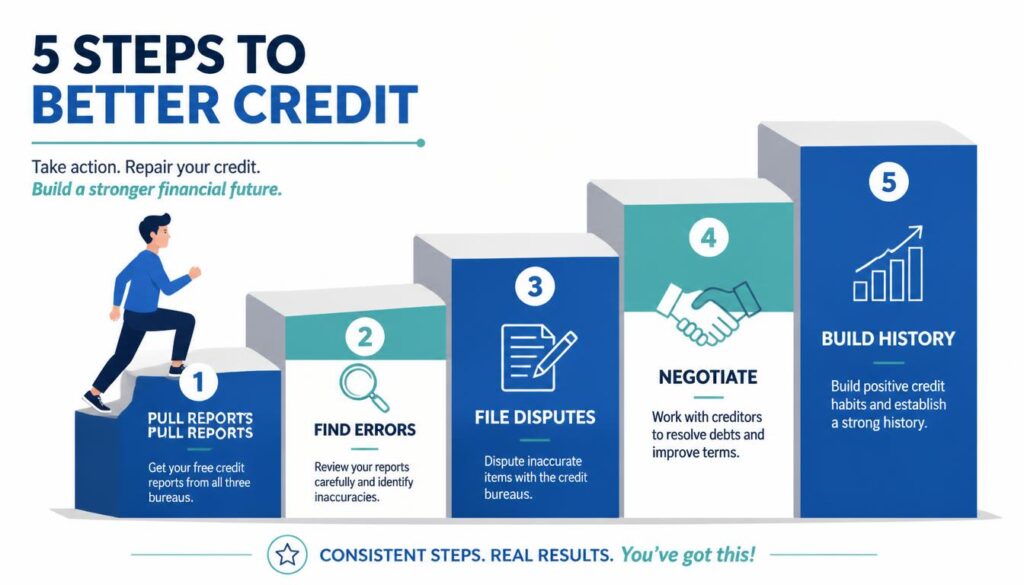
Step 1: Obtain Your Free Reports. Visit AnnualCreditReport.com and pull your reports from all three major bureaus. You’re entitled to one free report from each bureau every twelve months, and in some circumstances, you can access them more frequently.
Step 2: Audit Every Line Item. Go through each report methodically. Look for:
- Accounts you don’t recognize
- Incorrect personal information (wrong addresses, misspelled names)
- Duplicate entries for the same debt
- Closed accounts still reporting as open
- Incorrect payment histories or balances
- Wrong dates of last activity or account opening
Step 3: File Targeted Disputes. For every error you find, submit a dispute directly with the reporting bureau—online, by phone, or by certified mail. Be specific. State exactly what’s wrong, reference the account number, and attach supporting documentation like bank statements, payment receipts, or identity theft reports.
Step 4: Negotiate Directly with Creditors. For legitimate negative items, call the creditor or collection agency. Explain your situation. Offer a lump-sum payment in exchange for a pay-for-delete agreement. Get any agreement in writing before sending money. Many creditors prefer recovering a portion of the debt over recovering nothing.
Step 5: Build Positive History Going Forward. Set up automatic payments. Keep utilization below 30%. Become an authorized user on a family member’s well-managed account. Consider a secured credit card if traditional credit is unavailable.
This entire process costs you nothing except time and patience.
When Paying for Professional Help Actually Makes Sense
Not everyone should DIY their credit repair. There are legitimate scenarios where hiring a service provides real value:
- Overwhelming Complexity: If you have dozens of negative items across multiple bureaus, the administrative burden of tracking disputes, deadlines, and creditor responses can be genuinely unmanageable alongside a full-time job and family obligations.
- Emotional Distress: Financial trauma is real. If looking at your credit reports triggers anxiety or paralysis, delegating the process can be a valid mental health decision.
- Time Poverty: If you work multiple jobs or care for dependents, the hours required for thorough DIY repair may simply not exist in your schedule.
- Accountability Structure: Some people perform better with external accountability. A service that checks in monthly and tracks progress can keep you engaged.
If you decide to hire help, legitimate companies typically charge between $50 and $100 per month on a month-to-month basis. They should provide transparent pricing, explain exactly what they’ll do, and never guarantee specific numerical outcomes.
Six Red Flags That Signal a Credit Repair Scam
The Credit Repair Organizations Act (CROA) exists specifically to protect consumers from predatory services. Under this law, the following practices are illegal—and any company engaging in them should be avoided immediately:
- Guaranteeing specific point increases. No one can legally promise your score will rise by a set number.
- Promising to remove accurate negative information. If a late payment genuinely occurred and was reported correctly, no company can make it disappear before the reporting period expires.
- Demanding payment before performing services. Legitimate companies bill after work is completed, not before.
- Advising you not to contact credit bureaus directly. You have an absolute legal right to communicate with bureaus yourself.
- Creating a “new credit identity” using an Employer Identification Number instead of your Social Security Number. This is federal fraud.
- Claiming special relationships or insider access to credit bureaus. No such relationships exist.
If a company’s marketing sounds like a miracle cure, trust your instincts and walk away.

Long-Term Credit Building Strategies That Create Lasting Change
Quick fixes fade. Sustainable credit health comes from habits that compound over months and years.
Payment History (35% of your score): Automate every bill. Even one missed payment can drop your score by 60 to 100 points. Set calendar reminders, enable autopay, and treat every due date as non-negotiable.
Credit Utilization (30% of your score): Keep balances below 30% of your total available credit—and ideally below 10% for optimal scoring. If you have a $10,000 total limit across all cards, keep combined balances under $3,000, and preferably under $1,000.
Length of Credit History (15% of your score): Resist the urge to close old credit cards, even ones you rarely use. The age of your oldest account and the average age of all accounts matter. Use old cards for one small purchase every few months and pay them off immediately.
Credit Mix (10% of your score): Lenders like to see you manage different types of credit responsibly—revolving credit like credit cards alongside installment loans like auto loans or mortgages.
New Credit Inquiries (10% of your score): Limit applications for new credit. Each hard inquiry can temporarily dip your score by a few points. Space out applications by at least six months.
Smart Debt Management: Where Your Money Actually Goes Furthest
Before spending a single dollar on credit repair services, run this calculation: could that $75 monthly subscription instead go toward paying down your highest-interest debt?
Reducing your outstanding balances provides an immediate, measurable boost to your credit utilization ratio—which, remember, accounts for 30% of your score. A $900 annual fee paid to a credit repair company might generate a modest improvement through disputes. That same $900 applied to a $5,000 credit card balance could improve your utilization ratio dramatically and save you hundreds in interest.
Consider these debt strategies:
- Avalanche Method: Target the highest-interest debt first while making minimum payments on everything else. Mathematically optimal.
- Snowball Method: Pay off the smallest balance first for psychological momentum.
- Balance Transfers: Move high-interest balances to a 0% introductory APR card. But discipline is critical—don’t accumulate new charges on the cleared card.
- Debt Consolidation Loans: Combine multiple debts into one fixed monthly payment at a lower interest rate. Simplifies budgeting and can reduce total interest paid.
The golden rule: never run up new balances on cards you’ve just paid down. That cycle destroys progress faster than you can rebuild it.

Credit Monitoring: Your Early Warning System
Rebuilding credit isn’t a one-time project. It’s ongoing maintenance. Use free tools like Credit Karma, your bank’s built-in monitoring, or the free alerts offered by all three bureaus to track changes in real time.
Set up notifications for:
- New accounts opened in your name
- Balance changes exceeding a threshold you set
- New inquiries
- Changes to personal information
Review your reports monthly rather than waiting for the annual free pull. This proactive cadence means you catch identity theft, reporting errors, or unauthorized accounts within days instead of months—when the damage is minimal and resolution is straightforward.
Think of credit monitoring like a smoke detector. It won’t prevent every fire, but it ensures you respond before the whole house burns down.
The Real Cost Breakdown: DIY Versus Professional Services
Let’s put actual numbers on the table.
DIY Credit Repair:
- Cost: $0
- Time investment: 5 to 15 hours initially, then 1 to 2 hours monthly
- Tools needed: Internet access, a printer (optional), organized filing system
- Effectiveness: Identical legal mechanisms as paid services
Professional Credit Repair:
- Cost: $300 to $1,200+ annually
- Time investment: Minimal on your part
- Tools provided: Dispute letter templates, progress dashboards, creditor negotiation
- Effectiveness: Uses the same FCRA dispute process you can access free
The results are often indistinguishable because both approaches invoke the same consumer protection statutes. The difference is convenience versus cost.
If you choose a paid service, reframe it honestly: you’re paying for administrative convenience and emotional relief, not for a secret process unavailable to you. And if that $75 per month could instead reduce your revolving debt, the debt payoff will almost always produce a faster score improvement than disputing a three-year-old collection account.
The Uncomfortable Truth Nobody Markets
Here’s the part credit repair companies rarely emphasize: accurate negative information cannot be legally removed before its reporting period expires. Late payments, charge-offs, collections, and bankruptcies remain on your report for seven years (ten for certain bankruptcies). No company—no matter how persuasive their advertising—can override this timeline for accurate information.
What you can do during those seven years is overwhelm the negative items with positive ones. Every on-time payment, every month of low utilization, every year of consistent responsible behavior adds positive data that gradually dilutes the impact of old negatives. Credit scoring models weight recent behavior more heavily than distant history. A collection from four years ago hurts far less than one from four months ago.
Patience isn’t just a virtue in credit repair. It’s the entire strategy.

Conclusion: Take Back Control of Your Financial Narrative
The credit repair industry thrives on urgency, shame, and the belief that your financial situation requires a specialist’s intervention. The reality is more empowering—and more mundane. Your credit score is a reflection of patterns, not a verdict. It responds to consistent, deliberate action over time.
You have every legal right to dispute errors, negotiate with creditors, and manage your credit profile without paying a monthly subscription. The Fair Credit Reporting Act was written to protect you, and it requires no intermediary to activate those protections.
That said, there’s no shame in hiring help if the complexity or emotional weight of your situation warrants it. Just go in with clear eyes: you’re paying for convenience, not magic. And always, always redirect money toward debt reduction first if the choice presents itself.
Start today. Pull your reports. Find one error. File one dispute. Set up one automatic payment. These small actions compound into transformation. Your future self—applying for a mortgage, negotiating a car loan, or simply sleeping peacefully without financial dread—will thank you for starting now.
Credit repair isn’t a product you buy. It’s a practice you build.
Frequently Asked Questions
1. Can credit repair companies legally remove accurate negative items from my credit report?
No. Under the Fair Credit Reporting Act, accurate negative information—such as a verified late payment, a legitimate collection account, or a confirmed bankruptcy—must remain on your credit report for its designated reporting period, typically seven years (ten years for Chapter 7 bankruptcy). Credit repair companies can only challenge items they believe are inaccurate, incomplete, or unverifiable. If a creditor verifies the information as correct within the 30-day investigation window, the item stays. Any company promising to erase accurate negatives is either misleading you or engaging in illegal activity.
2. How long does DIY credit repair typically take to show results?
Timelines vary based on the severity and type of negative items on your report. Disputes with credit bureaus must be investigated within 30 days, so you may see corrections reflected within one to two billing cycles. However, building positive history to offset older negatives is a longer process. Most people notice meaningful score improvements within three to six months of consistent on-time payments and reduced utilization. Significant recovery from major negative events like foreclosure or bankruptcy typically takes two to four years of disciplined financial behavior.
3. Will checking my own credit report lower my score?
No. When you check your own credit report or score, it generates what’s called a “soft inquiry,” which has zero impact on your credit score. Soft inquiries are visible only to you and do not appear to lenders. Hard inquiries—generated when you apply for new credit like a loan or credit card—can temporarily reduce your score by a few points, but these effects fade within months. You should check your reports as often as you like without any fear of damage.
4. What is a “pay-for-delete” agreement, and do creditors actually honor them?
A pay-for-delete agreement is a negotiated arrangement where you pay a debt (often at a reduced, lump-sum amount) and the creditor or collection agency agrees to remove the negative entry from your credit report entirely, rather than updating it to “paid collection.” While some creditors and collection agencies will agree to this, it is not universal, and not all will honor the arrangement after payment. Always get the agreement in writing—via letter or email—before sending any money. If the creditor refuses to put terms in writing, do not proceed. Even without a delete agreement, paying collections is generally better for your long-term credit profile than leaving them unresolved.
5. Is it worth hiring a credit repair company if I’m applying for a mortgage soon?
It depends on your timeline and the specific issues on your report. Mortgage lenders typically require a credit review 30 to 60 days before closing, and major disputes or changes during underwriting can delay or derail approval. If your report contains clear errors, filing disputes yourself immediately is wise—but understand that investigations can take 30 to 45 days. A credit repair company won’t accelerate this legal timeline. If your negative items are accurate, no service can remove them before a mortgage application. In that case, focus on reducing utilization, avoiding new inquiries, and ensuring all payments are current in the months leading up to your application. Consult a HUD-approved housing counselor for free, personalized mortgage-readiness guidance.