

When it comes to building long-term wealth, few concepts are as elegantly simple or profoundly powerful as the philosophy pioneered by John C. Bogle, the founder of Vanguard. In a financial industry that often profits from complexity, the Bogleheads investing strategy offers a refreshing, highly effective alternative. This approach strips away the noise of Wall Street, focusing instead on low-cost index funds, broad diversification, and the undeniable math of compound interest.
Whether you are a beginner looking to make your first investment or a seasoned investor tired of underperforming active funds, the “lazy portfolio” approach can help you grow your money with minimal stress, minimal costs, and zero need to time the market. Let us explore the core principles of this philosophy, how to construct the ultimate three-fund portfolio, and the behavioral discipline required to let your wealth compound over a lifetime.
The Core Philosophy: What Are Bogleheads?
The Bogleheads movement is named after John Bogle and stems from his revolutionary realization that the vast majority of investors would be significantly better off buying and holding the entire market through low-cost index funds, rather than paying professionals to try and beat it.
At the heart of this philosophy is the “lazy portfolio.” Despite the name, a lazy portfolio is not about being careless with your money; rather, it is about being highly efficient with your time. It is a simple, broadly diversified investment strategy that requires minimal ongoing maintenance while generating solid, market-matching long-term returns.
The core tenets of the Bogleheads philosophy are straightforward:
- Time in the market beats timing the market: Attempting to predict market peaks and valleys is a fool’s errand. Staying consistently invested is the only reliable way to capture market growth.
- Keep costs low: Investment fees are the biggest predictor of future returns. Minimizing expenses is one of the few things an investor can completely control.
- Diversify broadly: Do not look for the needle in the haystack; just buy the whole haystack.
- Get rich slowly: This approach is not about hitting a home run or getting rich quick. It is about getting rich slowly and surely through the mathematical magic of compound growth.
The Ultimate Lazy Portfolio: The Three-Fund Strategy
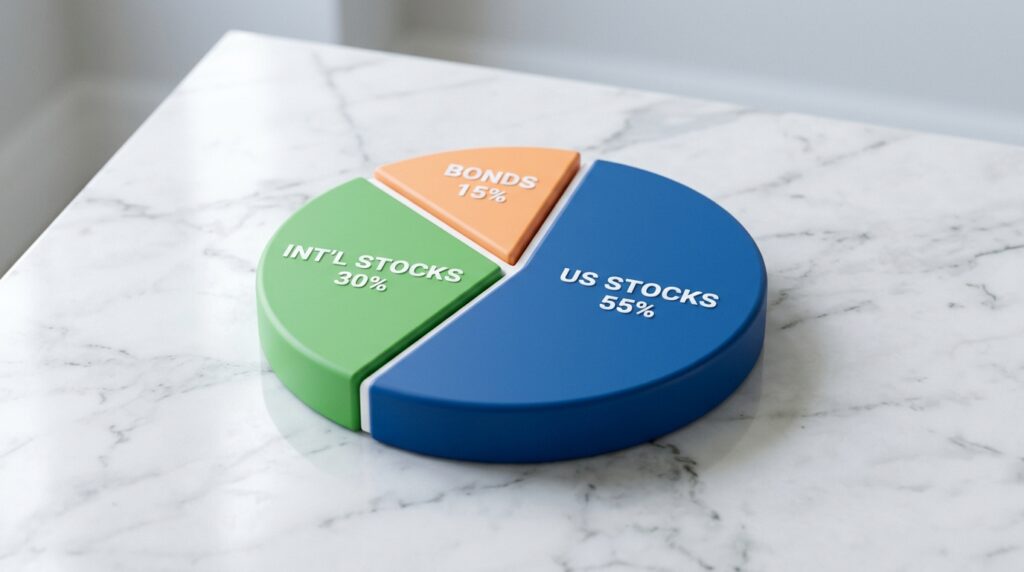
The crown jewel of the Bogleheads investing strategy is the Three-Fund Portfolio. As the name suggests, this strategy utilizes only three distinct mutual funds or exchange-traded funds (ETFs) to cover the entire global investable market.
- Total US Stock Market Index Fund: This fund gives you ownership in virtually every publicly traded company in the United States, from massive tech giants to small-cap emerging businesses.
- Total International Stock Index Fund: This fund provides exposure to companies outside the US, covering both developed markets (like Europe and Japan) and emerging markets, ensuring you are not solely reliant on the domestic economy.
- Total Bond Market Index Fund: This fund invests in a broad mix of US investment-grade bonds (government, corporate, and mortgage-backed). Bonds act as the shock absorbers in your portfolio, providing stability and income when stock markets experience volatility.
Determining Your Asset Allocation
The exact mix of these three funds depends on your age, risk tolerance, and time horizon. A common starting point for a younger, aggressive investor might be 60% US stocks, 30% international stocks, and 10% bonds. As you approach retirement, you would gradually shift this allocation to include more bonds to protect your capital. The beauty of this strategy is that you can own tens of thousands of global companies through just three simple holdings.
Why Index Funds Crush Active Management
One of John Bogle’s most significant contributions to personal finance was his rigorous research proving that actively managed funds consistently fail to beat their benchmark indices over the long term, especially after accounting for fees and taxes.
Active fund managers charge high fees—often 1% to 2% of your assets annually—and trade frequently, which generates taxable capital gains. According to extensive data, roughly 80% of actively managed funds underperform their respective index funds over a 15-year period.
Consider the mathematical drag of fees. If the stock market returns an average of 10% in a given year, but you are paying a 2% management fee to an active fund, you are surrendering 20% of your actual gross gains to the manager. Over a 30-year career, this fee drag can cost you hundreds of thousands of dollars in lost compound interest. In stark contrast, low-cost index funds typically charge between 0.03% and 0.20% annually. By choosing index funds, you keep nearly all of your market returns working for you. As Bogle famously advised, “In investing, you get what you don’t pay for.”
Mastering Asset Allocation and Dollar-Cost Averaging
Successful investing relies heavily on two mechanical processes: proper asset allocation and consistent contribution strategies.
Age-Based Asset Allocation
Bogleheads focus heavily on asset allocation (the mix of stocks and bonds) rather than individual stock picking. A traditional rule of thumb for determining your stock allocation is to subtract your age from 110. For example, if you are 30 years old, you would hold 80% in stocks (split between US and International) and 20% in bonds. Because people are living longer and low interest rates have altered bond yields, many modern investors use “120 minus your age” to maintain a slightly more aggressive posture for longer. The key is to define your allocation based on your personal risk capacity and stick to it through all market environments.
Dollar-Cost Averaging (DCA)
Perhaps the most powerful behavioral tool in the Bogleheads arsenal is Dollar-Cost Averaging. DCA means investing a fixed amount of money at regular intervals—such as $500 on the first of every month—regardless of whether the market is up, down, or flat.
This approach completely removes the impossible burden of trying to time the market. When prices are high, your fixed investment buys fewer shares. When prices are low, your fixed investment buys more shares. Over time, this lowers your average cost per share. The secret to making DCA work is automation. By setting up automatic transfers from your checking account to your brokerage, you remove human emotion from the equation and ensure your money is consistently put to work.

Rebalancing, Tax Efficiency, and Asset Location
While a lazy portfolio requires very little day-to-day attention, it is not entirely “set it and forget it.” You must occasionally rebalance and optimize your accounts for tax efficiency.
The Art of Rebalancing
Over time, different assets will perform differently, causing your portfolio to drift from its target allocation. If stocks have a massive year, your 80/20 stock-to-bond portfolio might drift to 85/15, inadvertently increasing your risk.
Rebalancing involves selling a portion of your overperforming assets and using the proceeds to buy more of your underperforming assets to return to your target percentages. Most Bogleheads rebalance annually, or whenever their allocation drifts by more than 5%. This disciplined practice forces you to do something that is emotionally difficult but financially vital: sell high and buy low.
Tax Efficiency and Asset Location
Smart investors also practice “asset location,” which is the strategic placement of specific funds in specific types of accounts to minimize taxes.
- Taxable Brokerage Accounts: These are best suited for highly tax-efficient investments, like total stock market index funds, which generate very few taxable capital gains. International funds are also great here, as they may generate foreign tax credits.
- Tax-Advantaged Accounts (IRAs, 401ks): These accounts should hold tax-inefficient assets that generate ordinary income, such as bond funds and Real Estate Investment Trusts (REITs). By sheltering these assets, you prevent your returns from being dragged down by annual tax bills.
The Psychology of Investing: Staying the Course
The Bogleheads approach recognizes a fundamental truth: successful investing is 10% head knowledge and 90% behavior. Market volatility will inevitably test your resolve. During a market crash, the financial media will incite panic, and your instincts will scream at you to sell everything to stop the bleeding. Conversely, during a bull market, the fear of missing out (FOMO) will tempt you to chase hot, speculative trends.
The most successful Bogleheads are often the most “boring” investors. They ignore the daily market noise. They do not check their portfolio balances every day. They refuse to abandon their strategy during downturns; in fact, they view market drops as a discount on stocks and continue their automated Dollar-Cost Averaging. Historical data overwhelmingly shows that investors who stay fully invested through complete market cycles dramatically outperform those who try to jump in and out. Developing the psychological discipline to stick to your simple plan is the true secret to wealth generation.

Common Mistakes to Avoid
Even with a simple strategy, investors can sabotage their own success. Here are the most common pitfalls to avoid:
- Overcomplicating the Portfolio: Adding 15 different sector-specific ETFs or individual stocks defeats the purpose of the lazy portfolio. Keep it to the three core funds.
- Abandoning the Plan During Downturns: Stopping your automatic contributions during a bear market is the worst thing you can do. You miss out on buying shares at discounted prices.
- Tweaking Allocations Based on Recent Performance: Do not shift your money into international stocks just because they had a good year, or into bonds just because stocks had a bad year. Stick to your predetermined plan.
- Chasing the Absolute Lowest Expense Ratio: While low costs are vital, do not complicate your portfolio or switch brokerages just to save 0.02% on an expense ratio. The difference is negligible compared to the value of staying consistently invested in a simple, sustainable setup.
Conclusion
John Bogle’s revolutionary approach to investing works precisely because it aligns with the mathematical realities of the market and the psychological realities of human behavior. By embracing the Bogleheads investing strategy, you stop trying to outsmart the market and start simply owning it.
Through the elegant simplicity of the three-fund portfolio, the mechanical advantage of dollar-cost averaging, and the disciplined avoidance of high fees, you can build substantial wealth over a lifetime. It may not be exciting, and it will not make for thrilling dinner party conversation, but this “boring” approach is the most reliable path to financial freedom. Stay consistent, stay diversified, ignore the noise, and let the power of compounding do the heavy lifting for you.

Frequently Asked Questions (FAQ)
1. What exactly is a Boglehead?
A Boglehead is an investor who follows the investment philosophy pioneered by John C. Bogle, the founder of Vanguard. The core principles include investing in low-cost, broadly diversified index funds, maintaining a long-term perspective, avoiding market timing, and keeping investment expenses to an absolute minimum to maximize compound growth.
2. How do I start a three-fund portfolio with a small amount of money?
You can start a three-fund portfolio with very little money by using low-cost brokerage accounts that offer fractional shares or no-minimum ETFs. Many major brokerages allow you to invest with as little as $1 to $50. You simply divide your initial investment across the three funds (Total US Stock, Total International Stock, and Total Bond Market) according to your target asset allocation percentages.
3. How often should I rebalance my lazy portfolio?
Most Bogleheads recommend rebalancing your portfolio once a year, such as at the end of the calendar year or on your birthday. Alternatively, you can use a “threshold” approach, where you only rebalance when your asset allocation drifts by 5% or more from your target percentages. Both methods are highly effective at maintaining your desired risk level.
4. Are bonds really necessary for young investors?
While young investors have a long time horizon and can afford to take on more risk, holding a small allocation of bonds (e.g., 10% to 20%) is still recommended. Bonds act as a psychological and financial shock absorber during severe market crashes. Having a stable asset class can prevent you from panic-selling your stocks at the bottom of a market downturn, ensuring you stay the course.
5. What is the difference between asset allocation and asset location?
Asset allocation refers to the percentage mix of different asset classes (like stocks and bonds) in your overall portfolio, which determines your risk and return profile. Asset location, on the other hand, is the strategic placement of those specific assets into different types of accounts (taxable vs. tax-advantaged) to minimize your overall tax burden and maximize after-tax returns.

