It feels completely harmless at the checkout screen. You select the option to split the cost into four easy payments. No interest, no problem. But behind the friendly, frictionless checkout button, “Buy Now, Pay Later” (BNPL) services like Klarna, Affirm, and Afterpay can quietly and severely damage your financial health.
In the modern e-commerce landscape, BNPL has been marketed as a revolutionary tool for budget-friendly shopping. However, as a financial advisor, I see the aftermath of this convenience every day. These platforms are engineered to make you spend more, and the best way to fight back is with knowledge. It is time to pull back the curtain on the marketing tricks and the fine print these companies hope you never read. Buy Now, Pay Later is not free money; it is simply delayed debt.
The Credit Score Trap and Lending Impacts
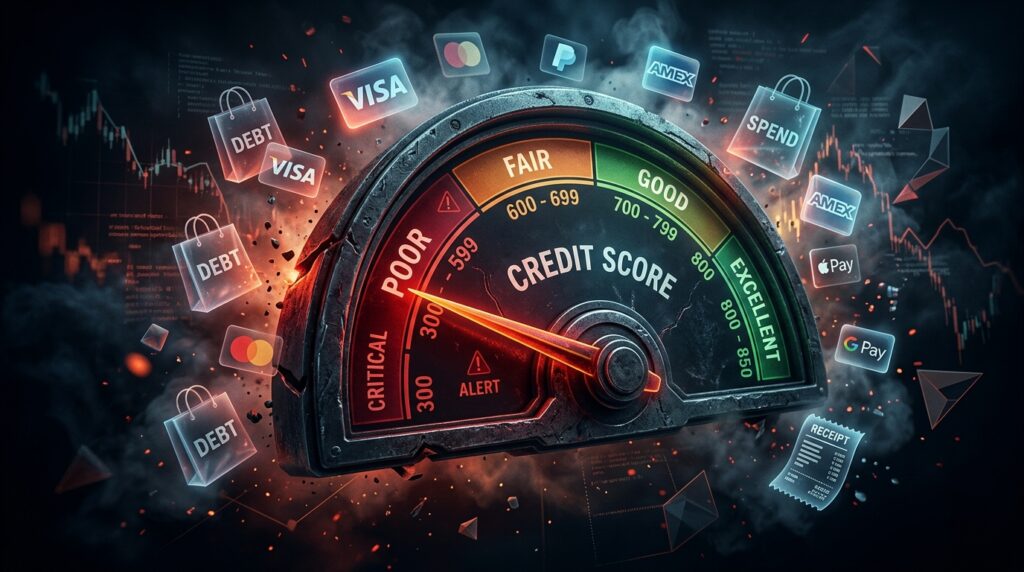
One of the most pervasive myths surrounding BNPL is that it is entirely invisible to credit bureaus. While many providers advertise that they do not perform hard credit checks for standard purchases, this does not mean your credit profile remains untouched.
Providers often conduct soft credit pulls for initial approvals, which do not affect your score. However, they frequently switch to hard inquiries for larger purchase amounts or longer payment terms. These hard inquiries can temporarily drop your credit score by several points. If you apply for multiple BNPL plans across different platforms in a short period, the compounded hard inquiries can cause significant damage.
Even more concerning is the asymmetrical way BNPL companies report your payment history. Many of these services do not report your on-time payments to the major credit bureaus. This means you get absolutely zero credit-building benefit for being a responsible borrower. However, if you miss a payment or default, they will absolutely report it to collection agencies and credit bureaus. You face all the downsides of credit reporting with none of the upside.
Furthermore, frequent use of BNPL harms your credit mix and the length of your credit history. Credit scoring models, like FICO, favor a diverse mix of credit types (revolving credit like cards, and installment loans like auto loans) and long-standing account relationships. By relying exclusively on BNPL, you miss the opportunity to build a robust traditional credit profile. Young adults who use these services exclusively often find themselves with “thin” credit files later in life, making it incredibly difficult to qualify for favorable rates on major purchases.
This fragmented debt also heavily impacts lending decisions. When you apply for a mortgage, auto loan, or traditional credit card, lenders specifically ask about BNPL commitments during underwriting. Even if the debt does not appear on your credit report, it reduces your disposable income. Lenders view this as a risk, which can result in higher interest rates, lower credit limits, or outright loan denials. In fact, many mortgage lenders now require borrowers to pay off all BNPL debt before closing on a home.
Hidden Fees, Interest Rates, and the Debt Spiral
The “interest-free” marketing is often highly misleading. While short-term, four-payment BNPL plans might genuinely be interest-free, longer payment plans offered by these same companies can carry Annual Percentage Rates (APRs) ranging from 0% to 36%. For borrowers with less-than-perfect credit, these rates are often significantly higher than those of traditional, low-interest credit cards.
Late fees are another hidden cost that catches consumers off guard. Some platforms charge up to $7 or $8 per missed payment. While this might seem like a minor inconvenience in isolation, these fees add up rapidly when you are juggling multiple BNPL commitments across different apps. Some platforms also tack on processing fees for certain payment methods, instantly turning your “free” installment plan into an expensive mistake.
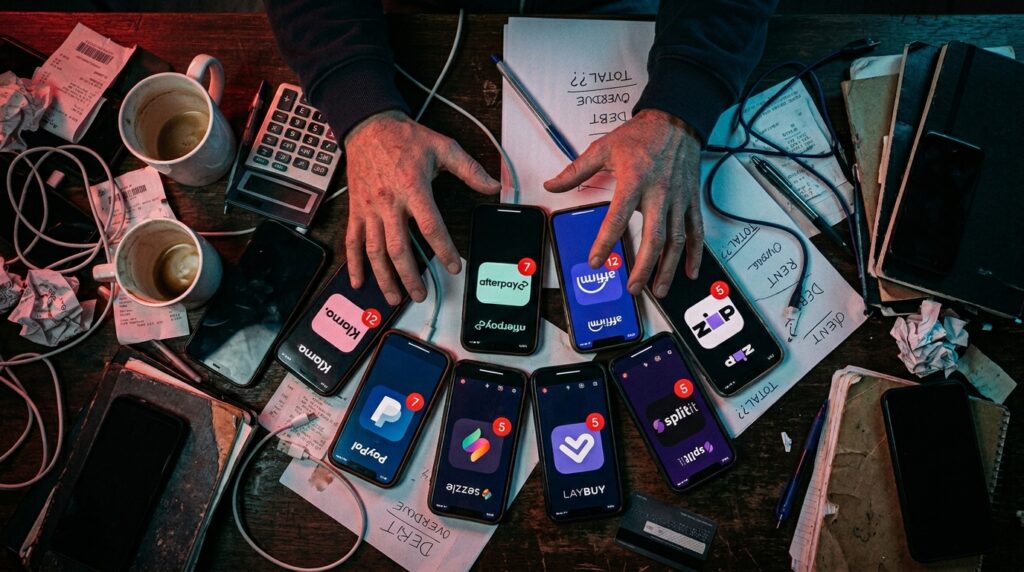
Perhaps the most dangerous mechanical feature of BNPL is the debt spiral effect. These services make it dangerously easy to accumulate debt across multiple platforms simultaneously. Unlike a traditional credit card, which has one clear limit and one consolidated balance, BNPL allows you to spread purchases across Klarna, Affirm, Afterpay, and others without any comprehensive view of your total obligations.
This fragmentation makes it nearly impossible to accurately track your actual debt-to-income ratio. You might feel that your payments are manageable with each individual service, but collectively, you could be drowning in debt. The psychological effect is particularly insidious: because each individual purchase feels affordable when broken down, it masks the reality of your rapidly growing financial burden. You are essentially taking out dozens of micro-loans, none of which communicate with each other, leading to a fragmented debt spiral that is incredibly difficult to escape.
The Psychological Illusion of Affordability
BNPL services create a powerful illusion of affordability that directly leads to poor financial decisions. Breaking a $200 purchase into four $50 payments does not make that item more affordable; it merely delays the financial impact.
This payment structure tricks your brain into justifying purchases you would not otherwise make. By decoupling the joy of consumption from the pain of payment, BNPL removes the psychological barriers that normally prevent overspending. Studies consistently show that consumers using BNPL spend 20% to 30% more than they would if they used traditional payment methods like cash, debit, or even credit cards.
When you pay with cash or debit, you feel the immediate reduction in your bank balance. When you use a credit card, you see a large lump sum added to your monthly statement, which can trigger budget anxiety. BNPL, however, disguises the cost. It makes a luxury item feel like a mundane utility bill. This easy approval process and delayed payment structure lead directly to buyer’s remorse and severe financial stress when the reality of the payments comes due. You are not buying things you can afford; you are buying things you can temporarily stretch to afford, which is a fundamentally different and much more dangerous financial strategy.
Weakened Consumer Protections and Budgeting Nightmares
When you use a traditional credit card, you are shielded by robust federal consumer protections. Credit cards provide dispute rights, chargeback options, and comprehensive fraud protection under laws like the Fair Credit Billing Act. If you receive defective merchandise, a service is not rendered, or you fall victim to fraud, you can withhold payment while the issue is investigated.
BNPL platforms offer minimal consumer protections by comparison. They typically operate with limited dispute resolution processes that heavily favor the merchants. If you receive a defective product, your recourse through the BNPL provider is often severely restricted. Worse, you are usually still obligated to make your scheduled payments even while you are disputing the charges. This creates immediate cash flow problems and potential late fees—a scenario that traditional credit cards simply do not impose.
Furthermore, BNPL companies operate in a regulatory gray area. They face minimal federal oversight compared to traditional banks and lenders. This lack of strict regulation allows them to change terms, conditions, interest rates, and fee structures with very short notice, potentially leaving consumers vulnerable to sudden policy shifts. While regulatory bodies are beginning to investigate these practices, current consumer protections remain woefully inadequate.
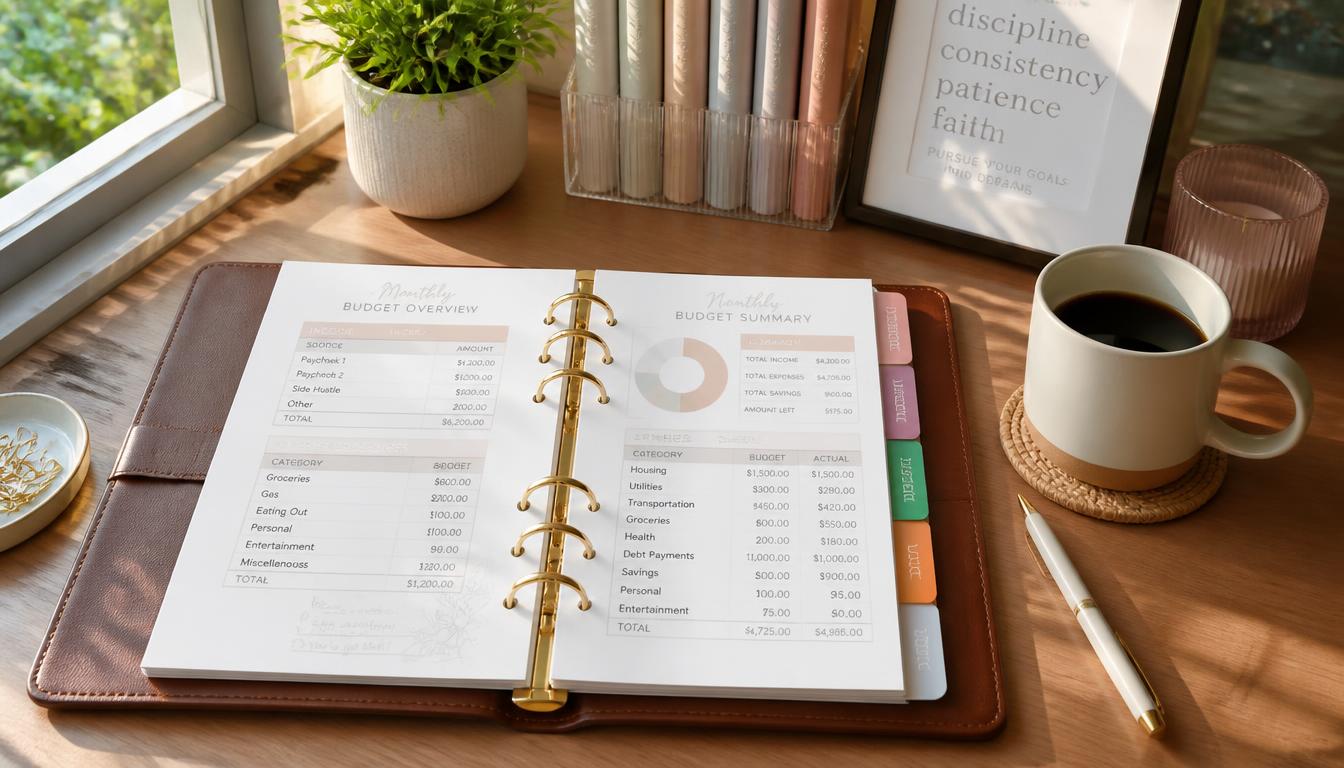
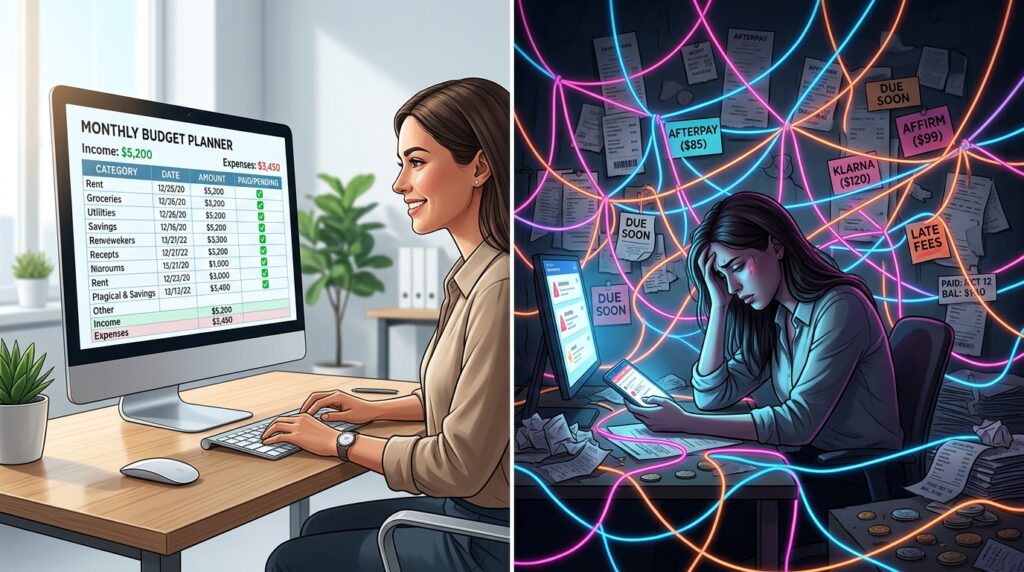
From a budgeting perspective, BNPL is a nightmare. These services disrupt traditional budgeting methods by creating multiple future payment obligations that are incredibly easy to forget or miscalculate. When you have payments due on different dates across various platforms, maintaining a clear, accurate monthly budget becomes nearly impossible. This payment fragmentation frequently leads to accidental missed payments, bank overdraft fees, and severe cash flow problems. Unlike a single credit card payment that you can plan for and automate, multiple BNPL commitments create a complex, tangled web of financial obligations that can easily overwhelm even the most disciplined budgeting system.
The Ultimate Cost: Derailing Long-Term Wealth Building
The most dangerous aspect of Buy Now, Pay Later is not just the immediate debt; it is how it fundamentally derails your long-term wealth-building strategies. Every single dollar committed to a BNPL payment is a dollar that is not being invested in appreciating assets, index funds, or your emergency savings.
Consider the opportunity cost. If you commit $100 a month to paying off various BNPL purchases, that is $1,200 a year. If that money were instead invested in a diversified S&P 500 index fund averaging an 8% annual return, it would grow to over $18,000 in ten years, and nearly $45,000 in twenty years. By using BNPL, you are actively stealing from your future self to fund present consumption.
Moreover, the habit of instant gratification fostered by BNPL prevents the development of crucial financial discipline required for wealth accumulation. Wealth building requires delayed gratification—the ability to save for a purchase, wait, and invest the difference. BNPL users often find themselves in perpetual payment cycles, constantly paying off last month’s purchases while simultaneously financing this month’s. This treadmill prevents capital accumulation entirely. You cannot build wealth if your future income is already spoken for before you even earn it.

Conclusion
Buy Now, Pay Later is not a harmless convenience; it is a sophisticated financial product designed to maximize merchant sales at the expense of your financial health. From hidden fees and asymmetrical credit reporting to the erosion of consumer protections and the destruction of your long-term wealth, the risks far outweigh the temporary convenience of splitting a payment.
To protect your financial future, you must break the cycle of instant gratification. If you cannot afford to pay for an item in full at the checkout, you cannot afford it at all. Instead of relying on BNPL, build a robust emergency fund, use a rewards credit card (paid in full every month) for consumer protections, and practice the discipline of saving for your purchases. Stay smart, stay cautious, and make sure your money works for you, not for the BNPL algorithms.
Frequently Asked Questions (FAQ)
1. Does Buy Now, Pay Later hurt your credit score?
It can, but often in hidden ways. While many BNPL services only perform a “soft” credit check that doesn’t affect your score, they may perform a “hard” inquiry for larger purchases, which can temporarily lower your score. More importantly, while they often do not report your on-time payments to build your credit, they will absolutely report missed payments and defaults to collection agencies, which can severely damage your credit score.
2. What happens if I miss a payment on a BNPL app?
If you miss a payment, the BNPL provider will typically charge a late fee (often between $7 and $8). If the payment remains unpaid, the account may be sent to a third-party collection agency, which will then be reported to the major credit bureaus, causing significant and long-lasting damage to your credit score. Additionally, the app may restrict your ability to make future purchases.
3. Is it better to use a credit card or Buy Now, Pay Later?
For most consumers, a traditional credit card is significantly safer and more beneficial. Credit cards offer robust federal consumer protections, including fraud liability limits and the ability to dispute charges and withhold payment for defective goods. Furthermore, if you pay your credit card in full every month, it helps build your credit history without incurring interest. BNPL lacks these protections and often fragments your debt.
4. Can having BNPL loans prevent me from getting a mortgage?
Yes, it absolutely can. Mortgage lenders look closely at your Debt-to-Income (DTI) ratio. Even if your BNPL debt does not appear on your credit report, lenders will ask about it during the underwriting process. Because BNPL payments reduce your monthly disposable income, lenders view you as a higher risk. Many mortgage lenders will actually require you to pay off all BNPL balances in full before they will approve your mortgage closing.
5. How do I get out of Buy Now, Pay Later debt?
To get out of BNPL debt, first stop using the services immediately. Next, list out every single BNPL account, the total balance, and the due dates. Create a strict budget to free up cash flow. You can use the “debt snowball” method (paying off the smallest balances first for psychological wins) or the “debt avalanche” method (paying off the highest interest/fee balances first). Consider taking on a temporary side hustle or selling unused items to generate lump-sum payments to clear the fragmented debt as quickly as possible.