Economic downturns can feel incredibly intimidating. The mere mention of a recession often conjures images of job losses, plummeting stock markets, and widespread financial instability. However, the truth is that you can proactively prepare and protect yourself long before the economic chill sets in. By taking deliberate steps to build an emergency fund, reduce unnecessary expenses, manage debt, and stay invested, you can weather any financial storm.
Economic recessions are an inevitable part of the broader financial cycle. While no one can predict the exact timing of the next downturn, being financially prepared makes the difference between barely surviving and remaining completely secure. The best time to prepare for a recession is always before it arrives. Preparation does not just protect your bank account; it protects your peace of mind. Here are ten comprehensive, proven strategies to recession-proof your finances and build lasting economic resilience.
1. Understand the Nature of the Economic Cycle
Before you can effectively prepare for a recession, you must understand exactly what you are preparing for. A recession is fundamentally a slowdown in economic activity. During these periods, businesses earn less revenue, which forces them to cut costs, halt expansion, and sometimes lay off employees. Consequently, consumers spend less, stock markets experience volatility, and unemployment rates rise.
While this sounds alarming, it is crucial to remember that recessions are strictly temporary. Historically, the vast majority of recessions last less than two years, whereas periods of economic expansion and growth often last much longer. For context, following the severe financial crisis of 2008, the economy entered one of the longest expansions in recorded history. Understanding that economic downturns are a normal, temporary phase of the business cycle helps you avoid panic. Instead of reacting with fear, you can focus on logical, strategic preparation.
Actionable Steps:
- Study historical economic cycles to understand that downturns are always followed by recoveries.
- Avoid making emotional financial decisions based on sensationalized news headlines.
- Focus on what you can control: your savings rate, your spending habits, and your skill set.
2. Build a Robust Emergency Fund for Peace of Mind
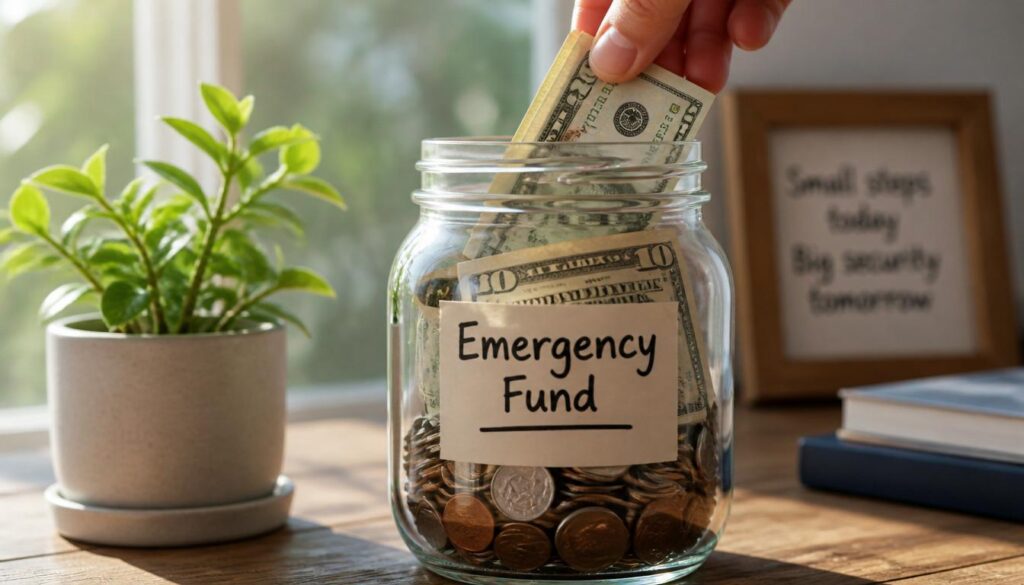
An emergency fund is your financial winter coat; it keeps you protected and warm when the economic chill sets in. Most financial experts recommend saving three to six months’ worth of essential living expenses. While this may sound like an overwhelming amount of money, it does not need to be built overnight.
Start small. Set an initial micro-goal of saving $500, then increase it to $1,000. Once you have a starter fund, aim for one month of expenses, then two, and so on. Over time, these incremental savings compound into a massive safety net. Consider two families facing a sudden layoff during a downturn. The first family has $10,000 in emergency savings; they comfortably cover their bills while they job hunt. The second family has zero savings and is forced to rely on high-interest credit cards, trapping them in debt long after the economy recovers. The difference in their outcomes is not luck; it is preparation.
Actionable Steps:
- Open a High-Yield Savings Account (HYSA) to keep your emergency fund separate from your checking account and earning competitive interest.
- Automate your savings by setting up direct deposits from your paycheck directly into your HYSA.
- Define your “essential monthly expenses” to know exactly what your 3-to-6-month target should be.
3. Proactively Reduce Non-Essential Expenses
One of the most effective ways to prepare for a recession is to trim your lifestyle before you are forced to. When the economy is booming and times are good, lifestyle creep inevitably sets in. People sign up for extra streaming subscriptions, eat out at restaurants regularly, and buy things impulsively online. These little luxuries feel perfectly fine during growth years, but they quickly become heavy burdens when the economy slows down.
For example, spending $15 on a streaming subscription, $50 a week on takeout, and $100 a month on impulse online shopping adds up to nearly $400 a month, or $4,800 a year. Cutting these non-essential expenses does not just free up cash to bolster your emergency fund; it also trains your brain to live on less. If your income suddenly drops, you will already be accustomed to a leaner lifestyle, making the transition much less stressful.
Actionable Steps:
- Conduct a comprehensive audit of your bank and credit card statements from the last 90 days.
- Cancel unused subscriptions, negotiate lower rates on your bills, and implement a 30-day waiting rule for all non-essential purchases.
- Redirect the money saved from these cuts directly into your emergency fund or investment accounts.
4. Crush High-Interest Debt Before It Crushes You
Debt is incredibly stressful in the best of times, but during a recession, it can be completely suffocating. Imagine owing $10,000 on credit cards with a 22% interest rate and then suddenly losing your primary source of income. Suddenly, you are not only struggling to pay for basic groceries, but you are also watching your debt snowball out of control due to compounding interest.
Paying down high-interest debt must be a top financial priority. Utilize proven strategies like the Debt Avalanche method, where you tackle the highest interest rate first to save the most money, or the Debt Snowball method, where you pay off the smallest balances first for quick psychological wins. Every single dollar of debt you eliminate now is one less mandatory bill you have to stress about later.
Actionable Steps:
- List all your debts, noting the total balance and the interest rate for each.
- If you cannot pay off the balances entirely, call your credit card companies and politely ask for a temporary interest rate reduction.
- Consider a 0% APR balance transfer card to halt interest accumulation while you aggressively pay down the principal.

5. Diversify Your Income Streams for Ultimate Stability
Relying on just one source of income is a massive financial risk. If that single paycheck disappears, your entire financial foundation crumbles instantly. This is why diversifying your income streams is an incredibly powerful tool for recession preparedness. You do not need to become a millionaire overnight; even small side hustles can provide a vital financial cushion.
For example, someone who drives for a rideshare app on weekends, sells digital templates online, or freelances as a graphic designer might earn an extra $500 to $1,000 a month. That supplementary money could go straight into your emergency savings, or it could be used to cover essential utility bills if your primary income is reduced or eliminated. Multiple income streams transform a catastrophic financial event into a mere temporary inconvenience.
Actionable Steps:
- Identify your marketable skills and explore freelance platforms like Upwork or Fiverr to offer your services.
- Consider monetizing a hobby, such as crafting, tutoring, or consulting.
- Explore passive income opportunities, such as dividend investing, creating digital products, or renting out a spare room.
6. Stay Invested and Avoid Panic Selling
One of the most catastrophic mistakes people make during a recession is selling their investments at the absolute bottom. When stock markets crash, fear takes over, and the emotional instinct is to liquidate everything to prevent further losses. However, historically, those who hold on—or even buy more—recover much faster and build significantly more wealth.
During major market corrections, many investors panic and sell, locking in their losses permanently. Conversely, those who stay the course and continue to invest through dollar-cost averaging end up buying shares at discounted, lower prices. This sets them up for massive future gains when the market inevitably rebounds. Investing is a long-term game. Your portfolio might look painful on paper during a recession, but history unequivocally shows that broad market indices always recover and reach new record highs.
Actionable Steps:
- Automate your investment contributions so you continue buying index funds consistently, regardless of market conditions.
- Stop checking your investment portfolio daily; check it quarterly or annually to avoid emotional reactions to short-term volatility.
- Rebalance your portfolio annually to ensure your asset allocation still matches your risk tolerance and time horizon.

7. Strengthen Your Career and Expand Your Skill Set
Money is incredibly important, but your fundamental ability to earn it is your greatest asset. During a recession, companies tighten their budgets and often resort to cutting staff. To protect yourself, you must make yourself as valuable and indispensable as possible. Strengthening your career makes you highly resilient to layoffs.
Take the time to update your resume, even if you are not actively looking for a job. Network regularly with colleagues and industry peers. Most importantly, commit to learning new skills. Whether it is mastering a new software, improving your project management capabilities, or learning data analysis, continuous education is key. Many free or low-cost online courses are available to sharpen your expertise. Employees who continuously grow and adapt are consistently viewed as more valuable and are therefore much less likely to be targeted during downsizing.
Actionable Steps:
- Dedicate two hours every week to taking an online course relevant to your industry.
- Update your LinkedIn profile with your latest achievements, skills, and certifications.
- Schedule quarterly “career check-ins” with your manager to discuss your goals and how you can add more value to the company.
8. Review Your Insurance and Safety Nets
Unexpected life emergencies do not politely pause just because the economy is in a recession. Cars break down, people get sick, and accidents happen. Without proper insurance, these unpredictable events can quickly morph into devastating financial disasters.
Take the time to thoroughly review your health, auto, home, renters, and life insurance policies. Ensure you have adequate coverage to protect your assets without overpaying for unnecessary extras. For example, choosing a high-deductible health plan might lower your monthly premiums, but it will leave you highly vulnerable if you face a medical emergency and do not have a robust emergency fund to cover the deductible. Conversely, paying for duplicate coverage or policies you no longer need is a waste of precious cash.
Actionable Steps:
- Shop around and compare quotes from multiple insurance providers to ensure you are getting the best rate.
- Consider adding an umbrella insurance policy for extra liability protection if you have significant assets.
- Ensure your beneficiary designations on all life insurance and retirement accounts are up to date.

9. Master the Barebones Survival Budget
A barebones budget is your ultimate financial survival plan. It is the stripped-down, no-frills version of your monthly finances where you spend money exclusively on absolute essentials: housing, basic groceries, utilities, transportation, and minimum debt payments.
Knowing your barebones number is absolutely crucial. For example, if your household normally spends $4,500 a month, but you could realistically survive on $2,500 by eliminating all luxuries, you have immense financial flexibility. That $2,000 difference gives you profound peace of mind and allows you to stretch your emergency savings much further. The best part? You should try practicing a barebones budget for one full month while times are still good. It is a powerful exercise that proves just how much you can adapt if you ever need to.
Actionable Steps:
- Calculate your absolute minimum monthly survival number by listing only the non-negotiable expenses.
- Challenge yourself to live on this barebones budget for 30 days to test your resilience and boost your savings rate.
- Keep a printed copy of this barebones budget in your financial binder so you can implement it immediately if your income drops.
10. Cultivate a Resilient Financial Mindset
Finally, the most important recession survival tool you possess is your mindset. Fear inevitably leads to panic-driven decisions: selling investments at a loss, overspending to cope with stress, or giving up hope entirely. However, thorough preparation builds unshakable confidence.
If you have diligently saved an emergency fund, ruthlessly reduced your expenses, aggressively paid down toxic debt, and created multiple streams of income, you will face the economic storm from a position of immense strength. Recessions do not last forever. They may test your resolve, but they also create incredible opportunities. Many successful investors and visionary entrepreneurs built the vast majority of their wealth by staying steady and buying assets at a discount during downturns. With the right psychological framework and consistent, disciplined habits, you will not just survive a recession—you will emerge from it more financially secure and wealthy than ever before.
Actionable Steps:
- Practice mindfulness and stress-management techniques to keep your emotions in check during market volatility.
- Surround yourself with a community of like-minded, financially disciplined individuals.
- Focus on the long-term vision of your financial independence rather than short-term economic headlines.

Conclusion
Preparing for a recession is not about living in fear; it is about being exceptionally smart with your money. Economic downturns are a guaranteed part of the financial lifecycle, but your reaction to them is entirely within your control. By building a robust emergency fund, cutting back on non-essential expenses, eliminating high-interest debt, and staying consistently invested, you transform uncertainty into opportunity.
Financial resilience is not built overnight. It is the result of small, daily habits compounded over time. Start implementing these ten strategies today, and you will build a financial fortress capable of withstanding any economic storm. You will not just survive the next recession; you will thrive in the recovery that follows.

Frequently Asked Questions (FAQ)
1. How much money should I realistically have in my emergency fund before a recession hits?
Most financial experts recommend having three to six months’ worth of essential living expenses saved in a highly liquid, easily accessible account, such as a High-Yield Savings Account. If you have a highly volatile income, work in a commission-based role, or are the sole breadwinner for your family, aiming for six to twelve months of expenses is a safer target.
2. Should I stop investing in the stock market if a recession is imminent?
No, you should not stop investing. In fact, stopping your investments during a market downturn means you miss out on buying assets at discounted prices. Historically, the stock market always recovers from recessions. Continuing to invest consistently through a strategy called dollar-cost averaging allows you to buy more shares when prices are low, which significantly boosts your long-term returns when the market rebounds.
3. What is the difference between the Debt Avalanche and Debt Snowball methods?
The Debt Avalanche method focuses on mathematical efficiency; you make minimum payments on all debts, but put every extra dollar toward the debt with the highest interest rate. This saves you the most money over time. The Debt Snowball method focuses on psychological momentum; you pay off the smallest balances first, regardless of the interest rate, giving you quick wins that motivate you to keep going. Choose the method that best fits your psychological needs.
4. How can I create a barebones budget without feeling miserable?
A barebones budget is meant to be a temporary survival tool, not a permanent lifestyle. To avoid feeling deprived, reframe it as a “financial challenge” or a “spending detox.” Focus on free or low-cost ways to enjoy life, such as hiking, hosting game nights at home, or utilizing your local library. Remember that this strict budget is temporary and is actively protecting your future financial freedom.
5. What are the best ways to diversify my income during an economic downturn?
The best ways to diversify income depend on your existing skills and available time. You can offer freelance services in your professional field (like consulting, writing, or graphic design), monetize a hobby by selling crafts or digital products online, participate in the gig economy (like ridesharing or pet sitting), or generate passive income through dividend-paying stocks, peer-to-peer lending, or renting out unused space in your home.