
Are you ready to start building wealth but believe you need thousands of dollars to begin? Think again. In today’s financial landscape, investing is more accessible than ever, and you can get started with just $100. Whether you are saving for the future, a major life goal, or simply want to grow your money, this step-by-step beginner’s guide will show you exactly how to start investing smartly, safely, and confidently with a small amount. Let’s break down the process and take your first step toward financial freedom.
Why Starting with $100 is a Smart Move
Starting your investing journey with just $100 is not only possible; it is a highly strategic move. The financial world has been revolutionized by technology, micro-investing apps, and commission-free trading platforms. You no longer need a massive bankroll or a degree in finance to build wealth.
Starting small allows you to develop crucial financial habits, learn how the markets operate, and build your confidence without risking your life savings. With inflation remaining a persistent concern and the cost of living rising globally, your cash loses purchasing power when it sits idle in a traditional bank account. Investing ensures your money works for you.
While $100 might seem modest, the magic of compound interest means it can yield substantial growth over time. For instance, a 10% annual return on $100, compounded monthly over 30 years, could grow to more than $2,000 without you ever adding another penny. The true point is not the initial amount, but the momentum. Beginning with $100 shifts your mindset toward long-term wealth creation. The psychological win of taking control of your finances, even with a small amount, can be transformative. Don’t wait until you have “more” money; start with what you have right now.
Set Clear and Actionable Investment Goals
Before you invest a single dollar, it is crucial to understand exactly why you are investing. Your investment goals will dictate your decisions, your timeline, and your risk tolerance.
Are you investing for short-term goals, such as buying a new laptop or funding a vacation in the next year? Or are you focused on long-term objectives like retirement, buying a home, or building generational wealth? The distinction is vital. For short-term goals, you want low-risk, easily accessible investments like high-yield savings accounts or short-term bond funds. You cannot afford to lose this money to market volatility.
For long-term goals, you can afford to take on more risk for greater potential returns, such as investing in stocks or diversified Exchange-Traded Funds (ETFs). Spend time assessing your timeline, current income, monthly expenses, and personal comfort with risk. Use online compound interest calculators to estimate how much you might need and what kind of return you will need to reach your target.
If your goal is retirement decades away, investing $100 now is a fantastic foundation. You do not need to get your strategy perfect right away; your plan will naturally evolve as your life changes. The key is clarity. If you do not know where you are going, any road will get you there, and that is a dangerous approach in the world of investing.
Understand the Basic Investment Concepts
Before diving into the market, familiarize yourself with fundamental investing concepts. You do not need to be a Wall Street analyst, but basic financial literacy is essential to protect your capital.
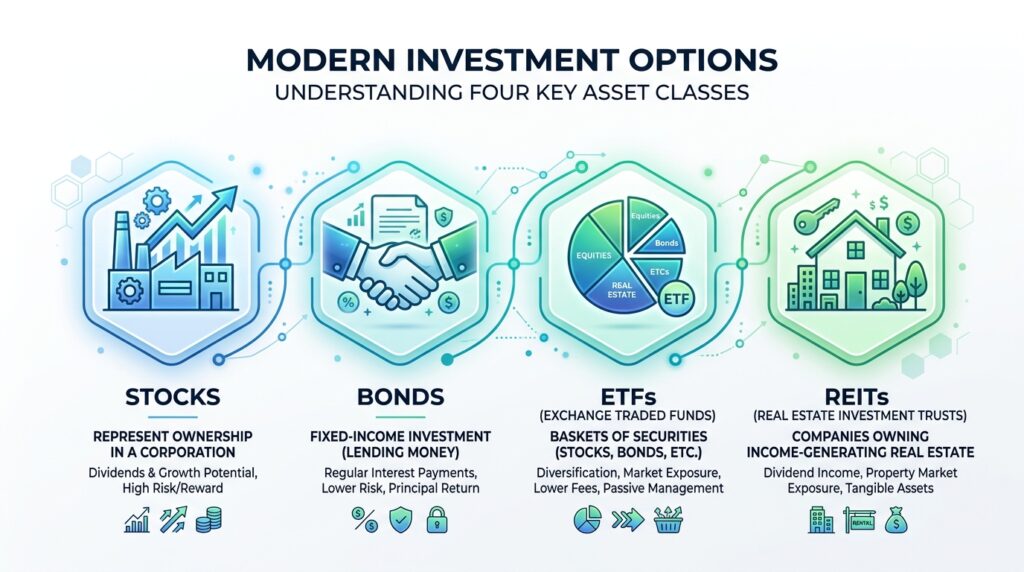
Begin by understanding the core asset classes:
- Stocks: Represent partial ownership in a specific company. They offer high growth potential but come with higher volatility.
- Bonds: Essentially loans you give to corporations or governments in return for fixed interest payments. They are generally safer than stocks.
- ETFs and Mutual Funds: These bundle multiple assets together, giving you automatic diversification. This is the secret weapon for beginners.
- REITs: Real Estate Investment Trusts allow you to invest in real estate without having to buy or manage physical property.
Diversification is the key to managing risk; it spreads your money across various assets so that if one fails, the others can cushion the blow. Next, grasp the concept of compound interest—the powerful force that allows your money to grow exponentially by earning returns on your previous returns.
You should also understand market terminology like “bull market” (rising prices) and “bear market” (falling prices), as well as the difference between active investing (frequently buying and selling to beat the market) and passive investing (buying and holding index funds to match the market long-term). Utilize free online resources, podcasts, and beginner-friendly books to build your knowledge. The more you know, the less likely you are to make emotional, panic-driven decisions when the market fluctuates.
Choose the Right Investment Platform
With your $100 ready and your knowledge expanding, it is time to pick an investment platform. Fortunately, the modern market offers an array of user-friendly, low-cost options tailored for beginners.
When evaluating platforms, look for specific features that maximize your small starting capital. First, ensure there are no account minimums and zero commission trading. You do not want fees eating up your initial $100. Second, look for platforms that offer fractional shares. Fractional shares allow you to buy a piece of a stock instead of a whole one. For example, if a top tech company trades at $150 a share, you can invest just $10 and own a fraction of that share.
Popular choices include major brokerages that offer robust mobile apps, as well as robo-advisors that automate your investing based on your specific goals and risk tolerance. If you prefer a “set it and forget it” approach, robo-advisors are ideal. Alternatively, micro-investing apps that round up your daily purchases and invest the spare change can help you accumulate more capital over time.
Crucially, ensure the platform is properly regulated and offers SIPC (Securities Investor Protection Corporation) insurance, which protects your securities up to $500,000 in the event the brokerage fails. Read user reviews, explore the user interface, and ensure the platform offers educational tools to help you learn as you go.
Open and Fund Your First Account
Once you have chosen the right platform, opening an account is a straightforward process that usually takes less than ten minutes. You will typically need to provide your legal name, home address, Social Security Number (for tax reporting purposes), employment status, and your bank account information for funding.
During this step, you must choose the type of account that fits your goals. You can open a standard taxable brokerage account, which gives you access to your money anytime without penalty, or a retirement account like a Roth IRA, if you meet the income eligibility requirements. A Roth IRA is specifically for retirement and offers powerful tax advantages, allowing your money to grow tax-free. Most beginners start with a standard brokerage account for maximum flexibility while they learn the ropes.
Once your account is approved and open, link your external bank account and initiate your $100 deposit. Many modern platforms offer instant funding or allow you to trade with pending funds. Before you make your first trade, take a moment to secure your account by setting up two-factor authentication (2FA). Familiarize yourself with the platform’s dashboard, look for watchlist features, and explore any paper-trading simulators they offer to practice without risking real money.

Start with Low-Cost, Diversified Investments
With your account funded, the next step is making your first investment. Since you are starting with $100, low-cost, highly diversified options are your best friend.
The simplest and safest way to start is by purchasing ETFs. These are bundles of stocks or bonds that trade like individual stocks but provide instant diversification across hundreds or thousands of companies. Look for broad-market ETFs with ultra-low expense ratios (ideally below 0.10%). Excellent examples include total US stock market funds or S&P 500 index funds. These give you a tiny slice of the largest, most successful companies in the economy all at once. If you are interested in socially responsible investing, you can easily find ESG (Environmental, Social, and Governance) screened ETFs.
Because your chosen platform supports fractional shares, do not worry if a specific ETF or individual stock costs more than your $100 balance. You can invest exactly what you have.
As a beginner, strictly avoid penny stocks, highly speculative cryptocurrencies, or trending “meme” stocks. While they might seem tempting for quick riches, they are incredibly risky and statistically likely to result in losses. Your goal right now is not to get rich overnight; it is to learn the mechanics of the market and build a solid foundation. Use this initial phase to experiment, track your investments, and pay attention to how the markets move on a daily basis.
The Magic of Consistency: Dollar-Cost Averaging
Making your first $100 investment is a massive milestone, but it is only the beginning. To truly build wealth, you need to embrace the strategy of dollar-cost averaging. This simply means investing a fixed amount of money at regular intervals, regardless of what the market is doing.
Even if you can only afford to add $10, $25, or $50 a month to your initial $100, this consistency creates financial discipline. When the market is down, your fixed amount buys more shares. When the market is up, your portfolio grows in value. Over time, this smooths out the average price you pay for your investments and removes the emotional stress of trying to “time the market.”
Set up automatic transfers from your checking account to your investment account on payday. By automating the process, you remove the temptation to spend the money elsewhere. You are not aiming for instant riches; you are building long-term, sustainable wealth one smart, consistent step at a time.

Conclusion
Starting your investing journey with just $100 is one of the most empowering financial decisions you can make. It shatters the myth that you need to be wealthy to build wealth. By setting clear goals, understanding the basics, choosing the right platform, and starting with low-cost, diversified ETFs, you lay a rock-solid foundation for your financial future. Remember that investing is a marathon, not a sprint. The most important step is simply taking that first one. Open your account, make your first trade, set up automatic contributions, and let the incredible power of compound interest do the heavy lifting for you. Your future self will thank you for starting today.
Frequently Asked Questions (FAQ)
1. Can I really start investing with only $100?
Yes, absolutely. Thanks to modern technology, commission-free trading, and the availability of fractional shares, you can start investing with as little as $5 to $100. You do not need thousands of dollars to open an account or buy into the stock market.
2. What is the best thing to invest in for a beginner with $100?
For beginners, broad-market Exchange-Traded Funds (ETFs) that track the S&P 500 or the total US stock market are generally the best option. They offer instant diversification, have very low fees, and spread your risk across hundreds of top companies, making them much safer than buying individual stocks.
3. Should I open a Roth IRA or a standard brokerage account?
It depends on your goals. If this $100 is strictly for retirement and you want your investments to grow tax-free, a Roth IRA is an excellent choice. However, if you want the flexibility to withdraw the money before retirement age for a house, emergency, or other life events, a standard taxable brokerage account is the better option.
4. What are fractional shares and why do they matter?
Fractional shares allow you to buy a specific dollar amount of a stock or ETF rather than a whole share. If a single share of a company costs $300 and you only have $100, fractional shares allow you to buy exactly one-third of a share. This is crucial for beginners because it allows you to invest in expensive, high-quality companies with a small budget.
5. How do I avoid losing my $100 to fees?
To protect your initial capital, only use brokerage platforms that offer zero-commission trading and have no account maintenance fees. Additionally, when buying ETFs or mutual funds, check the “expense ratio.” Aim for funds with an expense ratio below 0.10% so that management fees do not eat away at your small investment.