
For many people, the mere mention of the stock market triggers a wave of anxiety. Images of chaotic trading floors, flashing red and green ticker tapes, and complex financial jargon can make the idea of investing feel incredibly intimidating. Add in sensationalized news stories about market crashes, and it is no wonder that millions of people choose to keep their money safely tucked away in traditional savings accounts. Yet, avoiding the market altogether often means missing out on the single most powerful wealth-building tool available to the modern consumer.
The good news is that investing does not have to be complicated, risky, or scary. With the advent of beginner-friendly apps, simple strategies like index funds, and a structured, step-by-step approach, anyone can get started. As a financial advisor, my goal is to demystify the process. Let us break down the easiest, most effective ways to start your investing journey, even if you are terrified of taking the first step.
The Prerequisite: Secure Your Financial Foundation
Before we dive into stocks and funds, we must establish a crucial rule of personal finance: never invest money you cannot afford to lose in the short term. Before deploying capital into the market, ensure you have a fully funded emergency account covering three to six months of living expenses. This cash buffer prevents you from having to sell your investments at a loss if an unexpected expense arises. Additionally, prioritize paying off high-interest debt, such as credit card balances. The guaranteed “return” of eliminating a 20% interest credit card debt far outweighs the average historical return of the stock market. Once your foundation is solid, you are ready to build.
1. Understanding Why Investing Matters in the First Place
Before diving into apps or funds, you must understand the fundamental “why” behind investing. Simply keeping your money in a standard bank savings account does not allow it to grow in real terms. In fact, it guarantees a loss of purchasing power over time.
Inflation is often called the silent thief of wealth. It eats away at your money’s buying power every single year. If inflation averages 3% annually, the $10,000 you have tucked under your mattress today will only be able to buy about $7,400 worth of goods in a decade. Investing, however, allows your money to grow faster than the rate of inflation. By putting your capital into productive assets like stocks, bonds, or real estate, you give it the chance to compound. Compounding means your money earns returns, and then those returns start earning returns of their own. This snowball effect is the mathematical engine that turns small, consistent contributions today into significant, life-changing wealth in the future.
2. Busting the Wealth Myth: You Don’t Need to Be Rich to Begin
One of the most pervasive and damaging myths about the stock market is that it is an exclusive club reserved only for the wealthy. Decades ago, this was somewhat true; buying stocks required large sums of capital and high broker commissions.
Today, the landscape has completely transformed. The democratization of finance means you can begin your investing journey with as little as $5 or $10. The introduction of fractional shares is a game-changer for beginners. If a single share of a top-tier company costs $3,000, you do not need to save up thousands of dollars to own it. You can simply buy a fraction of that share for $50. Furthermore, mutual funds and exchange-traded funds (ETFs) allow you to invest small amounts across hundreds of companies simultaneously. This unprecedented accessibility means that regardless of your income level, you can begin building wealth right now.

3. Conquering Fear by Starting Small
Fear is the number one psychological barrier that holds beginners back from investing. People worry about losing everything, making a foolish mistake, or buying at the absolute peak of a market cycle. The most effective antidote to this fear is simply to start small.
You do not need to throw your entire life savings into the market on day one. Instead, begin with a small, highly manageable amount that you would not stress over if it temporarily dropped in value. This could be $20 or $50 a month. The goal of your first few investments is not to get rich quickly; the goal is to build the habit and desensitize yourself to market fluctuations. As you watch your account grow and become familiar with how the mechanics of investing work, your confidence will naturally increase. Experience is the ultimate teacher, and starting small removes the paralyzing pressure while building valuable, lifelong financial habits.
4. Choosing the Right Platform and Account Type
Technology has made executing trades easier than ever, but choosing the right platform and account type is critical. Today’s beginner-friendly brokerages and apps offer automated investing, robust educational tools, and zero-commission trading.
When selecting a platform, consider your desired level of involvement. If you want a completely hands-off approach, look into robo-advisors or micro-investing apps that automatically round up your daily purchases and invest the spare change. If you prefer a bit more control, choose a reputable, low-cost brokerage that offers fractional shares and no account minimums.
Equally important is choosing the right type of account. If you are investing for retirement, prioritize tax-advantaged accounts like an employer-sponsored 401(k) (especially if there is a company match, which is essentially free money) or an Individual Retirement Account (IRA). These accounts offer significant tax benefits that can accelerate your wealth building. For goals that are further out but not strictly for retirement, a standard taxable brokerage account offers maximum flexibility.
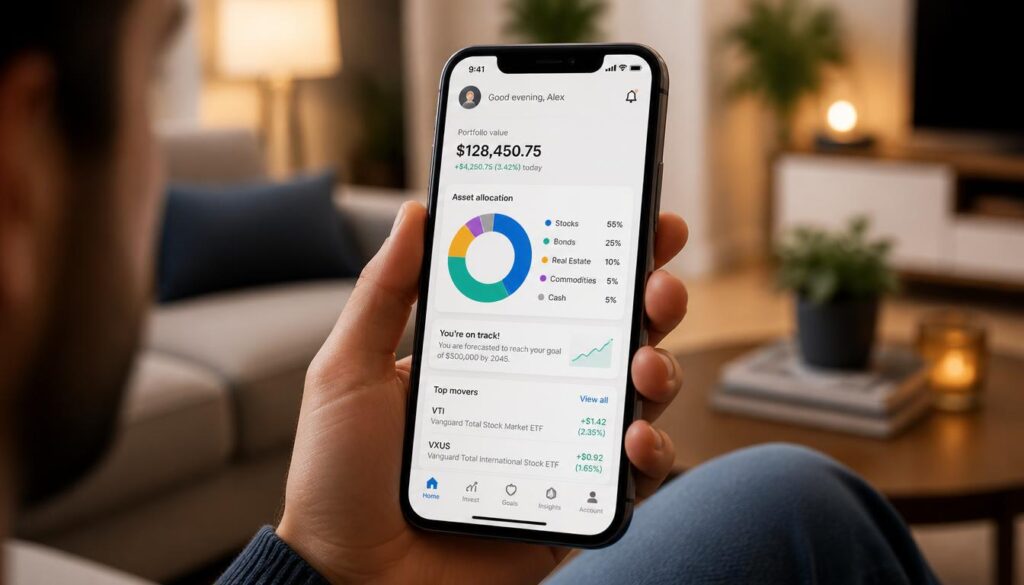
5. Understanding Index Funds: The Beginner’s Best Friend
If you have ever felt overwhelmed by the idea of researching and picking the “right” individual stock, here is the ultimate secret: you do not have to. Index funds are widely considered by financial experts to be the easiest, safest, and most reliable way for beginners to invest.
An index fund is a single investment vehicle that contains a collection of many stocks, bundled together to mirror a specific market index, such as the S&P 500. When you buy one share of an S&P 500 index fund, you are instantly buying a tiny slice of the 500 largest publicly traded companies in the United States. Instead of betting your financial future on the success of one single company, you are betting on the overall growth of the entire economy.
Historically, the broad stock market has returned an average of 7% to 10% annually over the long term. Index funds capture this growth while carrying incredibly low fees (expense ratios). They require zero constant monitoring, no deep financial analysis, and no stress over earnings reports. For a beginner, index funds provide instant diversification and peace of mind.
6. Automating Your Investments Through Dollar-Cost Averaging
Another brilliant way to reduce fear and eliminate stress is to remove the impossible task of “timing the market.” Trying to guess the absolute best day to buy or sell is a fool’s errand; even Wall Street professionals struggle with it consistently.
Instead, beginners should utilize a proven strategy called Dollar-Cost Averaging (DCA). This simply means investing a fixed amount of money at regular, predetermined intervals, regardless of what the market is doing. For example, you might set up an automatic transfer of $200 on the first day of every month.
When the market is high, your $200 buys fewer shares. When the market dips and goes on “sale,” your $200 automatically buys more shares. Over time, this averages out your cost per share and smooths out the volatility of the market. Because most investing apps allow you to set up automatic deposits, this strategy enforces discipline, removes emotional decision-making, and ensures you are consistently building your position.

7. Learning the Basics of Risk and Diversification
It is vital to understand that all investing involves risk. However, in the financial world, risk does not necessarily mean a guaranteed permanent loss of capital; it means volatility and fluctuation. The value of your investments will go up and down, sometimes on a daily basis. Over long time horizons, however, historical data shows that markets trend upward.
The best way to manage this volatility is through diversification, which is the financial equivalent of “not putting all your eggs in one basket.” By spreading your money across different investments, sectors, and asset classes, you protect yourself from catastrophic losses if one specific area underperforms. As mentioned, broad-market index funds provide excellent baseline diversification. As your portfolio grows, you can diversify further by mixing in bonds (which are generally less volatile than stocks), international funds, or real estate investment trusts (REITs). Understanding that short-term dips are a normal, expected part of the process will help you stay calm and focused on long-term growth.
8. Building Confidence Through Education and Experience
The more you understand the mechanics of investing, the less intimidating it feels. Financial anxiety is often just a fear of the unknown. Beginners should take advantage of the vast array of free resources available today. Read foundational personal finance books, listen to reputable financial podcasts, and utilize the educational tools built into most modern brokerage apps.
As you learn to comfortably use terms like compound interest, dividend yields, expense ratios, and asset allocation, the mystery of the stock market begins to fade. More importantly, nothing builds confidence quite like real-world experience. The act of making your very first investment, even if it is just $20 into a broad market index fund, creates a profound sense of empowerment. Each month you contribute, you will see your account grow, gaining a firsthand, practical understanding of how wealth is actually built.
9. Creating an Investment Plan That Matches Your Goals
Before diving in too deep, take a step back and think about what you are actually investing for. Your specific goals will dictate your investment strategy and your risk tolerance.
Are you investing for a retirement that is 30 years away? If so, you can afford to take on more risk with a portfolio heavily weighted toward stock index funds, because you have decades to recover from any market downturns. Are you saving for a down payment on a house in three years? For shorter-term goals, you should prioritize capital preservation, utilizing safer, more stable investments like high-yield savings accounts, certificates of deposit (CDs), or bond funds.
Having a clear, written plan keeps you grounded. Beginners often panic and sell their investments when the market experiences a temporary dip. But if you have a clear long-term plan tied to your life goals, you will know to stay invested, ignore the noise, and ride out the storm.
10. Taking the First Step and Staying Consistent
The single most important thing you can do as a beginner is to simply start. Waiting for the “perfect time” to enter the market, or trying to read every book on finance before buying your first share, often leads to years of missed opportunities and lost compound growth.
Investing is exactly like planting a tree. The best time to plant a tree was twenty years ago; the second best time is today. Begin with a small contribution. Choose a beginner-friendly app, open the appropriate account, and invest in a low-cost index fund. From there, the ultimate key to success is consistency. Keep investing regularly, automate the process, and refuse to panic during market swings. Remember that true wealth builds gradually, not overnight. Over time, your money will grow, your financial confidence will strengthen, and the fear that once held you back will completely disappear.
Conclusion
Getting started is undeniably the hardest part of the investing journey, but once you take that crucial first step, the process becomes remarkably straightforward and far less scary. By understanding the destructive power of inflation, leveraging the accessibility of fractional shares, and utilizing the passive power of index funds, you can bypass the complexities of the stock market. Whether you use an automated app or manually set up a monthly transfer into a diversified portfolio, you are taking control of your financial future. Stop letting fear dictate your financial destiny. Start small, stay consistent, and let the mathematical magic of compound interest work in your favor.
Frequently Asked Questions
1. How much money do I actually need to start investing?
You do not need a massive amount of capital to begin. Thanks to the rise of fractional shares and micro-investing apps, you can start investing with as little as $5 to $10. The most important factor is not the initial amount, but the consistency of your contributions over time. Start with whatever you can comfortably afford and increase your contributions as your income grows.
2. What is the safest investment strategy for a complete beginner?
For beginners, the safest and most highly recommended strategy is investing in broad-market, low-cost index funds or Exchange-Traded Funds (ETFs), such as those that track the S&P 500. These funds provide instant diversification across hundreds of top companies, significantly reducing the risk associated with picking individual stocks. Additionally, ensuring you have an emergency fund in a High-Yield Savings Account before investing is a critical safety measure.
3. How often should I check my investment portfolio?
It is highly recommended to check your portfolio infrequently—perhaps once a quarter or even just once a year. Checking your investments daily or weekly can lead to emotional decision-making and panic selling during normal market fluctuations. Set up automatic contributions, review your asset allocation annually to ensure it still matches your goals, and then let your investments grow undisturbed.
4. Should I pay off my debt before I start investing?
Generally, yes, with one major exception. You should always prioritize paying off high-interest debt, such as credit card balances, before investing, as the interest rates on these debts usually far exceed any reasonable return you could get in the stock market. However, if your employer offers a 401(k) match, you should contribute enough to get the full match before paying off lower-interest debt, because an employer match is an immediate, guaranteed 100% return on your money.
5. What is the difference between an Index Fund and an ETF?
Both index funds and ETFs (Exchange-Traded Funds) are designed to track a specific market index and offer instant diversification. The primary difference lies in how they are traded. Traditional index mutual funds are priced and traded only once a day at the market close. ETFs, on the other hand, trade on an exchange just like individual stocks, meaning their prices fluctuate throughout the day and you can buy or sell them at any time during market hours. For most beginners, both are excellent, low-cost options.