
Investing is one of the most powerful vehicles for building long-term wealth, but beginners often stumble into predictable traps that erode their returns. The most common pitfalls include attempting to time the market, chasing speculative hot tips, ignoring the silent drag of high fees, letting emotions dictate financial decisions, neglecting proper diversification, and underestimating the mathematical power of time. By shifting to a strategy rooted in dollar-cost averaging, low-cost index funds, disciplined emotional control, and the patience to let compound interest work, new investors can avoid these costly errors and build a resilient, thriving portfolio.
Investing is undeniably one of the most effective ways to build generational wealth and achieve financial independence. However, the path to financial freedom is rarely a straight line, and it is incredibly easy to make costly mistakes, especially when you are just starting your journey. The financial markets can be intimidating, filled with complex jargon, flashing screens, and conflicting advice. For a novice, this environment often leads to missteps that can severely hold you back from reaching your financial goals.
Understanding what not to do is just as important as knowing what to do. By identifying the most common traps that ensnare new investors, you can pivot toward smarter, more sustainable strategies. If you are ready to invest with confidence, protect your capital, and grow your wealth the right way, it is time to leave the gimmicks behind and focus on proven financial principles.
The Danger and Illusion of Market Timing
One of the most pervasive and damaging mistakes new investors make is trying to time the market. The concept sounds incredibly logical on the surface: buy assets when prices are low and sell them when they are high. It is the ultimate goal of every trader. Unfortunately, the reality of executing this strategy is nearly impossible, even for seasoned professionals with access to billions of dollars in research and supercomputers.
Financial markets are complex, adaptive systems influenced by countless unpredictable variables. Economic data releases, sudden shifts in interest rates, geopolitical conflicts, natural disasters, and the collective psychology of millions of investors all interact in ways that make short-term price movements essentially random. When beginners attempt to time the market, they usually end up sitting on the sidelines in cash, waiting for the “perfect” dip that never seems to come. By the time they feel confident enough to invest, the market has already rallied, meaning they missed the best days of growth and are now buying at a peak.
The Smarter Strategy: Dollar-Cost Averaging Instead of trying to predict the unpredictable, embrace a long-term perspective through a method known as dollar-cost averaging (DCA). This involves investing a fixed amount of money at regular intervals—such as every month or every quarter—regardless of what the market is doing.
When the market is down, your fixed investment buys more shares. When the market is up, your investment buys fewer shares. Over time, this mathematical approach lowers your average cost per share and smooths out the volatility of the market. More importantly, it guarantees that your money remains consistently invested, which is the true secret to capturing long-term market returns. Time in the market will almost always beat timing the market.
The Trap of Chasing Hot Tips and Fleeting Trends
We live in an era of unprecedented information access. Social media feeds are constantly flooded with stories of overnight millionaires who made fortunes on the latest meme stock, obscure cryptocurrency, or trending tech sector. It is incredibly easy to experience FOMO (Fear Of Missing Out) and jump into the latest investing trend based on a hot tip from a friend, an internet influencer, or a sensationalized news headline.
The excitement of a potential quick profit is intoxicating, but this type of investing is pure speculation, not investing. It is rarely based on solid fundamentals, cash flow, or sustainable business models. The harsh reality of market dynamics is that by the time a “hot tip” reaches the mainstream retail investor, the smart money has already bought in and driven the price up. You are essentially providing exit liquidity for early investors. When the hype fades, the price crashes, leaving latecomers with massive losses.
The Smarter Strategy: Focus on Fundamentals and Your Personal Goals A successful investor ignores the noise and focuses on investments that align strictly with their personal financial goals, risk tolerance, and time horizon. Instead of rushing into what is currently popular on social media, take the time to research asset classes that have proven track records of sustainable growth over decades.
Successful investing is not about hitting a home run on a single speculative bet; it is about hitting base hits consistently. Build a portfolio based on solid economic principles, focusing on broad market growth rather than trying to pick the needle in the haystack. Just buy the whole haystack through broad market index funds.

The Silent Killer: Ignoring Fees and Hidden Costs
Fees are the silent killer of investment returns. When you are just starting out with a small portfolio, a one percent management fee might seem like a negligible amount of money. However, as your portfolio grows over the decades, these seemingly small percentages compound against you, eating away at your wealth in a massive way.
Many beginners overlook the impact of expense ratios, trading commissions, and hidden administrative costs attached to their investment products. For example, actively managed mutual funds often charge fees upwards of one to two percent annually. Despite these high costs, historical data consistently shows that the vast majority of actively managed funds fail to outperform their passive benchmark indexes over a fifteen or twenty-year period. If you are paying a premium for active management and still getting market returns (or worse), you are essentially throwing money away. Over a thirty-year investing horizon, a mere one percent difference in annual fees can cost you hundreds of thousands of dollars in lost compound growth.
The Smarter Strategy: Minimize Costs with Index Funds and ETFs Pay attention to costs from day one. The most effective way to do this is to choose low-cost index funds or Exchange-Traded Funds (ETFs). These passive funds simply track a broad market index, like the S&P 500, requiring very little human management. Because of this, their expense ratios are incredibly low, often ranging from 0.03% to 0.10%.
Furthermore, take advantage of the modern brokerage landscape. Many online brokerages now offer commission-free trading and zero-account minimums. By ruthlessly minimizing fees, you allow more of your money to stay invested, working for you and compounding over time.

Mastering Your Mindset: Stopping Emotional Investing
The financial markets are a transfer mechanism from the impatient to the patient. Fear and greed are two primal, powerful forces that can derail even the most meticulously crafted investment plans. Beginners are particularly susceptible to emotional decision-making because they have not yet experienced the psychological toll of market cycles.
When the market experiences a sharp dip or a bear market, fear takes over. Beginners panic, look at their temporary paper losses, and sell their investments to “stop the bleeding.” Tragically, this locks in their losses permanently. On the flip side, when the market is soaring and everyone around them is making money, greed takes over. They rush to buy at the top, overpaying for assets right before an inevitable correction. This destructive cycle of buying high and selling low is the exact opposite of the golden rule of investing.
The Smarter Strategy: Create and Stick to a Written Plan The antidote to emotional investing is a rules-based approach. Before you invest a single dollar, create a clear, written investment plan. Define your specific goals (e.g., retirement in thirty years, buying a house in ten years), determine your exact asset allocation, and establish your risk tolerance.
When you have a plan, you remove the need to make decisions in the heat of the moment. Remind yourself that market volatility is not a bug; it is a feature. It is the price of admission for the higher returns that equities provide over the long term. When the market drops, view it as a discount on your favorite assets, not a disaster. By focusing on the bigger picture and resisting emotional impulses, you transform market volatility from a threat into an opportunity.

The Golden Rule: Why Diversification is Non-Negotiable
Putting all your money into a single stock, a single sector, or a single asset class might feel exciting, but it is essentially gambling. Beginners sometimes make the mistake of concentrating their investments in one area because they read a glowing article about a specific company or believe they have found a guaranteed winner. If that single company faces a scandal, a technological disruption, or a market shift, your entire financial future can be wiped out overnight.
Concentration risk is the easiest way to lose everything. Even the most brilliant companies can fail, and entire sectors can become obsolete. Relying on a single investment to carry your portfolio is a fragile strategy that leaves you highly vulnerable to unpredictable, idiosyncratic risks.
The Smarter Strategy: Build a Globally Diversified Portfolio Diversification is the only free lunch in investing. By spreading your capital across different asset classes—such as domestic stocks, international stocks, bonds, and real estate—you drastically reduce the impact of any single loss on your overall portfolio. If the tech sector experiences a downturn, your holdings in healthcare, consumer staples, or international emerging markets might remain stable or even grow, offsetting the losses.
Think of diversification as assembling a well-rounded sports team; you need defenders, midfielders, and strikers to win the game. A diversified portfolio might not deliver the thrilling, lottery-ticket gains of a single hot stock, but it provides crucial stability, smooths out your returns, and protects you from devastating, portfolio-ending losses. It ensures that you survive the inevitable downturns to capture the long-term upside.

Your Greatest Asset: The Power of Time and Compounding
Perhaps the most tragic mistake beginners make is simply waiting too long to start. Many people delay investing because they feel they do not have enough money, or they are waiting to “know more.” Others start, but expect quick, dramatic results and give up when their portfolio doesn’t double in a year.
The truth is that time is the most valuable, irreplaceable resource an investor possesses. Thanks to the mathematical miracle of compound interest, your money makes money, and then that new money makes even more money. Albert Einstein reportedly called compound interest the eighth wonder of the world. The longer your money has to compound, the more exponential the growth becomes. Waiting just five or ten years to start investing can cost you hundreds of thousands of dollars in lost growth by the time you reach retirement age.
The Smarter Strategy: Start Early, Start Small, and Stay Consistent The best time to start investing was ten years ago; the second best time is today. Do not wait until you are making a perfect salary or have a massive lump sum of cash. Start as soon as possible, even if it is only fifty or a hundred dollars a month.
A regular, automated habit of investing builds financial momentum and ensures that your capital has the maximum amount of time to grow. Patience is your greatest ally. Investing is not a get-rich-quick scheme; it is a get-wealthy-slowly mechanism. By giving your investments decades to compound uninterrupted, you allow the mathematics of exponential growth to do the heavy lifting for you.

Building Your Foolproof Investment Strategy: Actionable Steps
Now that you understand the common pitfalls and the smarter strategies to avoid them, it is time to put this knowledge into action. Building a resilient portfolio does not require a degree in finance; it requires discipline and consistency. Here is a step-by-step action plan to get you started on the right foot.
- Define Your Goals and Timeline: Are you investing for retirement in thirty years, or a house down payment in five? Your timeline dictates your risk tolerance and asset allocation.
- Build an Emergency Fund: Before investing, ensure you have three to six months of living expenses in a high-yield savings account. This prevents you from having to sell your investments at a loss during a market dip if an emergency arises.
- Choose a Low-Cost Brokerage: Open an account with a reputable, regulated brokerage that offers commission-free trading and low-cost index funds.
- Automate Your Investments: Set up automatic monthly transfers from your checking account to your investment account. This enforces dollar-cost averaging and removes the temptation to time the market.
- Buy Broad Market Index Funds: Allocate your money into a mix of low-cost, diversified ETFs. A simple mix of a total stock market index fund and a total bond market index fund is a powerful starting point for most beginners.
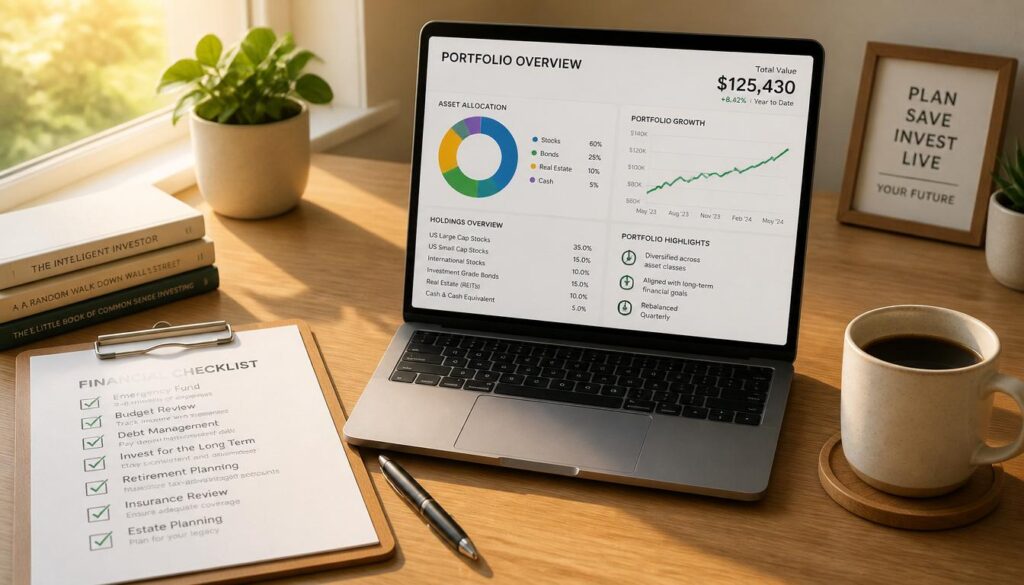
- Ignore the Noise: Delete speculative trading apps, mute financial hype on social media, and stop checking your portfolio every day. Check it quarterly to rebalance if necessary, and then get back to living your life.
Conclusion
The journey to financial independence is a marathon, not a sprint. The financial markets will always be filled with noise, speculation, and emotional traps designed to separate impatient investors from their money. By recognizing and actively avoiding the most common beginner investing mistakes—such as trying to time the market, chasing fads, ignoring fees, letting emotions rule, neglecting diversification, and underestimating time—you place yourself in the top tier of long-term wealth builders.
Remember that successful investing is inherently boring. It is about patience, relentless consistency, and making informed, unemotional choices. By embracing dollar-cost averaging, minimizing costs, and letting the power of compound interest work its magic over decades, you can build a resilient portfolio that withstands the test of time. Stop looking for the next big shortcut, commit to the proven principles of sound financial planning, and watch your wealth grow steadily and sustainably for a lifetime.
Frequently Asked Questions (FAQ)
1. How much money do I need to start investing?
You do not need a massive amount of capital to begin your investing journey. Thanks to the rise of fractional shares and zero-minimum online brokerages, you can start investing with as little as $5 or $10. The most important factor is not the initial amount, but the consistency of your contributions. Starting small and automating a monthly contribution of $50 or $100 is far more effective than waiting years to save up a “large enough” lump sum. Time in the market is much more critical than the size of your starting balance.
2. What is the difference between active and passive investing?
Active investing involves a fund manager or analyst actively buying and selling specific stocks in an attempt to outperform the overall market average. This requires extensive research and typically comes with high management fees. Passive investing, on the other hand, involves buying a fund (like an index fund or ETF) that simply tracks a specific market benchmark, such as the S&P 500. Passive investing requires no stock-picking, involves minimal trading, and carries significantly lower fees. Historically, passive investing has outperformed active management over long time horizons due to the drag of high fees.
3. How often should I check my investment portfolio?
Checking your portfolio too frequently is a primary trigger for emotional investing. If you watch your investments daily, you will naturally react to normal, everyday market fluctuations, which can lead to panic selling or impulsive buying. For a long-term, passive investor, checking your portfolio once a quarter or even just once a year is entirely sufficient. This allows you to review your asset allocation, rebalance if your investments have drifted from your target percentages, and ensure you are still on track to meet your long-term goals without the daily stress.
4. How do I stop myself from panic selling during a market crash?
Panic selling is an emotional reaction to seeing temporary paper losses. To prevent this, you must prepare psychologically before a crash ever happens. First, ensure you have a robust emergency fund in cash so you are never forced to sell stocks to pay for unexpected bills. Second, write down an Investment Policy Statement that clearly outlines your long-term goals and your commitment to stay invested. When the market drops, refer back to this document. Remind yourself that market corrections are normal, historical, and temporary, and that selling locks in your losses permanently.
5. Is dollar-cost averaging really better than trying to time the market?
Yes, for the vast majority of investors, dollar-cost averaging (DCA) is vastly superior to market timing. Market timing requires you to be right twice: you must know exactly when to sell at the peak and exactly when to buy at the bottom. Statistical analysis of market returns shows that missing just the ten best trading days in a decade can cut your overall returns in half. Because it is virtually impossible to predict those best days, DCA ensures you are always in the market, capturing both the good and the bad days, which mathematically results in superior long-term wealth accumulation.